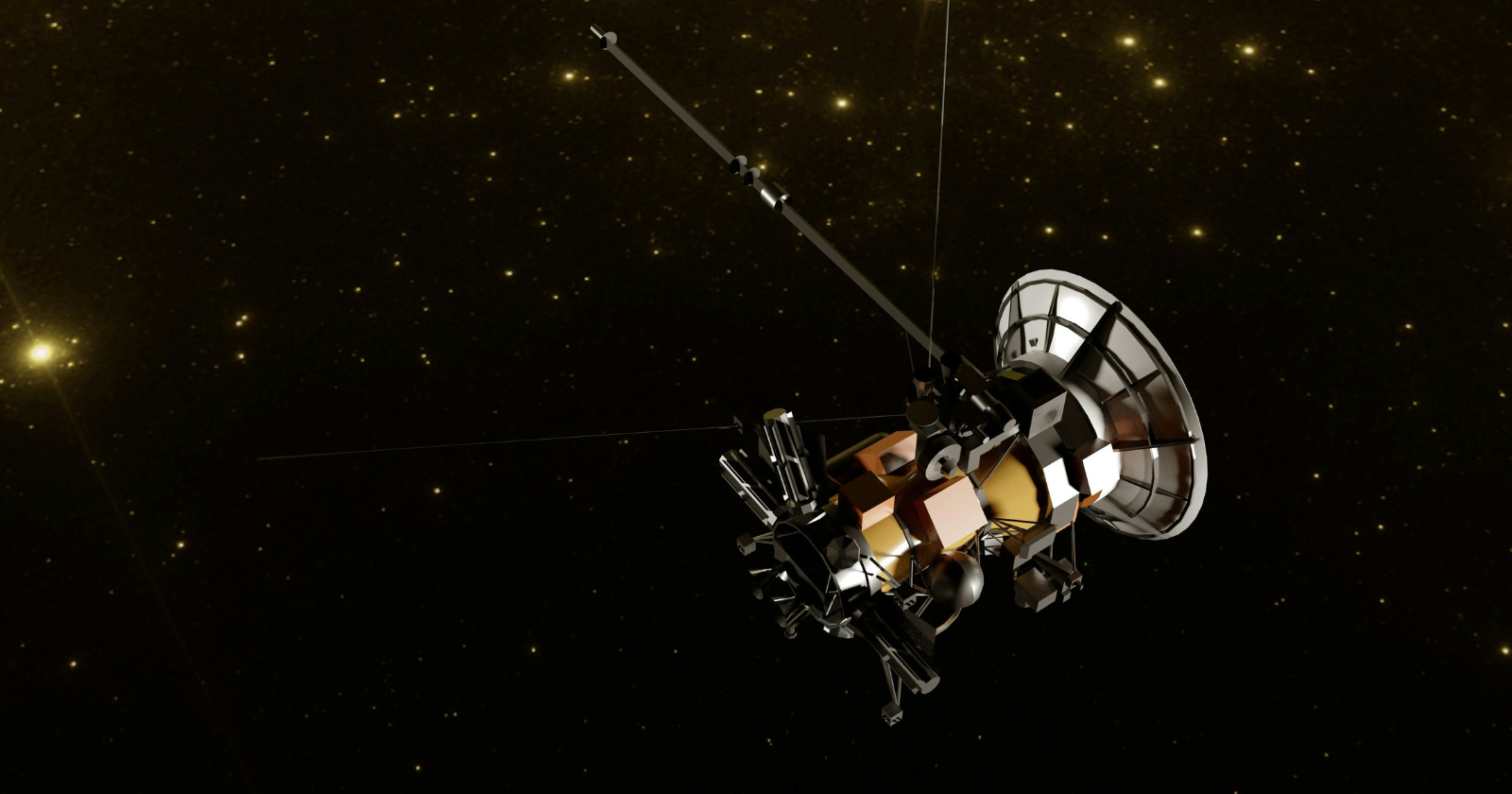
I must have been eight or nine the first time an adult told me, with unmistakable pride, that a Georgian song was floating somewhere past the edge of the solar system. I remember nodding along the way children do when a fact is clearly supposed to matter to them, without any real grip on what it meant. Space, at that age, was just a word for far away. What stuck wasn’t the science. It was the tone adults used when they said it — the specific, quiet pride of a small country pointing at something enormous and saying: that’s ours too.
It took me a long time, and a fair amount of adult research, to actually understand what had been sent, why it was chosen over enormous odds, and what it means that it is still, five decades later, the only Georgian object in the universe farther from home than Georgia itself.
A song every Georgian child grows up half-understanding
The song is called Chakrulo, a three-part polyphonic folk song from the Kakheti region in eastern Georgia that dramatizes the preparations for a battle. It’s built around two highly ornamented solo vocal lines carried over a full choral foundation, a structure that gives it a very particular texture: two individual voices improvising and trading ornamentation on top of a steady, grounded wall of sound underneath them. In 2001, UNESCO recognized Georgian vocal polyphony as a masterpiece of humanity’s Intangible Cultural Heritage, and Chakrulo was cited by name as one of its defining examples.
It’s one of 27 pieces of music NASA selected in 1977 for the Voyager Golden Record, a gold-plated phonograph disc carried aboard both Voyager spacecraft, assembled by a committee led by Carl Sagan to represent the sounds, languages, and music of Earth to whatever, or whoever, might eventually find it. The record’s other selections range from Bach and Beethoven to Chuck Berry’s “Johnny B. Goode” and Peruvian panpipes. Chakrulo is listed in NASA’s own catalogue simply as “Georgian S.S.R., chorus,” a piece of Cold War-era cataloguing that quietly erased the fact that it wasn’t Soviet at all — it was Georgian, specific to a place with its own language, its own polyphonic tradition, and its own reasons to be proud of it.
The two men who didn’t know they were going to space
What I didn’t know as a child, and only learned much later, is that the two soloists on the actual Voyager recording had no idea they’d been selected for any of this. According to reporting on the song’s history, they found out only when they arrived in the United States for a concert tour two weeks after Voyager’s September 1977 launch — the record was already somewhere past the Moon by the time anyone told them where their voices were headed. One of those two original lead singers, Rostom Saginashvili — whose singing career had ended in the 1990s — returned to Tbilisi for a fortieth-anniversary concert in 2017, jointly organized by the U.S. Embassy and the Georgian government, where he met the mission’s former program manager in front of an audience that had grown up, as I had, hearing the story secondhand long before understanding it.
Two men sang into a recording in a valley in Kakheti, and it was two weeks before either of them found out they had already left the planet.
Why a piano couldn’t play this if it tried
The detail that changed how I heard the song, once I understood it, is the tuning. Georgian polyphonic singing doesn’t use the same twelve-tone equal-temperament system a piano is built around. According to musicological analysis of the tradition, its intervals sit in their own, distinct space: a slightly compressed major second, a “neutral” third that is neither the major nor the minor third Western ears are trained on, a slightly stretched fourth, a compressed major sixth, a stretched minor seventh. None of those exist as playable notes on a standard keyboard, tuned the way every piano in the world has been tuned for the past three centuries. You cannot sit down and pick out Chakrulo’s harmonies on a piano, not because you lack the skill, but because the notes it needs simply are not there to press.
I think that’s the part that actually earns the pride I grew up absorbing without examining. It isn’t that a Georgian song made it into an exclusive, famous list. It’s that the record now traveling toward interstellar space carries a set of harmonic relationships that the dominant tuning system of Western music literally cannot produce — a genuinely different way of organizing sound, sent outward as evidence that there is more than one way to make music mean something.
A milestone with a five-decade fuse
The spacecraft carrying that record, Voyager 1, is about to cross a distance that has never been reached by anything humans have built. On November 18, 2026, according to NASA’s own calculations, Voyager 1 will be exactly one light-day from Earth — roughly 25.9 billion kilometers, or about 173 times the distance between Earth and the sun. A radio signal sent from mission control that day, traveling at the speed of light, would take a full 24 hours to reach the spacecraft, and another full day to get an answer back, if there were anyone out there left to send one.
Voyager 1 launched in September 1977, the same autumn those two Georgian soloists found out where their recording had gone. It has spent almost fifty years accumulating that distance at roughly 128,700 kilometers per hour (about 80,000 miles per hour), and it will keep going long after its instruments finally run out of power sometime in the early 2030s — a piece of 1970s engineering that will, this November, become the first human-made object ever to put a full day of light between itself and the planet that built it. Every one of the twenty-seven songs on that record, Chakrulo included, will cross that same threshold with it, still encoded in gold, still unplayed by anyone since the technicians who pressed it.
What finally caught up with me
I don’t think I understood, as a child hearing this story told with pride, that pride wasn’t really the point of it, or wasn’t the only point. What I’ve come to sit with instead, doing the research an adult does instead of just nodding along, is something closer to disbelief that it happened at all — that a recording of two men’s voices, made in a specific valley in Kakheti, tuned to intervals a piano cannot produce, ended up chosen by a small committee in 1977 to represent the sound of an entire species to whatever might eventually be listening. Nobody who sang or recorded that song could have imagined the distance it would eventually travel, in either sense of the word.
My own work, on and off, involves thinking about how people attach meaning to places and carry that meaning outward when they leave them. I don’t think I fully appreciated, until writing this, that Chakrulo is the most literal version of that idea I will ever encounter: a place’s sound, launched outward, still traveling, further from home with every year that passes, and still, forty-nine years later, unmistakably itself.