

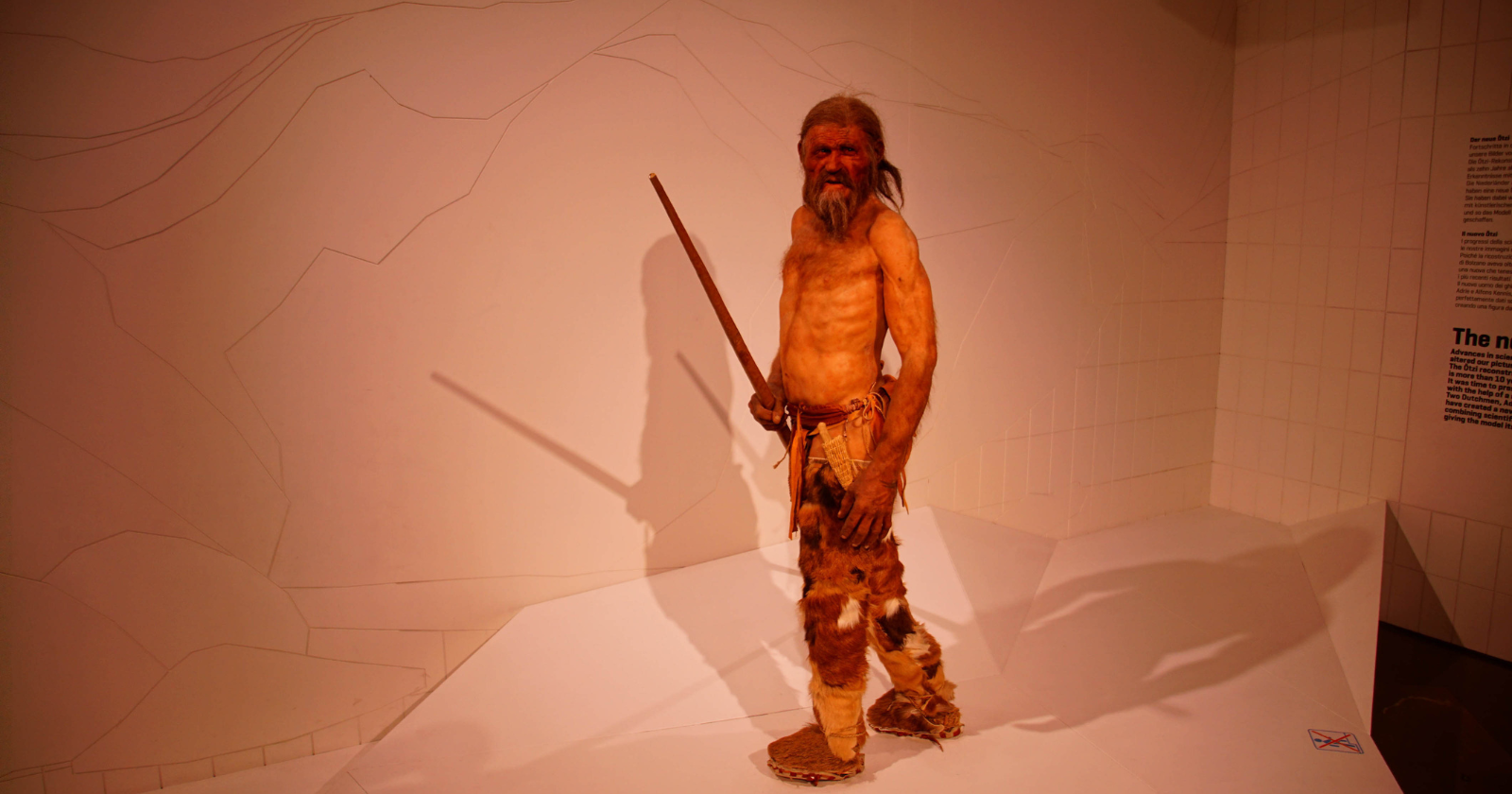
For thirty years, the standard picture of Ötzi the Iceman has been that he was, biologically speaking, done.
He died sometime around 3,300 BCE, took an arrow to the shoulder in the Ötztal Alps between what is now Italy and Austria, collapsed at an altitude of about 3,200 metres, and froze into the mountainside. There he stayed, entombed in glacial ice, for the next 5,300 years. In 1991, two German hikers found him and pulled him out. He has been in a refrigeration chamber at the South Tyrol Museum of Archaeology in Bolzano ever since, kept at minus six degrees Celsius with 99 percent humidity, being carefully examined by successive generations of researchers.
The standard picture, as it has been until this month, treated Ötzi as a specimen — a superbly preserved, well-studied, biologically inert object.
A new study published this week in the journal Microbiome has demonstrated that this picture is wrong.
What the researchers actually found
A team led by Mohamed Sarhan and Frank Maixner at the Eurac Research Institute for Mummy Studies in Bolzano conducted the most comprehensive microbial survey of Ötzi ever performed. They sampled his internal tissues, his stomach contents, the surface ice on his body, and the meltwater around him. Using modern high-throughput DNA sequencing combined with attempts to culture living organisms from the samples, they set out to determine what microbes had been living inside Ötzi during his life, what had colonised him after his death, and what — if anything — was still living on him now.
They found a lot of everything.
Ancient gut bacteria, preserved inside his intestinal remains, that closely resemble microbiomes reconstructed from other early human populations. Cold-adapted yeasts from four genera — Glaciozyma, Goffeauzyma, Mrakia, and Phenoliferia — genetically related to fungi currently found in the cold-adapted ecosystems of Antarctica. Modern human contamination bacteria, mostly Methylobacterium and Sphingomonas, introduced by three decades of scientific handling. And, most strikingly, viable populations of some of those cold-adapted yeasts still actively metabolising and slowly reproducing inside their sample containers.
The researchers were able to culture four groups of yeast fungi from Ötzi’s tissues into visible colonies in the lab. The genus called Glaciozyma had, on comparison with samples taken from Ötzi in 2010, actively grown during the intervening years despite the constant sub-freezing storage. Ötzi has, in effect, been quietly hosting a small living ecosystem the whole time he has been in the museum.
What is old and what is new
The team’s central technical achievement was distinguishing ancient microbes from modern contaminants. This is genuinely difficult work.
Bacteria and fungi are everywhere. Every time Ötzi has been examined, handled, sampled, or photographed, new organisms have been introduced. Some of these organisms are of scientific interest in their own right — Methylobacterium and Sphingomonas are common environmental bacteria brought in by humans over the past three decades. Others are essentially noise. Separating the ancient signal from the modern noise required both DNA damage analysis (ancient DNA accumulates specific chemical damage patterns that modern DNA does not) and careful cross-referencing against the microbial profiles of other cold environments.
What the team was able to identify with high confidence:
Ancient gut bacteria that Ötzi carried while alive. These correspond closely to microbiomes reconstructed from other Copper Age human remains and from a small number of currently living non-industrial populations. Most of these bacteria are rare in the guts of people from modern industrialised societies. Ötzi’s microbiome, in this sense, is a window into what human digestive ecosystems looked like before agriculture had reshaped them.
Cold-adapted yeasts that appear to have joined Ötzi after his death, likely from the glacial environment that entombed him. These are the organisms that have proven to be still alive. Their DNA shows the specific damage patterns of ancient origin, their genetic relatives are cold-adapted extremophiles from other similar environments, and their populations have measurably shifted during Ötzi’s thirty years in the museum — including responding to the specific environmental pressures of that storage.
Modern contamination introduced during the past thirty years of scientific study.
The specimen that is not a specimen
The most striking finding of the study — the observation that Glaciozyma yeast has been actively growing since at least 2010 despite constant sub-freezing storage — has substantial implications for how preserved remains should be understood.
The team’s own summary of what this means is worth quoting directly. In their paper, they write that their comprehensive assessment reveals that “the Iceman is not a biologically ‘frozen’ time-capsule but rather a complex ecosystem.”
This is not a small reframing. For most of the thirty years Ötzi has been under scientific study, the operating assumption has been that he was essentially inert — a piece of biological material to be measured, sampled, and interpreted. What the new study demonstrates is that this assumption is empirically wrong. Ötzi is, and has been throughout his three decades of preservation, a living ecosystem. Small quantities of microbial biomass are growing inside his tissues. Yeast populations are responding to conditions in the storage chamber. Some fungi have adapted to metabolise the phenol used to disinfect his environment — meaning the specific disinfection procedure has been driving evolutionary selection on his microbiome throughout the period he has been in the museum.
The specimen has been changing. Slowly. But changing.
Why this matters beyond Ötzi
The Ötzi finding is significant for the broader field of ancient biological preservation, because it suggests that the standard approach to preserving frozen remains may need substantial revision.
Most existing preservation protocols for frozen biological material — glacier mummies, permafrost animal remains, deep-frozen tissue samples, seed banks in Arctic vaults — assume that sub-freezing temperatures effectively halt biological activity. The Ötzi study is direct evidence that this assumption is incomplete. Cold-adapted extremophiles can, under the right conditions, remain metabolically active at temperatures well below freezing. If they are present in a specimen when it enters storage, they will continue to modify that specimen slowly over decades of preservation.
For future researchers wanting to reconstruct Ötzi’s original biology, this is a problem. Every sample taken today includes some contribution from organisms that have been growing since he was found. The distinction between “what was in Ötzi 5,300 years ago” and “what has evolved inside him during three decades in a museum” is not clean. The Sarhan team’s paper is explicitly framed as the baseline for future work — an attempt to characterise the current state of Ötzi’s microbial ecosystem so that any future changes can be tracked from a known starting point.
For scientists preserving other rare biological specimens, the implication is similar. Preservation is not neutral. It changes what is being preserved. Understanding those changes, and accounting for them in scientific interpretation, is now a specific ongoing challenge in the field.
What is happening right now, in a chilled room in Bolzano
Ötzi is currently in his chamber at the South Tyrol Museum of Archaeology, at minus six degrees Celsius, with 99 percent humidity around him. He has been there since 1998, when the museum opened, and he is expected to remain there indefinitely.
He is not doing nothing. Inside him, somewhere in his gut and in his tissue microenvironments, small colonies of cold-adapted yeasts are slowly metabolising, occasionally dividing, and gradually shifting in composition. The particular strain of Glaciozyma that has been growing since 2010 is presumably still growing. The bacteria on his skin, mostly modern contaminants, are being cycled through as new researchers handle him. His own ancient gut bacteria are preserved but largely inactive.
The Iceman has been in that chamber, quietly hosting his ecosystem, for a period of time that is essentially nothing compared with the 5,300 years he spent frozen in the mountain. He is still here. So are some of the microorganisms that were with him when he died. And so, apparently, are their descendants — still doing what living things do, at temperatures where most life on Earth would simply stop.
