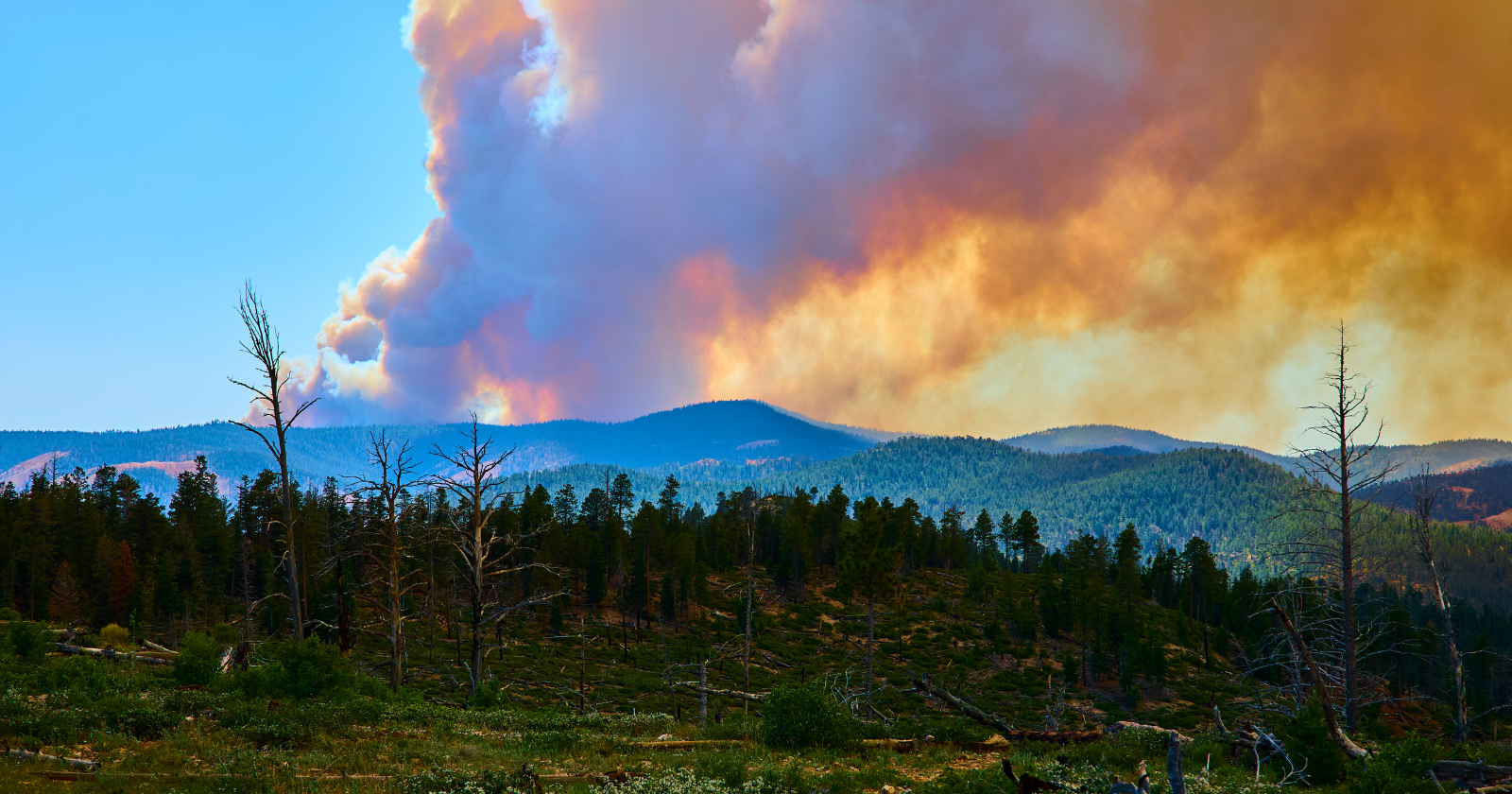
Here is a question worth sitting with for a second before you reach for the obvious answer: why does a smoke-filled sky turn orange instead of just going gray, the way you’d expect smoke to behave?
Smoke is, after all, mostly just tiny particles suspended in air. It should dim the light, not recolor it. But it does recolor it, reliably, almost everywhere wildfires burn, and the reason has less to do with fire than with the size of the particles fire happens to produce.
On a clear day, the sky is blue because air molecules are small, far smaller than the wavelength of visible light, and that mismatch in scale matters enormously. Short wavelengths, the blues and violets, scatter off molecules that tiny far more efficiently than long wavelengths do, which is why blue light arrives at your eyes from every direction and red light mostly just passes straight through from the sun to wherever it’s going. That’s ordinary blue-sky physics, and it holds until you introduce something bigger into the air.
Wildfire smoke is bigger — not in any way you’d notice by eye, but at the scale that matters for light, where smoke particles are large enough to change which wavelengths get scattered. As Miriam Guthrie puts it on weather.com, “since smoke particles are larger than air molecules, they cause longer wavelengths to scatter even more.” Once that happens, the blue and violet light that would normally dominate the sky gets scattered so aggressively in every direction that much of it never makes it to your eyes in a coherent beam at all. What’s left, arriving in a straighter line, is weighted toward the reds, oranges and yellows the particles are comparatively bad at deflecting. The sky isn’t dimmer so much as it’s been filtered, the way a colored lens filters light, except the lens is smoke and it’s suspended over an entire region.
A second filter stacked on top of the first
Particle size alone doesn’t tell the whole story, and smoke has a second trick that most people never hear about. A lot of wildfire smoke, especially the slow, smoldering kind rather than the fast-burning kind, contains a family of organic compounds called brown carbon, which doesn’t just scatter light, it absorbs it, and it absorbs blue wavelengths far more efficiently than red ones.
So the sky isn’t only losing blue light to scattering, it’s losing additional blue light to outright absorption, on top of the scattering effect already at work. Two separate physical processes, stacked on each other, both pushing the visible spectrum in the same direction. That’s an unusually clean case of redundancy in nature: if scattering alone didn’t finish the job, brown carbon would finish it anyway.
The result is a sky that looks less like weather and more like a photograph that’s aged badly, the kind where the blues have faded out of an old print and left everything sitting in amber and rust. That resemblance isn’t a coincidence either. Old photographic dyes degrade unevenly, and the blue-recording dye layer tends to be among the least stable, fading first and leaving warmer tones behind. Smoke does something conceptually similar to daylight in real time: it strips out the color that fades first, chemically in the photograph’s case, physically and chemically at once in the sky’s.
Watching the physics arrive in person
I wrote about being evacuated from a project camp near Toledo as wildfires moved through the region, and about what it felt like to stand under a sky that had turned that exact amber-rust color while nobody had yet said the word fire out loud. I won’t retell that story here. What I didn’t get into at the time, because there wasn’t room and because I was more interested in the fear and the coffee and the memory it dredged up than in the chemistry, is that the color itself was never in question. It was always going to look like that. Given enough smoke of that composition, any sky, anywhere, would have done the same amber fade, because the particles don’t know or care what they’re hanging over.
That’s the part I find strangely comforting in hindsight, the same week Spain’s wildfires were being logged by Copernicus’s monitoring service as among the largest the country had ever recorded. That color is a predictable output of particle size and organic chemistry, not a warning sign, however ominous it felt from underneath it — the same equation whether the smoke is drifting over an evacuation in Ávila province or a wholly uneventful afternoon somewhere nobody has to leave.
Why the color is real information, and why it isn’t enough
That doesn’t make the color meaningless: air quality monitors and satellite instruments use this same scattering and absorption signature to estimate how much particulate matter is in the air and roughly what it’s made of, which is a real, quantifiable thing a photograph of an orange sky can gesture toward without proving. What the color can’t tell you, no matter how dramatic it looks, is how far away the fire actually is, how much time you have, or how frightened you should be. I learned that distinction the slow way, watching a sky change color while trusting other people to tell me whether it meant we needed to leave in five minutes or fifty.
The physics is elegant, in its own removed way. Somewhere underneath the fear and the ash and the packed bags, a fixed set of rules about particle size and light absorption was quietly determining exactly what color the disaster would appear to be, with no interest whatsoever in how anyone standing under it happened to feel about that.