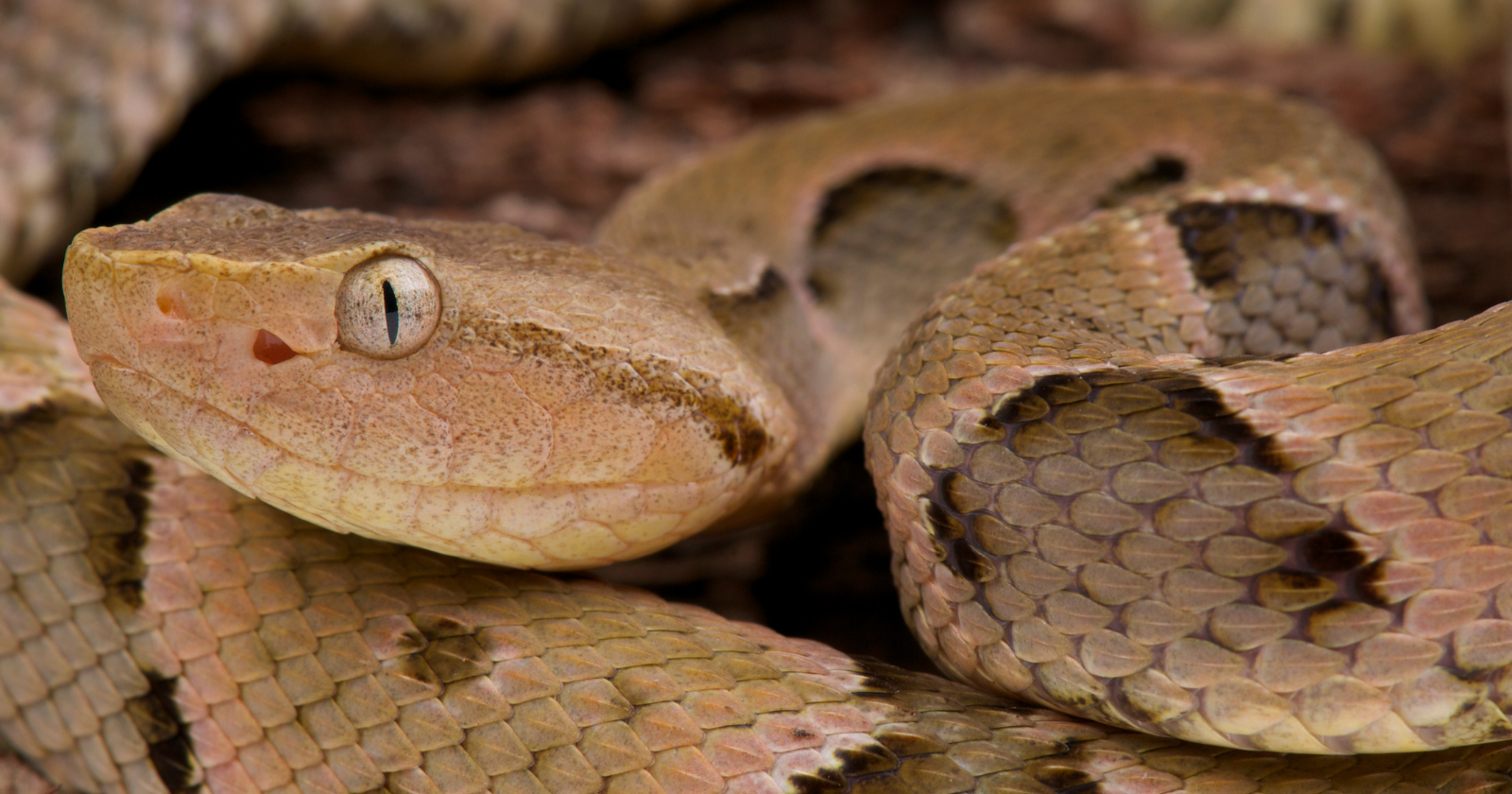
A migrating bird drops onto a branch to rest and never lifts off again. The branch it picked is the colour of dead leaves and has not moved in hours. That arrangement plays out on Ilha da Queimada Grande, a 43-hectare wedge of rock and Atlantic forest about 33 kilometres off the coast of São Paulo, and it explains why Brazil has quietly struck the place off the map for visitors.
Fishermen called it Ilha das Cobras, which saved everyone the trouble of explaining why they never went back.
How a snake ends up with its own island
Sea levels did it. When the last ice age ended, rising water severed Queimada Grande from the mainland some 11,000 years ago and stranded a population of pitvipers on the wrong side of the gap. No ground predators followed them. Neither did rodents, an absence that would go on to reshape the whole species.
Over the millennia the marooned snakes diverged into Bothrops insularis, the golden lancehead, a species found nowhere else on Earth. Its mainland relative, the jararaca, hunts small mammals. With almost none available, island adults went after the only reliable protein passing through: birds. Otavio Marques and colleagues at the Instituto Butantan, writing in the Journal of Natural History, found that adult lanceheads lean on just two seasonally plentiful visitors, the southern house wren and the Chilean elaenia.
Venom built for prey that can fly away
Biting a bird is a timing problem. Bite a rat and it staggers off, dies nearby, and gets eaten at leisure. Bite something with wings and anything short of near-instant collapse means dinner disappears over the water.
André Zelanis and two co-authors tested that idea in the lab. In a paper published in the South American Journal of Herpetology, they reported the venom hitting chicks and bees considerably harder than mice, which points to chemistry tuned toward whatever the island actually offers. That is one study on captive-milked venom, so treat it as a strong hint rather than a settled fact.
Nobody agrees on how many are down there
Four thousand is the figure that circulates online, usually alongside a discarded older claim of several hundred thousand that was not based on counting anything.
Real numbers arrived in 2008, when Marcio Martins, Ricardo Sawaya and Marques ran plot surveys along the single trail crossing the island and wrote it up for the same journal. Their best estimate sat between 2,000 and 4,000, with error bars they were refreshingly blunt about.
Later work narrowed it without settling it. A mark-recapture analysis of a decade of field data, published in PLOS ONE in 2014, detected an average annual decline and then said outright that the uncertainty was too wide to draw conclusions from. In 2021 Carlos Roberto Abrahão and colleagues used distance sampling to put the forest population at 2,899 animals, with a plausible range of somewhere between 1,900 and 4,400, in an extinction-risk assessment. Spread across the island’s forest, that works out to something like one snake per hundred square metres.
An island this small breeds problems
Isolated populations get strange. Golden lanceheads have been recorded with intersex anatomy, genetic females carrying small non-functional hemipenes, an oddity noted in the literature since the 1950s and usually blamed on inbreeding, though that link has never been pinned down conclusively. A 2020 genetic survey in Ecology and Evolution found low but statistically significant inbreeding in both the wild snakes and the captive stock held for conservation breeding.
Fewer viable offspring, one location, one bad wildfire away from nothing. Abrahão’s team ran the scenarios and found something counterintuitive: the species proved more vulnerable to a handful of animals being pulled off the island each year than to a catastrophe killing 95 percent of it outright.
Who the ban is really protecting
Keeping people off is not folklore. Queimada Grande and its smaller neighbour form a federal conservation unit created by decree in 1985, and ICMBio lists the golden lancehead among the threatened species the designation exists to shelter. Landing means a permit, a research project and a review, plus a boat willing to drop people onto a bare rock face. The same 2020 genetics paper notes that access is limited to the navy and authorised researchers.
Read casually, the restrictions look like a public safety measure, and a bite from a lancehead is a genuine emergency. Yet a bitten tourist can reach a hospital with antivenom, while a stolen snake does not come back. The 2008 survey team flagged exactly that risk, noting suspected illegal trading and one buyer’s reported offer of US$30,000 for a single snake. At that price, the island looks less like a warning sign than a shop with a broken lock.