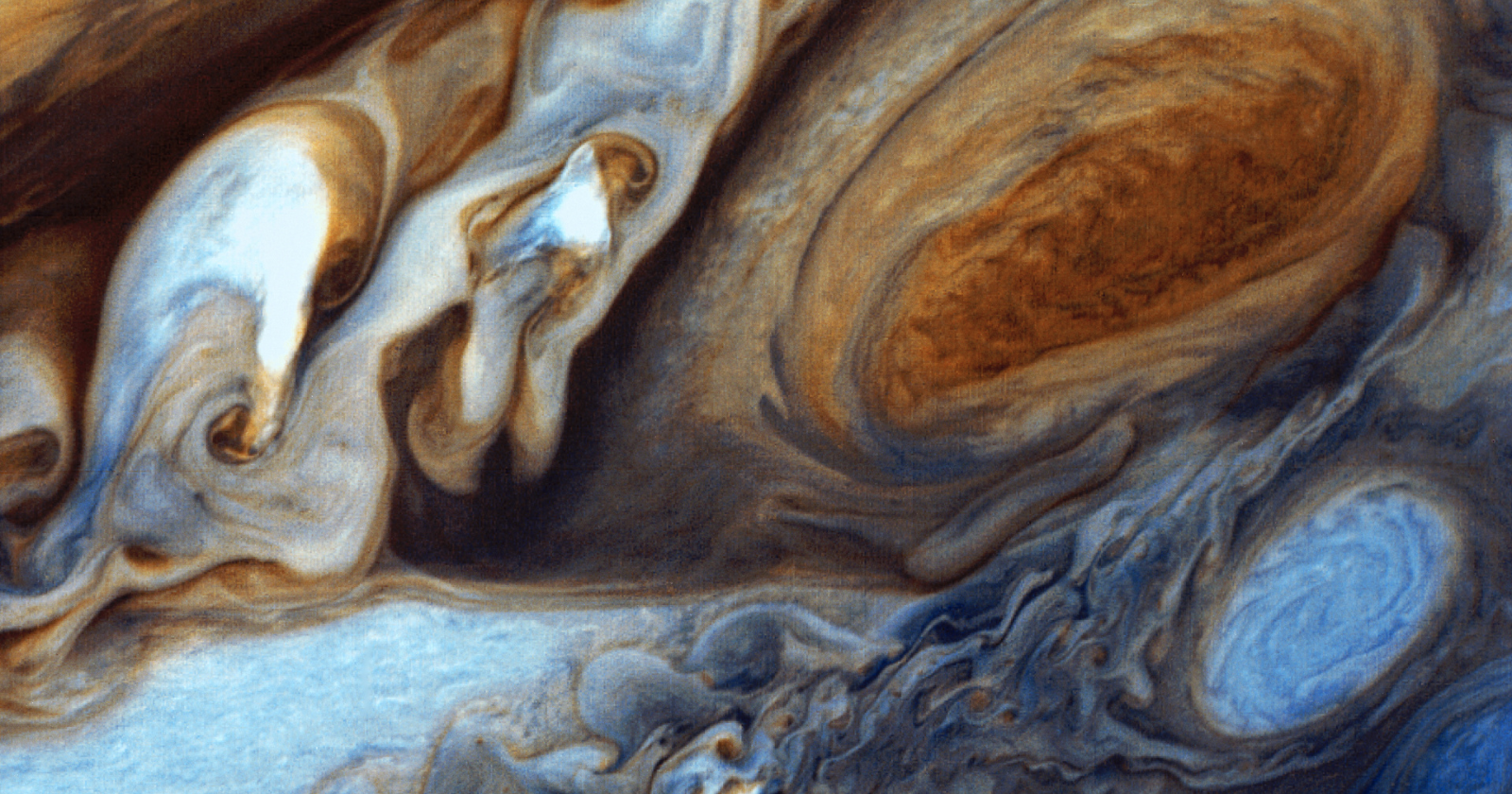
Every photograph of Jupiter tells a small lie. There is a clean round edge, a striped face, weather organised into neat belts and zones. It looks like a place, the way any rocky planet does, and a brain raised on solid worlds quietly assumes the obvious: somewhere under all that cloud, there must be ground.
There is not. Not a crust, not a seabed, not a scorched plain waiting a few thousand kilometres down. Drop something into Jupiter and it will not land. It will simply keep going, deeper and deeper, until the planet takes it apart.
What actually happens on the way down
NASA’s planetary overview is blunt about it: gas giants like Jupiter never developed a genuine surface, just churning gas and liquid from top to bottom. A spacecraft wouldn’t find anywhere to land, and it wouldn’t survive trying. Deep enough inside, the pressure and heat crush metal, melt electronics and boil a probe away to nothing.
Pressure is the whole story. On Earth you fall about 100 kilometres through thickening air and then hit something. On Jupiter the air keeps thickening and never stops. Gas becomes dense enough to behave like liquid, but there is no shoreline where one ends and the other begins.
Benjamin Roulston, an assistant professor of physics at Clarkson University, makes a related point writing in The Conversation: hydrogen doesn’t flip from gas to liquid to something metallic in one clean step. It thickens by degrees, so gradually that you could never mark a single point as the edge. By the time you’d reach the centre, he adds, the pressure would run to something like 100 million times sea-level pressure on Earth.
Nothing in that descent ever resolves into ground.
The one machine that has tried it
In July 1995, a 337 kilogram probe separated from the Galileo spacecraft and spent five months falling toward Jupiter with no engine and no way to steer. On 7 December it hit the top of the atmosphere at roughly 170,000 kilometres per hour, which is a speed better suited to a comet than to a piece of hardware built in a clean room.
It survived that. Behind a heat shield, it slowed, shed the shield, opened a parachute and started reporting. Per Britannica’s account of the mission, the probe drifted down through about 165 kilometres of atmosphere while measuring temperature, pressure, density, clouds, chemistry and electrical activity.
Then the heat got to it. NASA’s mission page records 58 minutes of data before the transmitter failed, and the probe was never going to hit anything solid. It simply grew hotter and more compressed until it stopped being a probe at all, and to this day those 58 minutes remain the only direct measurements anyone has taken from inside a giant planet.
Hydrogen that behaves like metal
Keep descending and hydrogen starts doing something it never does in a lab. Squeezed hard enough, its atoms pack so close that electrons stop belonging to any one atom and roam through the bulk instead. Free-roaming electrons are, more or less, the definition of a metal.
So Jupiter has an enormous interior region of liquid metallic hydrogen: not a metal you could hold, but a fluid that conducts electricity like one. NASA links that conducting layer directly to Jupiter’s magnetism. The planet spins once every ten hours, and that fast rotation turns the hydrogen into a natural dynamo, throwing off the ferocious magnetic field Jupiter is known for.
It is the closest thing Jupiter has to solid matter, and it is still a liquid.
Even the centre may not be a floor
Surely there is a rock at the very centre, at least, doing the job of a surface? That was the standard picture for decades: a compact core of ice, rock and metal, wrapped in layer after layer of hydrogen.
Juno complicated it. Once the spacecraft mapped Jupiter’s gravity field precisely enough to pin down the interior density, the old models stopped fitting. In a paper published in Geophysical Research Letters, Sean Wahl and colleagues showed the numbers work better if the core is dilute, meaning heavy elements are spread through a wide region near the centre rather than packed into one distinct ball. Later modelling by Burkhard Militzer’s group, published in The Planetary Science Journal, reached a similar conclusion.
Nobody has actually seen Jupiter’s core, so some caution belongs here. These are interior models tuned to match gravity measurements, and they depend heavily on assumptions about how hydrogen and helium behave under conditions no laboratory can reproduce. The dilute core is currently the favoured explanation, which is a very different claim from a settled one.
Why the word landing fails
Every term humans use for arriving somewhere assumes a boundary. Touch down, hit the deck, reach bottom. All of it takes for granted that a planet has an outside and an inside with a line between them.
Jupiter refuses the distinction, and it is not the odd one out. Its mass alone outweighs every other planet in the solar system combined, by a factor of roughly two and a half. Add Saturn and the imbalance gets starker still: most planetary material out here is gas and fluid with no edge to speak of.
Ground, it turns out, is the local peculiarity. Rocky planets are the small print.