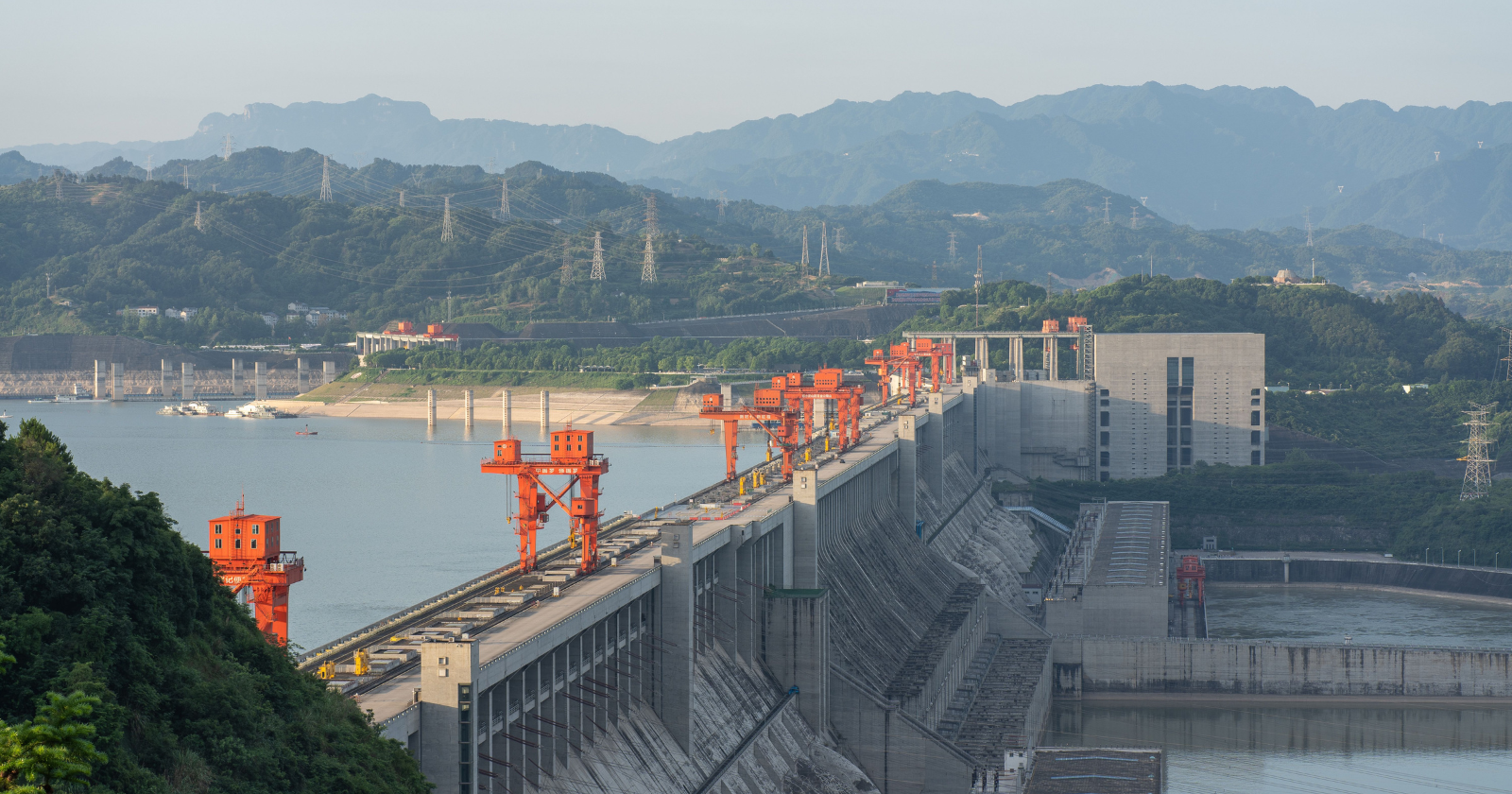
Somewhere in Hubei province, a wall of concrete holds back enough water that two geophysicists once sat down and worked out, on paper, what it would do to the length of a day.
In 2005, that was still a projection. The reservoir hadn’t reached its design level yet, so the figure was conditional: once full, it would stretch every day on Earth by 0.06 microseconds, sixty billionths of a second. The reservoir reached that level for the first time in October 2010, state media reported at the time, and has sat near it most years since. The “would” quietly became the case.
Nobody has ever missed a train because of it.
That figure comes from Benjamin Fong Chao at NASA’s Goddard Space Flight Center and Richard Gross at the Jet Propulsion Laboratory, and it arrived almost as an aside. The two were working out how the December 2004 Sumatra earthquake had reshaped the planet, and they wanted a benchmark a reader could picture. So they picked the biggest pile of water humans had ever assembled. A 2005 release from JPL ran the comparison: the quake shortened the day by 2.68 microseconds and shoved the mean North Pole about 2.5 centimetres east, while a full Three Gorges reservoir, all 40 cubic kilometres of it, would lengthen the day by that 0.06 and move the pole roughly two centimetres.
Chao and Gross derived that number from the mass and height of the water, the way an engineer sizes up the load on a bridge, not by reading it off an instrument. A change that size, the release said, was too small to detect but perfectly possible to calculate.
Why standing water pushes back
Ask a figure skater. Arms out, they spin slowly. Arms in, they speed up, with nothing pushing them.
What changes is moment of inertia, which is just a measure of how stubbornly a spinning object resists being spun. Pile mass further from the axis and the resistance goes up. Because the total amount of spin in a system stays fixed, something has to give, and what gives is speed.
Three Gorges does that on a planetary scale. Water that used to sit low and spread out along the Yangtze now sits pooled and perched, up to 175 metres above sea level, in a reservoir that astronomy writer Colin Stuart, in BBC Science Focus, sized up as roughly 16 million Olympic swimming pools. Mass moved outward. Earth slowed.
Chao put it plainly in the JPL release: any event that shifts mass around affects the planet’s rotation, right down to driving a car.
Bigger culprits than a dam
The viral version of this story tends to stop at the concrete, which is a shame, because the ranking is the good part.
Maik Thomas and Robert Dill of the German Research Centre for Geosciences told Science Focus that other megastructures probably do less, and that ordinary water management has done far more to the spin than any single feat of engineering. Their example is the Aral Sea, which has lost over three quarters of its volume since 1960 after Soviet planners diverted the rivers feeding it. By their estimate, that loss slowed Earth’s rotation more than three times as much as filling Three Gorges did. Greenland’s ice losses, they reckon, run about ten times the dam.
Then there is the invisible water. In a 2023 paper in Geophysical Research Letters, a team led by Ki-Weon Seo at Seoul National University found that groundwater pumping between 1993 and 2010 had tilted the rotational pole close to 80 centimetres eastward. As the American Geophysical Union summarised it, some 2,150 gigatonnes came out of aquifers and ended up in the oceans, and models of polar drift only matched observations once that transfer was included. Irrigation in northwestern India and the western United States shifted the pole more than meltwater from either Greenland or Antarctica over the same window.
One dam buys two centimetres. Farm bores buy eighty.
Where the microseconds matter
Space agencies, mostly. Steering a probe toward another planet means knowing the exact orientation and spin rate of the platform you launched from, and small unmodelled wobbles turn into large errors a few hundred million kilometres downrange. Stuart notes those effects are big enough to throw a spacecraft off course when the correction gets skipped.
It is also why the second stopped being an astronomical unit. Since 1967 it has been pegged to the oscillation of a caesium atom rather than to any fraction of a rotation, because Earth turned out to be a mediocre clock. On 29 June 2022 it managed the shortest day on record, 1.59 milliseconds under average, for reasons that seem to start in the core.
Dams do not register on any of that. Ice does.
Writing in Nature in 2024, Scripps geophysicist Duncan Agnew showed that melting in Greenland and Antarctica has slowed the planet fast enough to partly cancel a long acceleration driven by the liquid core. Timekeepers have been heading toward a first ever negative leap second, an unprecedented subtraction from Coordinated Universal Time, and Agnew’s extrapolation pushes that moment out to 2029 instead of 2026. One paper, one model, one prediction. Treat it accordingly.
Three Gorges displaced about 1.2 million people, triggered thousands of small quakes and drowned archaeological sites, as documented in NASA’s Landsat imagery of the valley. Those costs show up in a ledger. The 0.06 microseconds are a curiosity for physicists and cost no one anything.
The melting ice will not stay a curiosity. Somewhere around 2029, every computer system that has only ever been asked to add a second gets asked to remove one, and the bill for all that redistributed mass finally lands on somebody’s desk.