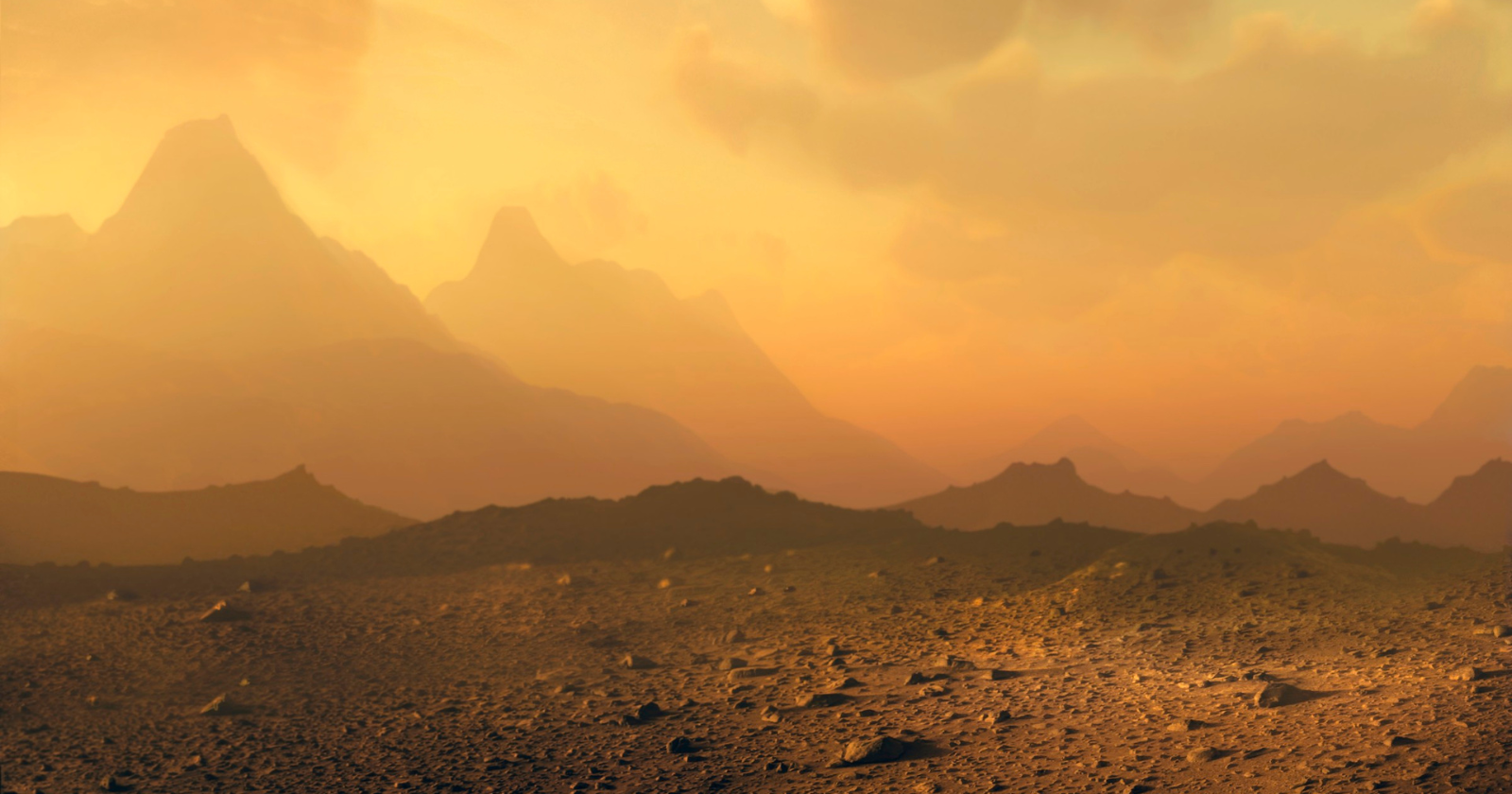
There’s a strange thing about Venus: at the surface, the atmosphere presses in at about 1,350 pounds per square inch. Climb fifty kilometres into that same atmosphere and the pressure falls to something close to sea level on Earth, while temperatures enter a range found back home.
The Planetary Society’s Kate Howells reaches for a homely image to make the surface pressure land: “it would be like having a small car sitting on your thumbnail”. Not the whole car on your whole body. That much force applied to a patch the size of a thumbnail.
It’s an analogy, not an engineering readout, but it gets you close to how odd the number is.
The crush at the surface
The raw figures explain the small-car image. The pressure at Venus’s surface is about 92 bar, roughly 92 times Earth’s sea-level pressure, which the Planetary Society puts at around 1,350 psi. Another way they frame it: standing on Venus is like being roughly a kilometre underwater.
And the pressure keeps bad company. The atmosphere is about 96.5% carbon dioxide, and the surface sits near 460°C, hot enough, as the Planetary Society notes, to melt lead. The thumbnail image captures the pressure but not the furnace it arrives inside.
Why the whole planet, not just one spot
The number is hard to picture because pressure does not work like a single weight on a scale. In a fluid atmosphere it acts in every direction, not only downward. The small-car comparison describes the force on one square inch, but a person is not literally a thumbnail beneath a car: body tissues transmit pressure, while gas-filled spaces and sealed structures are endangered by pressure differences.
Any ordinary person or craft would still have no chance there. The Soviet Venera landers showed how difficult even a purpose-built machine found the surface. Venera 9 lasted 53 minutes after landing in 1975, long enough to return one of the first photographs from the surface of another planet. Venera 13 survived for 127 minutes in 1982, still the record for a spacecraft on Venus’s surface.
Ride up fifty kilometres and the air calms down
Venus’s atmosphere is deep, and pressure drops with height there just as it does on Earth, only from a far higher starting point. Climb to around 50 kilometres and the pressure becomes similar to Earth’s surface. NASA puts the temperature in that layer at 30 to 70 Celsius, with pressure similar to Earth’s surface. The upper end is dangerously hot, but both figures are far less extreme than those below.
This is why NASA has described that altitude as offering the “most Earth-surface-like conditions within the Solar System”. The comparison comes with big caveats, but on the two numbers that would defeat almost any surface mission, pressure and temperature, that band genuinely resembles home.
The catch nobody gets to skip
“Earth-like” at fifty kilometres means pressure and temperature, not breathable air. The atmosphere is still almost all carbon dioxide, and the clouds contain concentrated sulfuric acid droplets that can damage unprotected materials and systems.
Engineers who studied this were careful on exactly this point. Dale Arney and Chris Jones of NASA Langley, in their High Altitude Venus Operational Concept study, describe the environment at 50 km as “relatively benign, with similar pressure, density, gravity, and radiation protection to the surface of Earth.” Benign on those terms. The follow-on study treated acid protection and deployment of the airship during atmospheric descent as central engineering challenges.
Why anyone cares about a middle layer of a hostile planet
Because of that band, one bold idea for exploring Venus is not a lander at all but a floating vehicle. The HAVOC concept imagines a lighter-than-air craft drifting at 50 km, carrying instruments or, at its most ambitious, a habitat and ascent vehicle for a crew of two for up to a month. It was an internal NASA study rather than an approved flight mission, but the logic holds: operate where the atmosphere supplies useful buoyancy and Earth-like pressure rather than trying to survive the surface.
What I keep turning over is the split itself. One planet, Earth’s near-twin in size and mass, holds one of the most hostile surfaces ever reached and, a short climb above it, the most Earth-surface-like atmospheric conditions elsewhere in the Solar System. The gap between those two places is about the length of a morning commute. Venus manages to be two different worlds stacked on top of each other, and the friendlier one is reachable only by never landing at all.