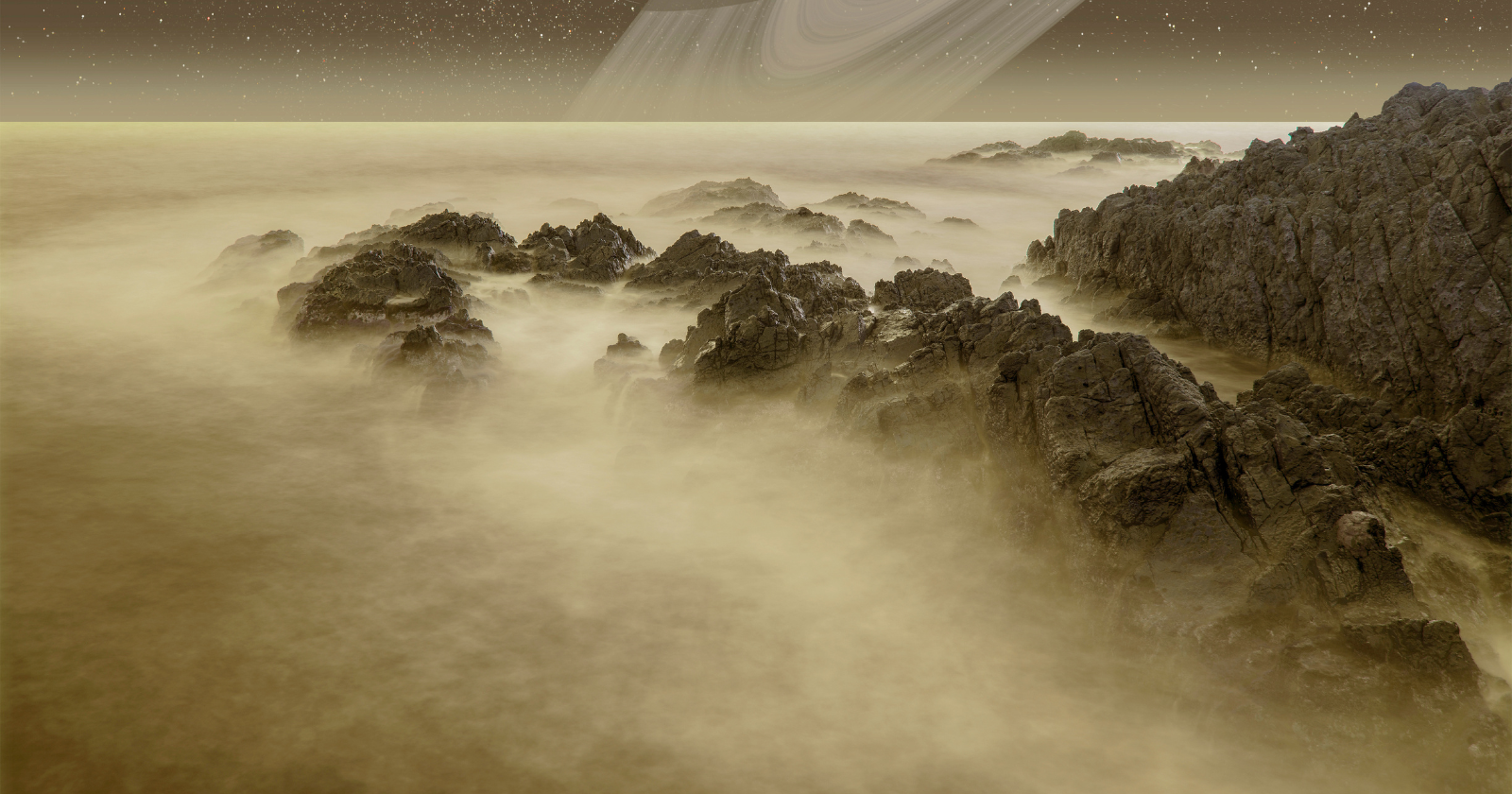
Titan is the only world besides our own we know of with a full weather cycle: liquid falls from the sky, runs in rivers, and pools into lakes and seas. The twist is what that liquid is. \
Titan’s surface sits near minus 179 degrees Celsius, far too cold for liquid water. So the rain is methane instead. Everything water does here, methane does there.
How we know it rains at all
In late September 2010, about a year after Titan’s northern spring equinox in August 2009, NASA’s Cassini spacecraft caught the equator changing color. Its cameras showed a region about 2,000 kilometers long and 100 km wide darkening over a few days. The team read that as clouds and a burst of methane rain over dunes that were supposed to be dry. They called it the arrow storm.
That one sighting changed how we think about the equator. The dune fields there aren’t rainless forever. They have a season, tied to when the sun crosses Titan’s equator.
As Tetsuya Tokano put it, “Equatorial precipitation is likely to occur near equinoxes”. The rain belt itself moves. “The rain belt, while being intermittent, swings between the south and north pole, so every area on Titan could experience rainfall in the course of a Titan year,” he said, drawing that picture from atmospheric models rather than repeated sightings.
Why the wait runs so long
Climate models of Titan’s methane cycle keep drawing the same map: wet poles, dry equator. Tapio Schneider and colleagues built a model that produces polar lakes, mostly in the north, a parched belt near the equator streaked with river-cut features, and only occasional equatorial storms. Steady rain falls at whichever pole is in summer. The equator just isn’t where the methane wants to be most of the time, so it goes without for stretches that dwarf anything on Earth.
The math is humbling. Titan’s rain adds up to very little over a year. The only way to square that with the deep channels we see is if the rain comes in rare, ferocious bursts rather than steady weather.
When it comes, it comes hard
A 2017 study by Sean Faulk, Jonathan Mitchell and colleagues ran Titan’s climate forward and found the worst storms are savage. “The most intense methane storms in our climate model dump at least a foot of rain a day, which comes close to what we saw in Houston from Hurricane Harvey this summer,” Mitchell said. That’s the model’s output, not a reading off a gauge on Titan, but it’s a striking thing for a simulation to produce.
How often they hit surprised the team too. Their model produced these extreme storms less than once per Titan year, which runs about 29.5 Earth years. Still rare, but more often than they’d guessed. “I would have thought these would be once-a-millennium events, if even that,” Mitchell said. “So this is quite a surprise.”
The same model ties the worst downpours to the map. The extreme storms cluster where Cassini actually found alluvial fans, the fan-shaped debris deposits that only running liquid leaves behind. Those sit mostly between 50 and 80 degrees latitude, closer to the poles than the equator. The driver, as the team read it, is the temperature gap between the wetter high latitudes and the drier low ones. The equinox is when that setup lines up over the equatorial dunes and lets go.
Weather on a different clock
What I keep coming back to is how strange this makes the word “weather.” On Earth we think of it as something that happens more or less all the time, a background hum of clouds and fronts you can complain about on most days. On Titan’s equator, weather looks more like a geological event. It happens on the timescale of decades, then vanishes for so long that the ground forgets it. The rain is real, the rivers are real, the floods are real. They just run on a clock with almost nothing in common with ours. My read is that the striking thing isn’t that another world is wet. It’s that it can run the same physics on a rhythm so slow it barely counts as weather at all.