We were sitting in a circle in the woods when ash began falling around us.
It was not an emergency exercise or a discussion about wildfires. We were completing an ordinary activity for an international personal development project called Voice, taking place at Campamento El Piélago, in the Sierra de San Vicente near Toledo. The task was deeply personal. We had spent time reflecting on ourselves and were now sharing what had come up.
It was the kind of conversation that usually makes the rest of the world temporarily disappear.
Except the outside world was becoming increasingly difficult to ignore.
The air was full of smoke. Small pieces of ash fell through it. When I looked up, the sky had turned a strange yellow-orange colour unlike anything I had seen before.
Our trainers, Lukáš and Aneta, continued holding the circle together. Their voices remained controlled, and they tried to keep the atmosphere calm. Still, it was easy to notice that they were anxious too. They were managing their own reactions while also carrying responsibility for everyone around them.
Nobody said the word fire yet. We just kept sharing, while the air changed around us.
The science inside an orange sky
Only later did I come across the term brown carbon.
At first, I misunderstood it as a name for the colour I had seen. The science is more complicated. Brown carbon actually refers to part of the organic aerosol released during biomass burning, not to the color of the sky itself.
Wildfire smoke contains a complicated mixture of particles and gases that absorb and scatter sunlight. Depending on the smoke and atmospheric conditions, that can transform a familiar blue sky into something yellow, orange, red, grey or brown. NASA has documented the dramatic ways wildfire smoke can change the appearance of the sky and Sun, although colour alone cannot tell us exactly what the smoke contains or how dangerous the air is at ground level.
From the ground, none of this looks like a thermal anomaly.
It looks like ash landing near your feet while someone is talking about the most vulnerable part of themselves.
Precautions do not eliminate uncertainty
The organizers had not ignored the wildfire danger.
Before the project began, its original venue had already been changed because of fire warnings in that area. We were moved to El Piélago as a precaution.
We had already moved once to be safer. Somehow, we still ended up packing again.
El Piélago is located in the municipality of Navamorcuende, in a forested area of the Sierra de San Vicente. It was also operating as a children’s summer-camp venue during this period. Contemporary reporting later placed hundreds of children from El Piélago among the people received at emergency accommodation in Talavera de la Reina as fires affected Toledo and neighbouring Ávila.
Because children were present, Carlos, the Spanish organizer, initially told us that there would be an evacuation simulation. At the time, I understood it as a way of keeping the situation calm while everything was still developing, especially for the children around us.
Then, not long after, the word simulation disappeared. We were told to pack and leave.
At this point, the practical logic of evacuation took over: collect what you can, listen for instructions, stay with the group, and move.
That was the moment when the experience stopped feeling merely unusual.
Not because I suddenly understood the chemistry of the smoke or knew how close the flames were — I didn’t. It was because I had been told to pack quickly and leave before I fully understood what was happening.
I had experienced that structure before.
The unequal meaning of leaving
My own initial reaction to the fire was complicated.
As a foreign visitor, I sometimes experienced it with more curiosity than fear. Part of me was even excited by how unfamiliar and surreal everything felt. I had never seen a sky like that. I had no house, land, animals, furniture, or lifelong collection of memories in the threatened area.
This did not mean I had literally nothing to lose. I was still physically present in an emergency. But I had much less place-bound loss at stake than the people who lived there.
For me, leaving meant abandoning a temporary camp with the belongings I had brought in a bag.
For a local resident, the same instruction could mean leaving a home, pets, neighbours, family objects, land, routines, and the place in which the future was supposed to continue.
Place itself also changes the experience. A home holds more than square footage exposed to environmental damage — it holds routines, identity, social relationships, memories, and a sense of control. When people evacuate, they are not simply changing coordinates. They are temporarily separated from the setting around which much of ordinary life is organized.
I understood that more clearly after we reached the evacuation centre.
Losing a campsite is not the same as losing a home
That week, the threat wasn’t small. The wildfires burning through Ávila, Madrid, and Toledo became one of the largest fire emergencies in Spain’s recorded history, with tens of thousands evacuated or confined and a national emergency eventually extended to Toledo itself.
I can’t tell you exactly which flank of that fire reached the hills around our camp, but the ash and the color of the sky put us inside that emergency, not adjacent to it. For residents named in that evacuation order, leaving meant animals, land, a future built into that specific ground.
For me, it meant abandoning a wooden cabin.
Red Cross shelters, toilet queues, and one very good coffee
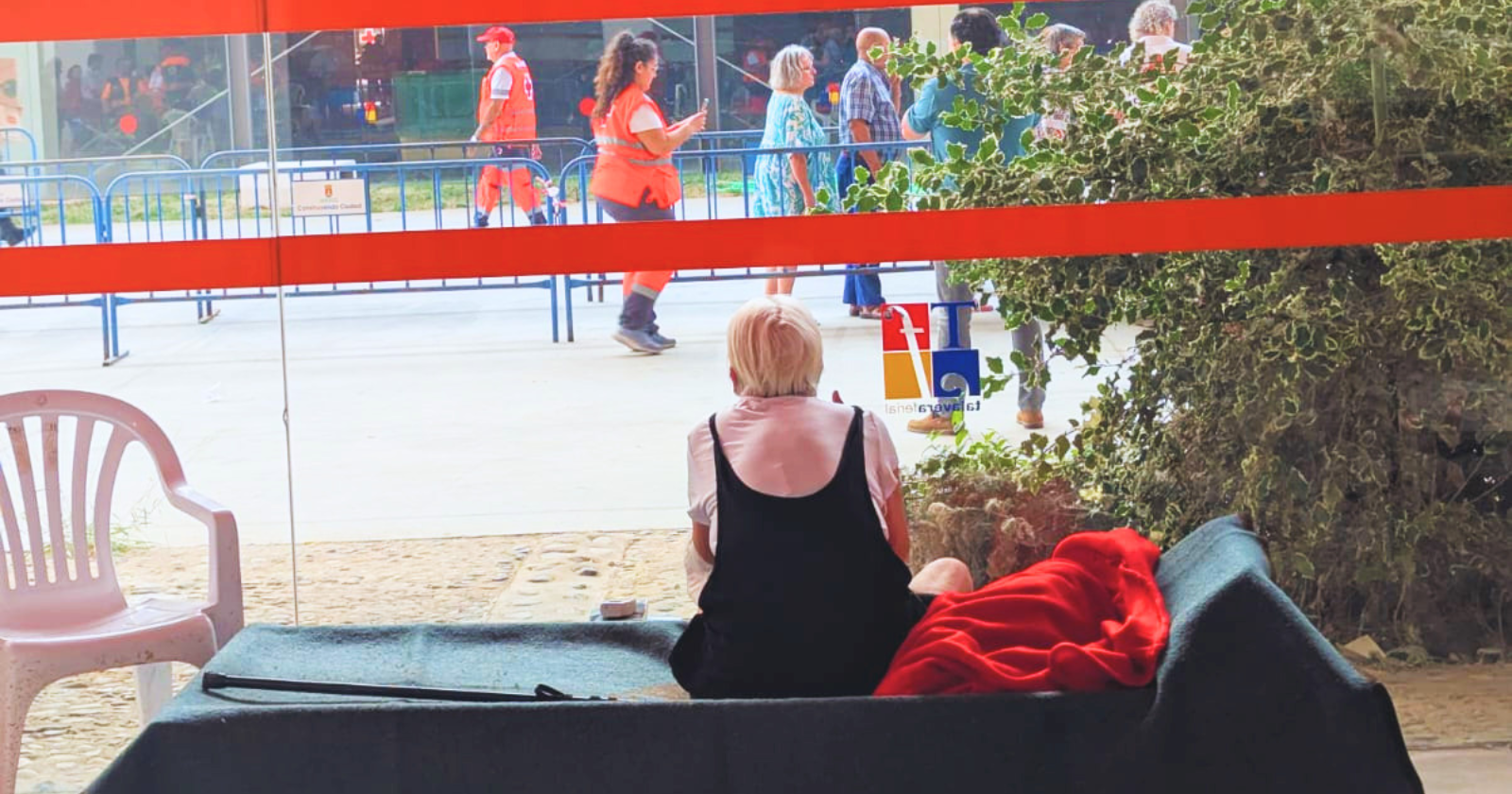
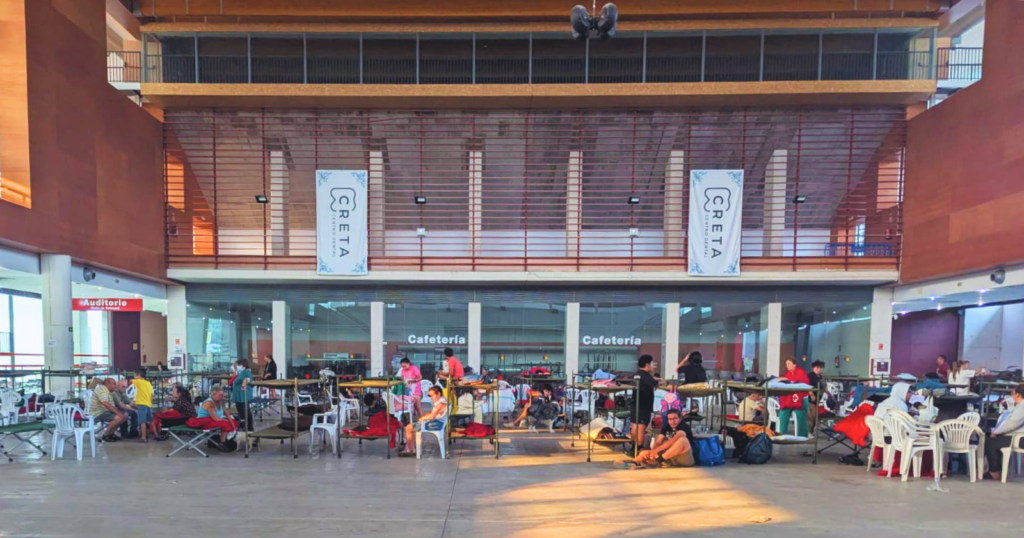
The public reception space in Talavera de la Reina was crowded.
There were older people everywhere, many accompanied by pets. Red Cross personnel moved through the building. Food was distributed. The toilet queues became enormous. People waited, spoke to strangers, cared for animals, searched for information, and tried to create temporary order inside a situation none of them had chosen.
Local reporting described emergency facilities in Talavera providing beds, food, water, showers, ventilation and designated areas for pets as evacuees arrived from affected areas. Multiple venues were opened as numbers increased.
I spoke briefly with several women while waiting for the toilet. The following morning, I talked to a French man in the coffee queue who seemed surprisingly cheerful.
That did not necessarily mean he had not been frightened. Outward calm tells us little about what preceded it, what someone has lost, or what they expect to find when they return.
It did show me that there was no single correct emotional response in the shelter.
Some people looked tense. Others concentrated on practical problems. Some talked casually. Some cared for their animals. Some accepted food and coffee as though ordinary rituals could still be protected from the emergency.
The Spanish people around us were exceptionally hospitable. They shared food, gave directions, and behaved with a steadiness that made the unfamiliar environment feel safer.
Strangely, I had the best coffee of the entire project there the next morning.
It sounds like an irrelevant detail, which is probably why I remember it so clearly.
Coffee belonged to normal life. It required someone to prepare it, distribute it, and make room for a small preference or comfort inside a large emergency. It reminded me that safety is not created only by removing people from physical danger. It is also created by restoring fragments of predictability: somewhere to sit, something to eat, space for a pet, reliable information, and a warm drink after a night of uncertainty.
Emergency hospitality is not separate from emergency infrastructure. It helps turn a large public building into a place where people can temporarily exist rather than merely wait.
Sometimes smoke brings back flashbacks from the war
Somewhere in that day, underneath the ash and the noise and the packing, something older opened up in me.
I was nine years old during the 2008 war in Georgia.
I was in my hometown, Gori, and my family had to leave quickly.
The Spanish wildfire was not equivalent to war. The causes, scale, context, and dangers were different, and I do not want to flatten them into the same event.
But memory does not always organize experiences according to their historical categories.
Sometimes it connects them through a few shared elements.
Smoke.
Ash in the air.
Adults trying to stay calm.
Being told to pack.
Having to leave immediately, before there is enough time to understand what is happening.
That was what frightened me.
Most of the time, I felt that I was ready for whatever came next. I was far from home, already living out of my luggage, and had little attachment to the physical place we were leaving. But for a moment, the present evacuation opened a much older memory.
What came back wasn’t a detailed replay of 2008 — it was the emotional logic of sudden departure.
At nine, I depended on adults to recognize danger, decide what mattered, and tell me when we needed to go. Near Toledo, I was an adult, but I was once again dependent on organizers and emergency services to interpret an evolving situation that I could not assess myself.
The orange sky was new.
The instruction to pack was not.
Terror, tension, and gratitude in the same room
Once we were safe, Lukáš and Aneta adapted the project instead of continuing as though the evacuation had simply been an interruption.
They gave us space to reflect on what had happened.
The responses were radically different.
Some participants had been terrified. Some felt anxious or tense. Some felt grateful. I was still processing it and couldn’t immediately turn the experience into a clear emotion or lesson.
Voice had already been asking us to pay close attention to ourselves and to one another before any of this happened. We had spent days talking, reflecting, doing exercises and sharing things that were not always easy to share.
After the evacuation, that suddenly felt much less abstract. We had all been in the same camp, under the same sky, and received the same instruction to leave. Still, we had not lived through the same experience. Giving those differences space instead of trying to turn the night into one shared lesson became one of the parts of the project I remember most clearly.
The trainers had their own experience too. During the earlier circle in the woods, they had been trying to manage uncertainty while remaining responsible for everyone else. Their controlled behaviour did not mean they were unafraid. It meant that they were doing the emotional work necessary to keep a group coordinated.
In emergencies, calm can be both real and constructed.
It can also be contagious.
What can be seen from space
From above, satellites can detect active fires, follow smoke plumes, monitor aerosols and show how fire changes the landscape. They can reveal a scale that nobody standing inside the event can see.
More importantly, satellites observe environmental conditions. They do not observe meaning.
They can detect particles capable of absorbing light, but not what the altered light reminds a person of.
They can follow a smoke plume, but not the childhood memory moving beneath it.
They can map the distance between a camp and a fire, but not the difference between leaving a place where you are temporarily staying and leaving a home that contains your entire life.
They cannot see a trainer hiding anxiety, an older person waiting with a pet, strangers speaking in a toilet queue, or someone handing out unexpectedly good coffee in the morning.
Those details are not alternatives to scientific knowledge. They are another layer of the same event.
Brown carbon and older memories
Brown carbon gave me a scientific way to begin understanding part of what I had seen.
But chemistry could only explain why the sky looked unfamiliar, not why the moment itself felt familiar.
For that, I had to think about Gori, my nine-year-old self, and the particular fear contained in being told to leave before knowing what will remain when you return.
The fire moved through a landscape that could be monitored from above. Our evacuation became part of an emergency operation that could be counted in people, vehicles, beds, meals, and locations.
My experience of it remained harder to measure.
It existed somewhere between smoke particles and autobiographical memory, between the physical danger in front of us and an older danger that the atmosphere unexpectedly brought back.
The sky over Toledo had changed because of what was burning.
For a few moments, so had the distance between my present and my past.