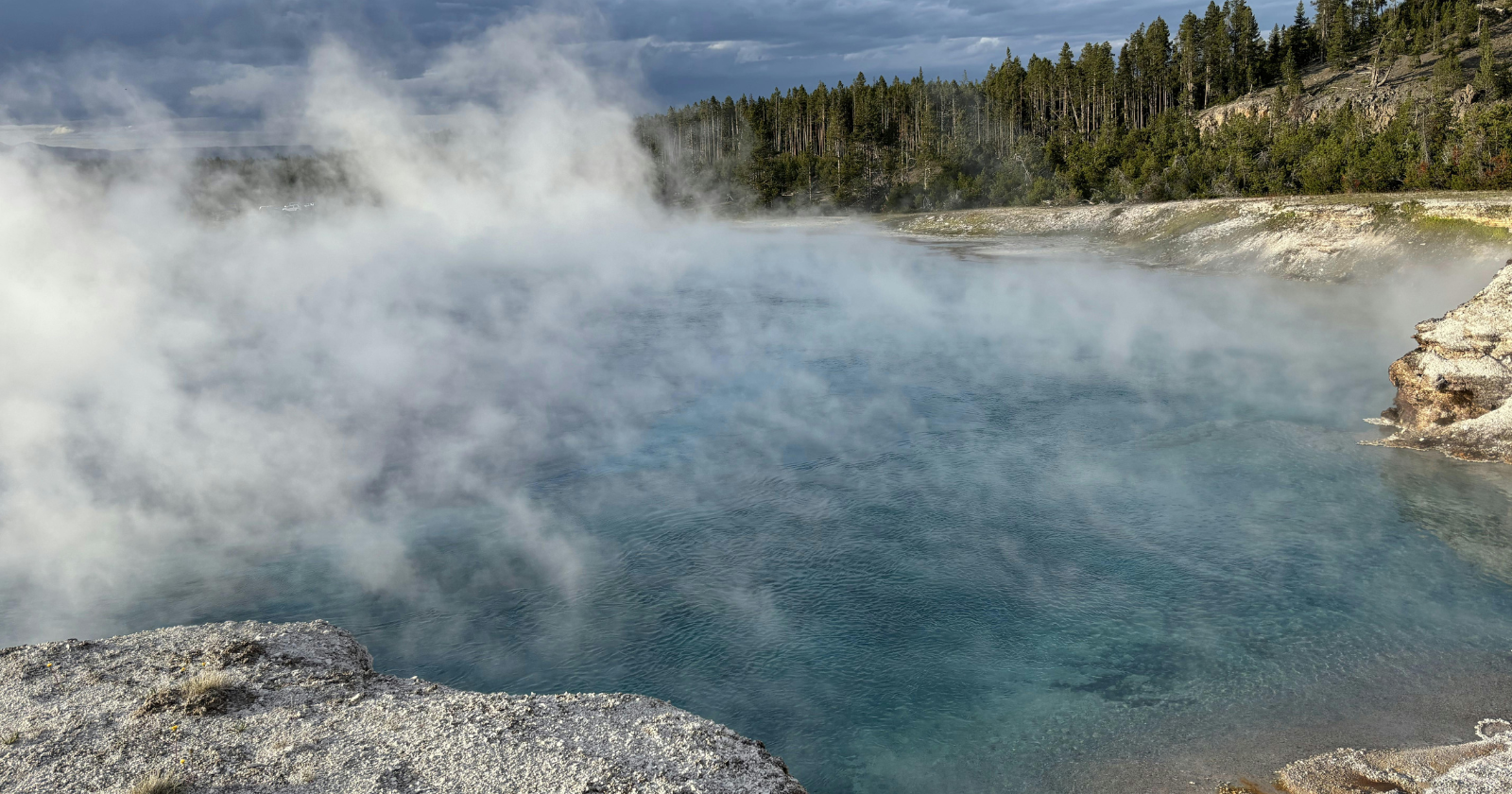
In the summer of 1966, an undergraduate barely out of his second year knelt beside a scalding creek in Wyoming and scooped pink slime into a plastic bottle. He was not chasing a cure, a patent or a fortune. His professor wanted to know whether anything could live in water hot enough to poach a hand, and the only way to find out was to go and look.
That bottle is the reason your local pathology lab can read your genome, and the reason a jury in a murder trial can be told the odds of a match are one in several billion.
A pool where nothing should have grown
Thomas Brock was a microbiologist at Indiana University when he first drove through Yellowstone in 1964 and noticed the coloured mats streaming out of the hot springs. Those mats were alive, which was not supposed to be possible. Textbooks of the day put the ceiling for bacterial life somewhere around 55 degrees.
Brock came back with grant money and a small team, including the honours undergraduate Hudson Freeze. They lowered microscope slides into boiling pools and pulled them out days later covered in growth. In April 1969 the two of them described a new species in the Journal of Bacteriology, a heat-loving rod they named Thermus aquaticus, isolated from Mushroom Spring in the Lower Geyser Basin and happiest at around 70 degrees.
It was a finding about where life can exist, nothing more. Brock, who spent most of his career at the University of Wisconsin–Madison and died in 2021 at 94, had effectively opened the study of extremophiles by proving the ceiling was imaginary.
Why the heat mattered so much
Why should a bug’s heat tolerance matter to a crime lab? Because of a small, brutal engineering problem at the heart of DNA copying.
To read DNA you usually need more of it than the evidence gives you. The polymerase chain reaction solves that by copying a chosen stretch over and over. Each cycle starts by heating the sample to about 95 degrees, which prises the double helix apart into single strands. Then it cools, short primer sequences latch onto the target region, and an enzyme called a polymerase builds fresh strands along each half. Repeat thirty times and one molecule becomes a billion.
The trouble is that 95 degrees also wrecks the polymerase. When Kary Mullis worked out the technique at Cetus Corporation in 1983, the enzyme had to be replaced by hand at every single cycle, which made the whole thing a miserable, sweaty grind of pipettes and water baths.
An enzyme from a bacterium that lives near boiling does not care. In a 1988 paper in Science, Randall Saiki and colleagues at Cetus reported using the Thermus aquaticus polymerase, Taq for short, in the reaction. Single-copy human sequences were amplified more than ten million fold. You could load the tube once, walk away, and let a machine do the temperature cycling. Mullis took a share of the 1993 Nobel Prize in Chemistry for the idea.
A culture collection, not a patent
Strain YT-1 went into the post. In 1968 Brock deposited his Yellowstone cultures with the American Type Culture Collection, the non-profit repository that supplies reference organisms to laboratories, where it sat in the catalogue available to anyone who asked. That is how Cetus got hold of it years later, by ordering a sample of somebody else’s discarded curiosity.
Everything downstream depends on a bit of ordinary scientific housekeeping.
Three hundred million dollars, and a ten thousand dollar bonus
The money went elsewhere. Cetus patented purified Taq, and in 1991, as reported by Nature Biotechnology, sold the rights to that patent and the PCR process to Hoffmann-La Roche for 300 million US dollars. Mullis had already taken a 10,000 dollar bonus from Cetus and left. The patent then had a rough life of its own, with a federal judge in California ruling in 1999 that it had been obtained through misrepresentation, a finding that spent the next several years bouncing around on appeal.
Brock and Freeze got none of it, and neither did Yellowstone. What they did get, in 2013, was the Golden Goose Award, which exists specifically to honour federally funded research that looked frivolous and proved foundational. Cowboy State Daily, which could not reach Freeze for comment, reported that he received no share of the profits from the enzyme he helped isolate as a student.
What it does in a courtroom
A cotton swab goes over a doorhandle. Whatever cells came off it are far too few to analyse directly, so the lab amplifies specific regions called short tandem repeats, stretches of DNA where a short sequence stutters a variable number of times, and reads how many repeats each one carries. The National Institute of Justice describes how the copying step lets analysts work from a stain the size of a pinhead and from badly degraded material that older methods could not touch.
The enzyme does none of the identifying. Its job is photocopying, humbler and completely unskippable, and that same sensitivity explains why forensic labs are neurotic about contamination. The reaction copies whatever DNA is present with no interest in how it got there, a point the agency stresses in its guidance on handling evidence.
The reach goes well past criminal courts. Paternity testing, prenatal screening, cancer mutation panels, ancestry kits, veterinary diagnostics and the mountain of nasal swabs processed during the pandemic all run on thermostable polymerases descended from that Yellowstone lineage or engineered to do the same job.
Yellowstone learned to write a contract
In 1997 the park signed a research agreement with the biotechnology firm Diversa Corporation, the first of its kind in the United States, and Congress followed a year later by authorising benefit-sharing arrangements through the National Parks Omnibus Management Act. The National Park Service notes that environmental groups sued over the Diversa deal and that the case was eventually dismissed. The terms, as documented by WyoHistory, ran to 20,000 dollars a year for five years plus royalties on anything commercial that emerged.
Modest numbers, and a direct institutional response to the memory of an enzyme walking out of a national park for free.
What stays with me is the gap. A sample collected in 1964, a species named in 1969, a commercial enzyme in 1988, a global testing infrastructure by 2020. Fifty-six years from pink slime to pandemic response, and not one line of that could have been promised in a grant application. Brock spent a decade of public money establishing that certain bacteria are fine with heat. That was the finding. The rest was luck, patent lawyers and other people’s cleverness stacked on top of a man who simply wanted to know what was living in the water, which is a worse pitch than any funding committee will ever accept and a better bet than almost anything they fund on purpose.