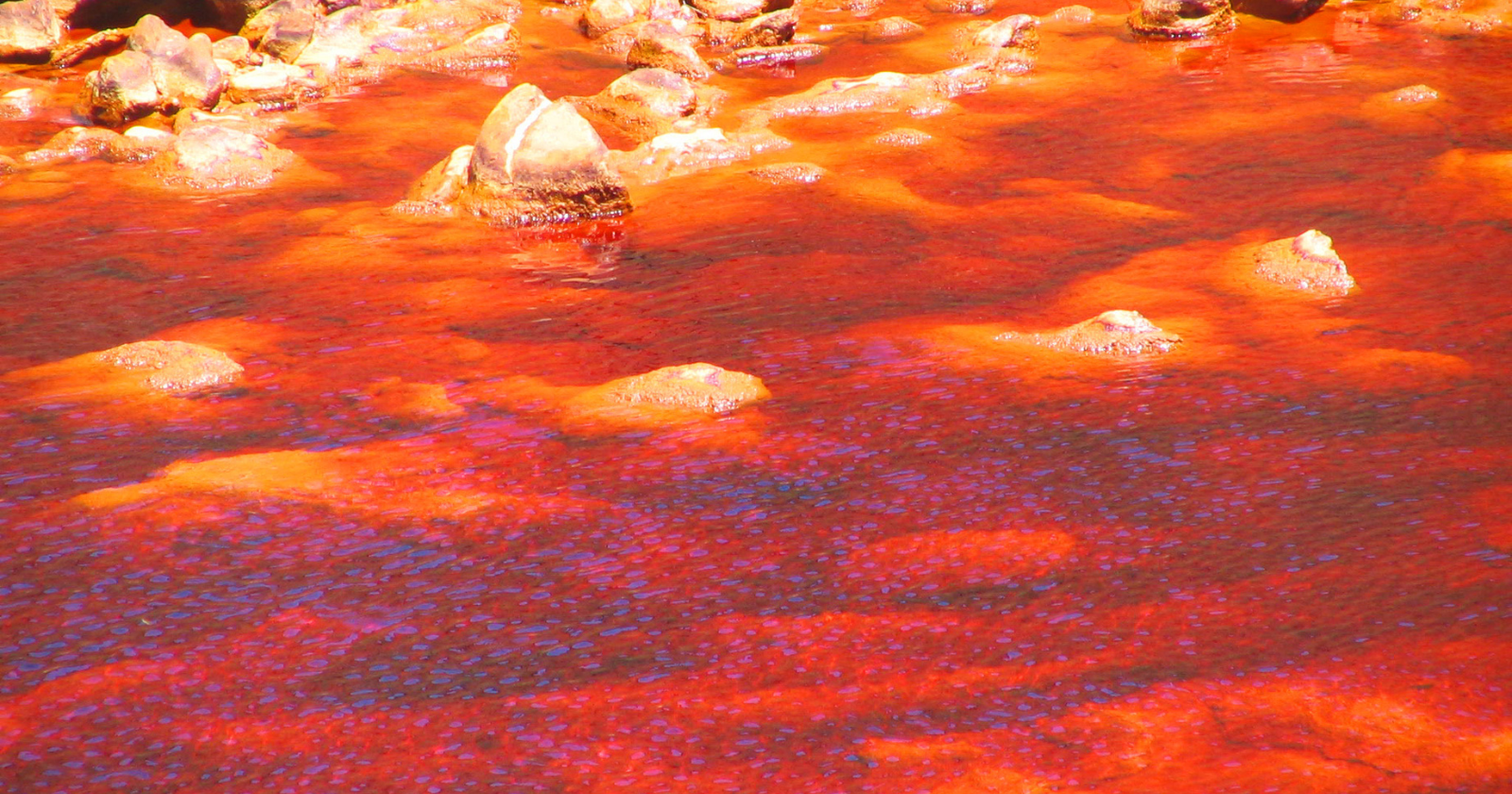
Dip a pH strip in the Río Tinto and it reads like the vinegar in your kitchen cupboard.
The Río Tinto runs for roughly 100 kilometres through southwestern Spain, and its upper reaches, the first 50 kilometres or so nearest the source, are the stretch that turns the colour of rust and old wine, acidic enough to turn a scratch into a proper problem. Cattle avoid it. Tourists photograph it and then discreetly wipe their hands. And a surprising number of astrobiologists have spent large chunks of their careers standing in it with sample bottles, because this corner of Andalusia is the nearest thing on Earth to ground that a NASA rover has already photographed on Mars.
What makes the water red
Beneath the valley sits the Iberian Pyrite Belt, an enormous body of sulfide ore laid down hundreds of millions of years ago when the region was volcanically active. NASA’s Earth Observatory lays out the mechanism plainly: when metals buried in those deposits meet water and oxygen, the runoff turns acidic. Iron in its oxidised form does the rest, tinting the flow anywhere between tomato soup and dried blood depending on the light.
Microbes do more here than merely endure. Iron- and sulfur-oxidising bacteria, among them Acidithiobacillus ferrooxidans and Leptospirillum ferrooxidans, make a living by stripping electrons off iron and sulfur compounds in the rock, and acid is the by-product. So the organisms best suited to the river are the same ones manufacturing the conditions that keep almost everything else out.
Five thousand years of digging
People have been mining this valley since the Copper Age, which makes the obvious suspicion a reasonable one: perhaps the river is just a very old industrial wound. Earth Observatory notes that millennia of extraction have probably amplified the acidification by exposing more sulfide ore to air and water. Ricardo Amils and David Fernández-Remolar, writing in Life, go considerably further, arguing that the chemistry is not a mining artefact but the surface expression of an underground bioreactor: microbes metabolising massive sulfide deposits well below the water table, feeding the products up into the river.
That is one research group’s reading of decades of its own fieldwork, and it happens to be the reading that makes the site valuable to Mars scientists, so it deserves a little scepticism alongside the respect.
The residents are stranger than expected
The Phoenicians knew it as the River of Fire, per the 2002 paper in Nature by Linda Amaral-Zettler and colleagues, and what that paper reported was odder than the name. Eukaryotes, meaning organisms with complex cells like algae and fungi rather than bacteria, are the principal contributors of biomass at pH 2. Their diversity outstrips that of the prokaryotes doing all the chemical heavy lifting.
Later work put numbers on it. Eduardo Costas and co-authors, in New Phytologist, recorded a pH range of 1.7 to 2.5 and found microalgae accounting for about 60 per cent of total biomass. Green algae, the sort you would scoop out of a farm dam, flourishing in dilute acid loaded with iron, copper and zinc.
Why Mars keeps coming up
In 2004 the Opportunity rover, poking around a small crater on a plain called Meridiani Planum, turned up jarosite, a hydrated iron sulfate mineral. Göstar Klingelhöfer and the rover’s Mössbauer spectrometer team reported the detection in Science, noting that its presence was mineralogical evidence of water acting on rock under acidic, sulfate-rich conditions.
Jarosite is also scattered right through the Río Tinto basin.
Same mineral, same implied chemistry, one version reachable only by a rover with a fixed power budget and the other reachable by hire car.
Rehearsing the search
All of which turned the riverbank into a practice ground. NASA and Spain’s Centro de Astrobiología ran the Mars Astrobiology Research and Technology Experiment there between 2003 and 2006, drilling with an autonomous coring rig mounted on a simulated lander, as NASA’s Ames Research Center describes it. A follow-up campaign, the Iberian Pyrite Belt Subsurface Life Detection project, ran from 2011 to 2015.
Then in 2017 a team led by Laura Sánchez-García staged a full dress rehearsal, later written up in a 2020 paper in Astrobiology. A metre-class prototype drill sat on a full-scale mockup of the Phoenix and InSight lander platform, cutting sterile cores from the riverbank, transferring samples automatically, and testing them on the spot with an antibody-based life detector chip while a remote science team assessed the results blind. Microbial markers turned up all the way down the metre, their distribution shaped by the local mineralogy. The most practical conclusion was also the least glamorous: one hole is not enough, because the chemistry shifts over a few metres of ground.
How quickly the algae adapted
Costas and his co-authors also tested how those green algae managed the transition, and the answer came back faster than you would guess. Cultures of a common freshwater species, dropped into river water, mostly died. A few cells survived and multiplied, and a fluctuation test indicated the resistant variants had arisen by rare spontaneous mutation before exposure, at something like one per million cell divisions. One paper, one species, so hold it loosely. Still, the implication is that adapting to an environment this brutal can happen quickly, given a big enough population and a bit of luck.
Which quietly reframes the Mars question. Drilling the Río Tinto is usually described as practice for finding life somewhere hostile, and the harder question runs the other way: if organisms can slide into conditions like these within a few generations, then anything living in Meridiani’s acid brines had no shortage of ways to get going. Staying was the difficult part.