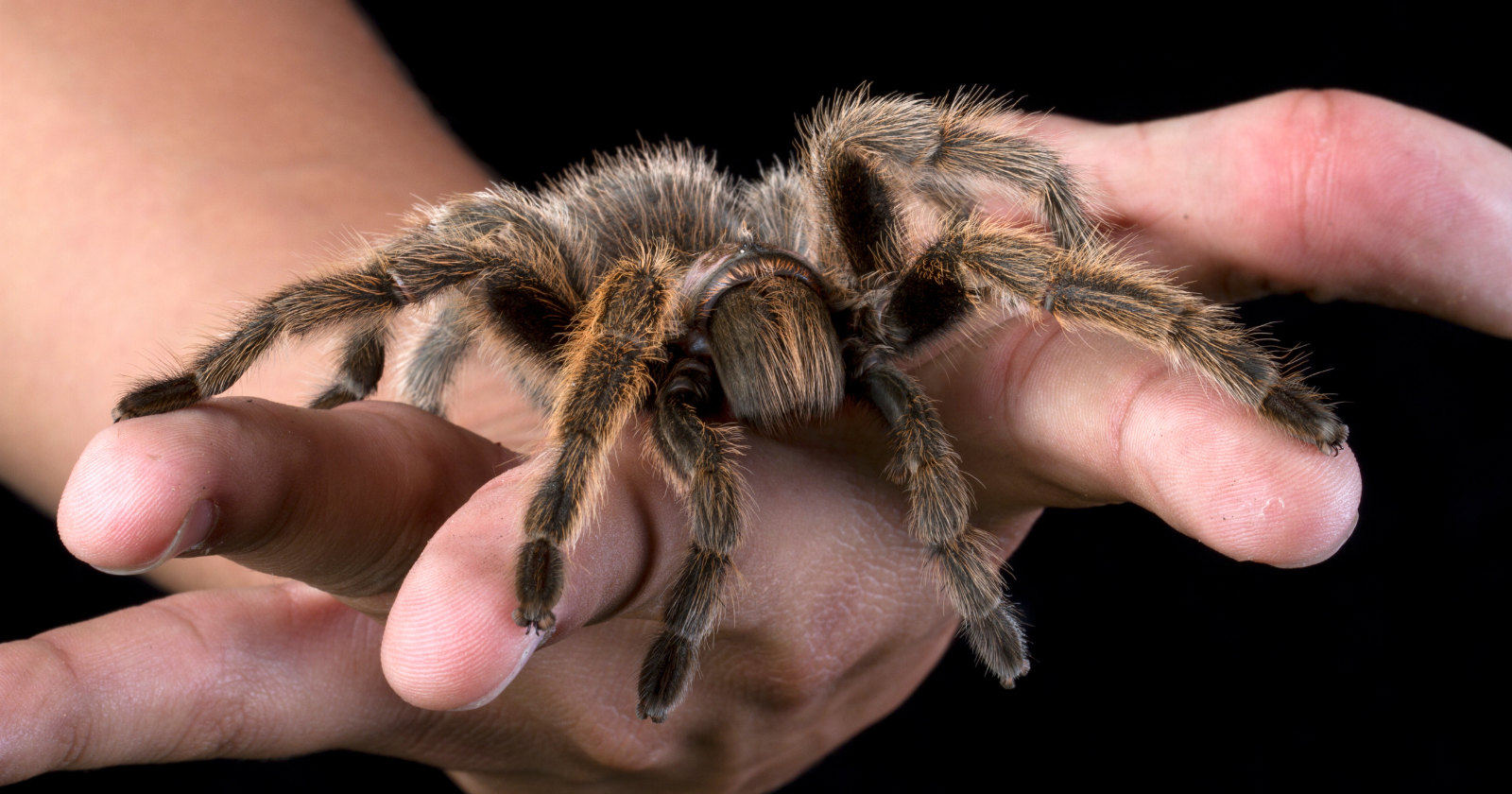
The tarantula is the point where the researchers had to physically intervene.
Everything before that had gone fine by their standards. In an exotic pet shop in Iowa, a woman known in the scientific literature only as SM had spent three minutes handling a snake. She rubbed its scales, touched its flicking tongue, and asked the shop assistant what snakes see when they look at a person. She asked fifteen separate times whether she could touch the larger ones, the animals the assistant kept warning her would bite. Then she reached for the tarantula, and someone grabbed her wrist before she got hold of it. Asked why she’d want to handle a creature she’d spent years claiming to hate, she said she was curious.
Justin Feinstein and Daniel Tranel, at the University of Iowa, ran the study with Ralph Adolphs at Caltech and Antonio Damasio at USC, and published it in Current Biology in 2011. On a zero to ten fear scale, she never got above a two in that shop.
What Urbach-Wiethe disease does
SM has Urbach-Wiethe disease, an autosomal recessive condition also called lipoid proteinosis. A faulty copy of a gene called ECM1 lets a glassy protein deposit accumulate in skin, mucous membranes and, in some patients, the brain. DermNet puts the global tally at just over 500 reported cases.
In SM the deposits calcified in both amygdalae and nowhere else that counts. Hippocampus, cortex, insula and brainstem all untouched. Her IQ, memory, language and perception all test normal. What she lost was a pair of almond-sized structures, and with them the response most of us would call being scared.
The damage seems to have arrived slowly. She recalls being cornered by a large dog at a house her mother was visiting, feeling her gut tighten, wanting to go home. That is roughly the last time.
Leading strangers through a haunted house
“This way guys, follow me!”
One Halloween the team took her to Waverly Hills Sanatorium, a decommissioned tuberculosis hospital in Kentucky that runs an annual scare attraction and has a reputation. She was paired with five women she had never met, and she led. Round blind corners, into dark corridors, calling the stragglers along behind her.
Staff in monster costumes did their jobs. She smiled at them, laughed at them, tried to strike up conversations. At one point she poked one of them in the head to find out what it would feel like, and startled him. Her fear ratings sat at zero throughout, though she reported plenty of excitement, which she compared to riding a rollercoaster.
The scary films went the same way. Ten clips, no fear response, and partway in she asked for the title of one so she could rent it later.
Why this is not a superpower
I spent years in offices where a low hum of dread stopped people from doing career-ending things, and I’ve wondered what I’d have got away with if I couldn’t feel it. SM is that experiment, already run. The results don’t flatter the premise.
Local police records back up a history that includes a knife at her throat, a gun pointed at her, a beating from a much larger woman, a domestic assault that nearly killed her, and repeated threats to her life. None of it registered as urgent while it was happening, by her own telling. She also struggles to spot danger before it’s already on top of her, which may be a large part of why so much of it found her in the first place.
Fear turns out to be load-bearing for the imagination too. In work published in The Journal of Neuroscience in 1995, Ralph Adolphs and colleagues asked her to draw facial expressions from memory. She enjoys drawing, and produced skilled versions of happiness, sadness, anger, surprise and disgust. Fear defeated her. She explained that she did not know what an afraid face would look like, and the sketch she eventually produced after repeated prompting was the only one of the six that showed no face at all.
The one stimulus that worked
Twelve years later, the same group finally found it. It arrived through her lungs.
Feinstein, working with John Wemmie and others, had SM inhale a single breath of air containing 35 per cent carbon dioxide. Within seconds her hand was waving frantically near the mask. Shortly after, she called out for help and the experimenter pulled it off her face. She said afterwards that she had been worried about suffocating, and that the feeling was the worst she had known. Writing in Nature Neuroscience, the team reported that this was, as far as they knew, the first fear she had experienced in any setting since childhood.
Two other women with the same disease and comparable lesions, monozygotic twins, panicked as well. All three crossed the study’s threshold for panic. Only three of the twelve neurologically intact comparison participants did. Three patients is three patients, and the authors said as much, but the pattern is hard to wave off.
Their reading is that carbon dioxide never knocks on the door the amygdala guards. It works on acid-sensing chemoreceptors, and the alarm travels up through the brainstem and the insula, a route that in SM is completely undamaged. A 2016 follow-up by Sahib Khalsa and Feinstein gave two of the three an infusion of isoproterenol, a drug that mimics adrenaline out in the body without acting on the brain directly. Both reported anxiety, and one had a full panic attack.
Which leaves an odd suggestion sitting in the 2013 paper, offered cautiously and still unresolved. The patients panicked more readily than the healthy volunteers did, which may mean an intact amygdala spends part of its working life holding panic down. If that holds up, the woman who cannot be frightened by a corridor full of monsters and the man who panics on a quiet Sunday afternoon are describing the same piece of wiring from opposite ends.