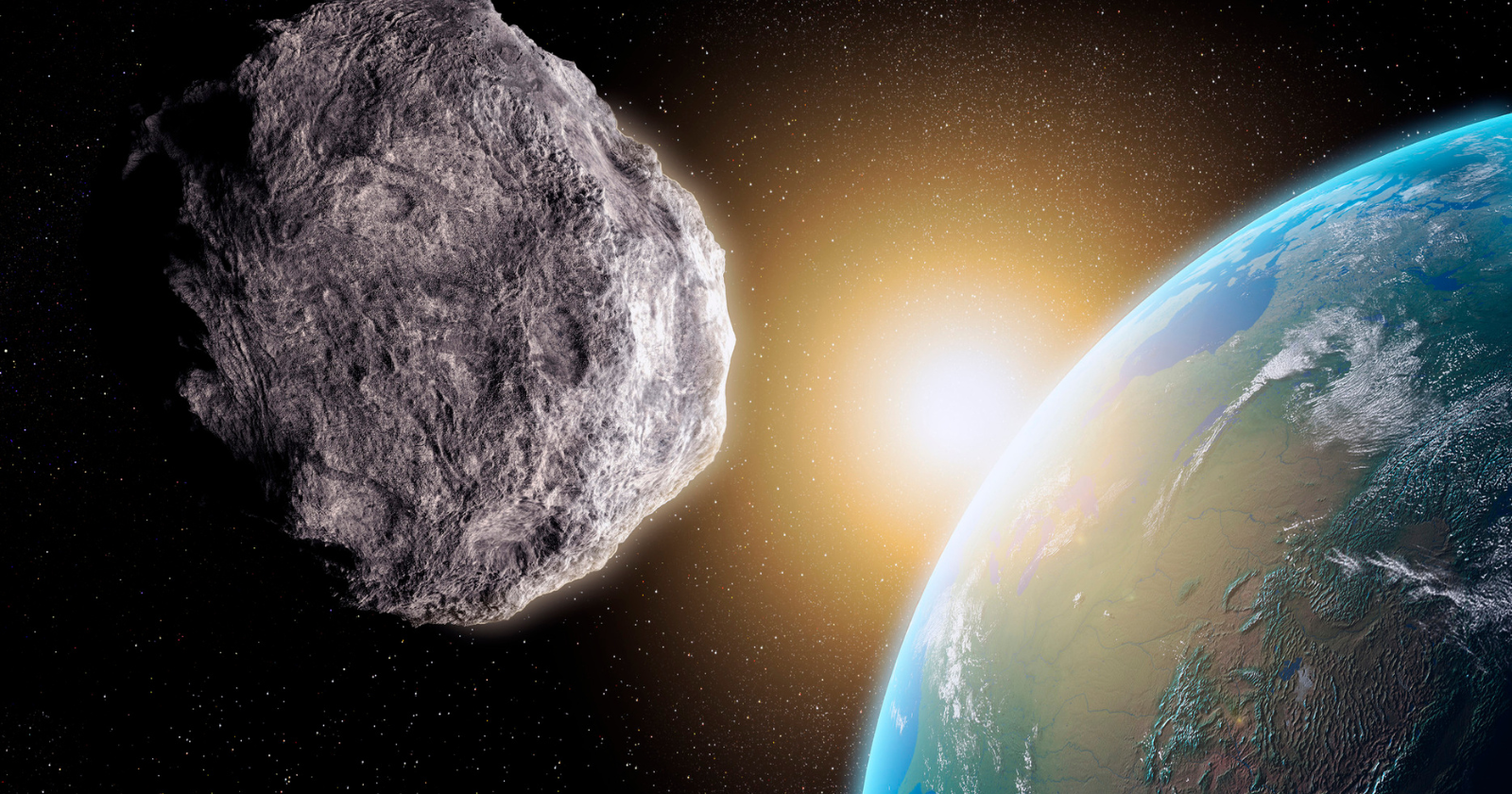
Humanity’s first deliberate act of interplanetary vandalism was over before the pictures finished arriving.
On 26 September 2022, a spacecraft roughly the size of a refrigerator flew into a 150-metre heap of rubble called Dimorphos at about six kilometres per second. The last image it sent back is a partial frame, grey gravel filling the view, cut off mid-transmission because the camera had ceased to exist. Dimorphos was never a threat to anyone. It orbits a larger asteroid, Didymos, and it was chosen precisely because hitting it could be measured without consequence.
That was the entire point. Not the crash, the measurement.
What the numbers actually showed
NASA set the bar generously low. Any change of 73 seconds or more in Dimorphos’s orbit around Didymos would count as a win. Two weeks after impact, the team at the Johns Hopkins Applied Physics Laboratory announced the orbit had shortened by 32 minutes, clearing the minimum by more than 25 times. Longer analysis, reported by Cristina Thomas and colleagues in a paper published in Nature, settled the figure at 33 minutes.
DART weighed around 580 kilograms when it hit. Dimorphos is a 150-metre-wide mountain of loose gravel held together by almost nothing. Simple physics said a direct transfer of momentum should have shaved about seven minutes off the orbit.
It shaved 33.
The debris did most of the pushing
Where did the extra come from? From everything DART threw off the surface. The impact blasted a plume of dust and rock out of the new crater, and that ejecta gave Dimorphos an extra kick by simple recoil, the same way a rocket gets pushed one way by exhaust leaving the other. That recoil added to the push DART had already delivered. Andrew Cheng and a very long list of co-authors calculated the momentum enhancement factor at about 3.6, assuming the two asteroids share the same density. In plain terms: the spray of rubble shoved harder than the spacecraft did.
The hit also reshaped the target. Navigation engineer Shantanu Naidu led a follow-up study finding that Dimorphos went from a squashed sphere on a tidy circular path to something lumpier, on an orbit that no longer closes neatly. So the target came away lopsided too, tracing a tighter, quicker lap around Didymos.
The rubble is still out there
Some of this experiment will outlast everyone reading about it. Hubble picked out 37 boulders drifting away from the system, the largest close to seven metres across, moving tortoise-slow at just over a kilometre an hour. They were probably not excavated by the crash so much as shaken loose by it.
Researchers Marco Fenucci and A. Carbognani then ran those boulders forward 20,000 years in Monthly Notices of the Royal Astronomical Society and found the swarm will cross Mars’s orbit repeatedly, with a real chance some of it eventually lands there. That is one modelling study, not a settled forecast, and the timescales involved make it more curiosity than concern. Still, Tony Farnham and a large team, writing in the Planetary Science Journal in 2025, found the boulder clusters carried more than triple the momentum of the spacecraft itself, which means anyone planning a real deflection has to model the shrapnel as well as the shot.
What Hera goes to check
Everything above rests on one soft number: nobody knows exactly how much Dimorphos weighs. Without that, the momentum figure is a range with a preferred value, not a measurement.
Which is why the European Space Agency sent Hera, a van-sized spacecraft that launched in October 2024, swung past Mars in March 2025, and is due at Didymos late this year. It will weigh Dimorphos properly, photograph the crater, and drop two briefcase-sized CubeSats to poke at the interior. The experiment happened four years ago. The lab report is still being written.
The part we never had to practise
Then came a candidate, or something that briefly looked like one. Astronomers found 2024 YR4 in December 2024, a rock between 53 and 67 metres across by ESA’s reckoning, city-block scale rather than civilisation-ending. Its odds of hitting Earth in 2032 briefly reached 3.1 per cent, the highest ever recorded for an object that size, before dropping to effectively zero. Attention then shifted to the Moon, where the chance of impact climbed to 4.3 per cent, and a genuinely thrilling prospect of watching a crater form in real time began to look plausible.
In March 2026, using Webb observations taken in February, NASA’s Center for Near-Earth Object Studies ruled the lunar impact out entirely. YR4 will pass about 21,200 kilometres from the surface. The odds never really moved. Our knowledge of where the thing was got sharper, and the possibility evaporated.
Notice what did the work there. Not a spacecraft. A telescope, an archive of old images, and a star catalogue precise enough to pin a faint smudge against the background. DART proved we can shove a rock off course, provided we spot the threat years before it arrives and have enough runway to design, build and fly something to meet it. What it could not prove is that we will get that much warning.