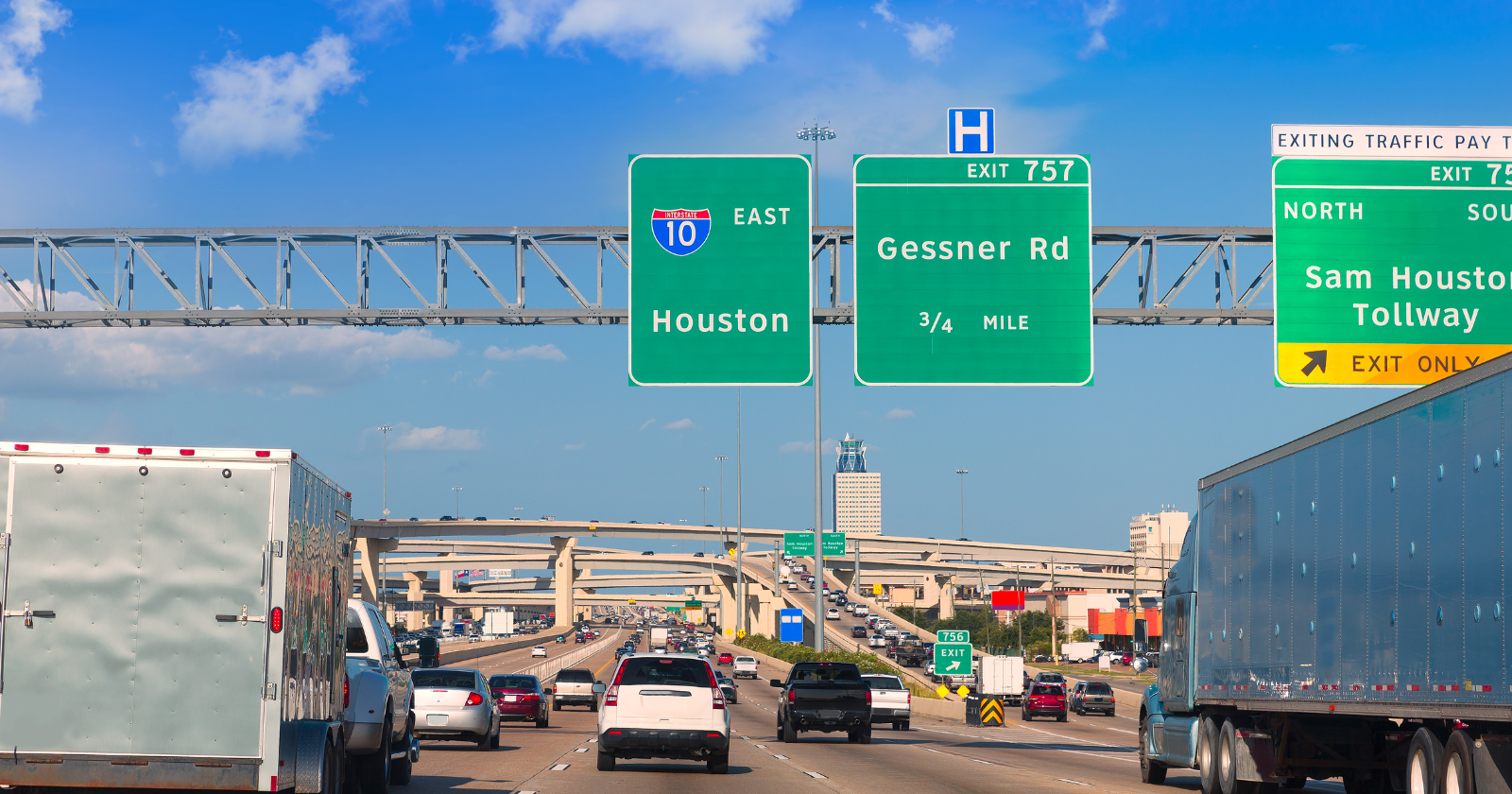
Picture a road so wide that from the middle of it you cannot make out what shops are on the other side. Twenty-six lanes of concrete laid flat across west Houston, wide enough to land a jumbo jet on. Now picture it at five thirty on a Tuesday, packed solid, everyone breathing their own exhaust and quietly wondering what the three billion dollars bought.
That is the Katy Freeway, and it is the most expensive economics lesson anyone has ever poured in concrete.
What Texas actually built
Interstate 10 runs from downtown Houston to the suburb of Katy, roughly 30 miles west. By the early 2000s it was a legendary mess. A Federal Highway Administration project profile notes the corridor was built in the 1960s to carry about 80,000 vehicles a day and was handling close to three times that forty years later, with congestion running as long as eleven hours daily.
So Texas did the obvious thing, at enormous scale. Construction ran from 2003 to October 2008 and cost $2.79 billion, and that profile describes six lanes in each direction plus variably priced toll lanes down the median.
The famous twenty-six comes from adding the frontage roads and managed lanes to the main lanes near Beltway 8, as the Houston Chronicle counted it. PolitiFact checked the widest-in-the-world claim in 2016 and put the real number at 13 main lanes, close enough to the FHWA count above that the gap looks like rounding, with Ontario’s Highway 401 wider still. The title rests entirely on whether feeder roads count, which is a very Houston thing to argue about.
Rick Perry turned up for the ribbon cutting anyway. Hundreds of balloons went up over the Beltway, and the governor told the crowd the project set an example for other cities, as Houston Public Media reported that morning.
He was right about that, just not in the way he meant it.
The numbers that spoiled the party
At first it worked. Rush hour times dropped, the local press wrote the happy story, and the highway lobby filed the Katy away as a win.
Then people checked again.
Jay Crossley at Houston Tomorrow pulled the region’s official traffic data and found the peak-hour run outbound from downtown to Pin Oak, past the Katy Mills Mall, took 70 minutes and 27 seconds in 2014. In 2011 that same drive took 46 minutes and 53 seconds. Fifty-one per cent more time on a freeway rebuilt for nearly three billion dollars, as Streetsblog USA documented in 2015, alongside a congressman’s boast to Congress that the project was moving more cars in less time than anything in Houston’s history.
Joe Cortright at City Observatory pulled the same Transtar database for two segments across those years and got a morning commute 25 minutes longer and an afternoon commute 23 minutes longer, increases of 30 and 55 per cent.
Precision matters here, because the sloppy version of this story gets told a lot. Nobody has demonstrated that 2014 traffic was worse than 2003 traffic. What the data shows is that the gains evaporated within a few years of opening and then kept heading the wrong way, a different and more interesting claim.
Why the lanes fill up
The mechanism has a name that sounds like jargon and is really just supply and demand in a hard hat: induced demand.
Driving has a price, and most of that price is time. Widen a road, the time cost drops, and people buy more of the thing that got cheaper. They take trips they would have skipped. They stop catching the bus. They move house to the far suburb because the commute finally looks survivable, and a developer, noticing this, puts another two thousand homes out there. Give it a few years and the new lanes carry the same crawl as the old ones, with more people stuck in it.
Gilles Duranton and Matthew Turner put numbers on this in the American Economic Review in 2011, finding that vehicle kilometres travelled rise roughly in proportion to lane kilometres on urban interstates. They called it the fundamental law of road congestion. The name stuck.
One paper is one paper. This one has held up well enough to shape policy, though. The induced travel calculator built at UC Davis applies an elasticity of 1.0 to interstate widenings, so a 10 per cent rise in lane miles is assumed to yield roughly 10 per cent more driving within three to ten years. Caltrans wrote the tool into its official analysis framework in 2020.
That kind of modelling produces uncomfortable numbers. RMI’s analysis of highway widening ran a related calculator over a proposed 1.7 mile expansion of I-5 in Portland and came out with 35 to 53 million additional vehicle miles a year.
The case for the defence
Houston’s boosters have a comeback, and it deserves a hearing.
The Katy moves far more people than it used to. The tolled managed lanes did not exist before, and they give anyone willing to pay a reliable trip. If congestion is simply the sign of an asset being fully used, the argument runs, then a jammed public investment is a popular one.
I find that unconvincing but not stupid. The trouble is that it quietly redefines success after the fact. Texas sold this thing as congestion relief, and the relief lasted about as long as the balloons.
There is also a fair methodological objection. One freeway is not a controlled experiment. Houston’s population grew, fuel got cheap for a stretch, and untangling those forces from the widening is genuinely hard, which is why the Duranton and Turner style of research carries more weight than any single road.
What happens when you go the other way
I wrote a while back about Seoul pulling down the elevated road over the Cheonggyecheon stream, and the part that stays with me is how confidently everyone predicted disaster. The city scrapped a four lane elevated highway and the ten lane surface road beneath it, which between them carried more than 170,000 vehicles a day.
Mostly, the traffic went away. Bus ridership rose 15.1 per cent and subway ridership 3.3 per cent between 2003 and 2008, and the Global Designing Cities Initiative case study logs the lesson without ceremony: cutting travel lane capacity cut vehicle traffic. Demand responds to supply shrinking as readily as it responds to supply growing.
Houston is doing it again
In October 2024, TxDOT broke ground on the North Houston Highway Improvement Project, a rebuild of I-45 running north from downtown to Beltway 8. The agency’s own construction announcement describes a $13 billion effort to expand roadway capacity and reduce congestion, and quotes the chairman of the Texas Transportation Commission on getting Texans out of traffic faster.
Thirteen billion dollars. Getting on for five Katys, on a corridor crossing the one that already ran the experiment.
Mike Zientek, a public involvement liaison at TxDOT, told Spectrum News in June that the figure is nearly double the original seven billion dollar estimate, and that he expects the work to finish around 2038 or 2040. I doubt I will be on any overpass when that ribbon gets cut. I would put money on the balloons, though.