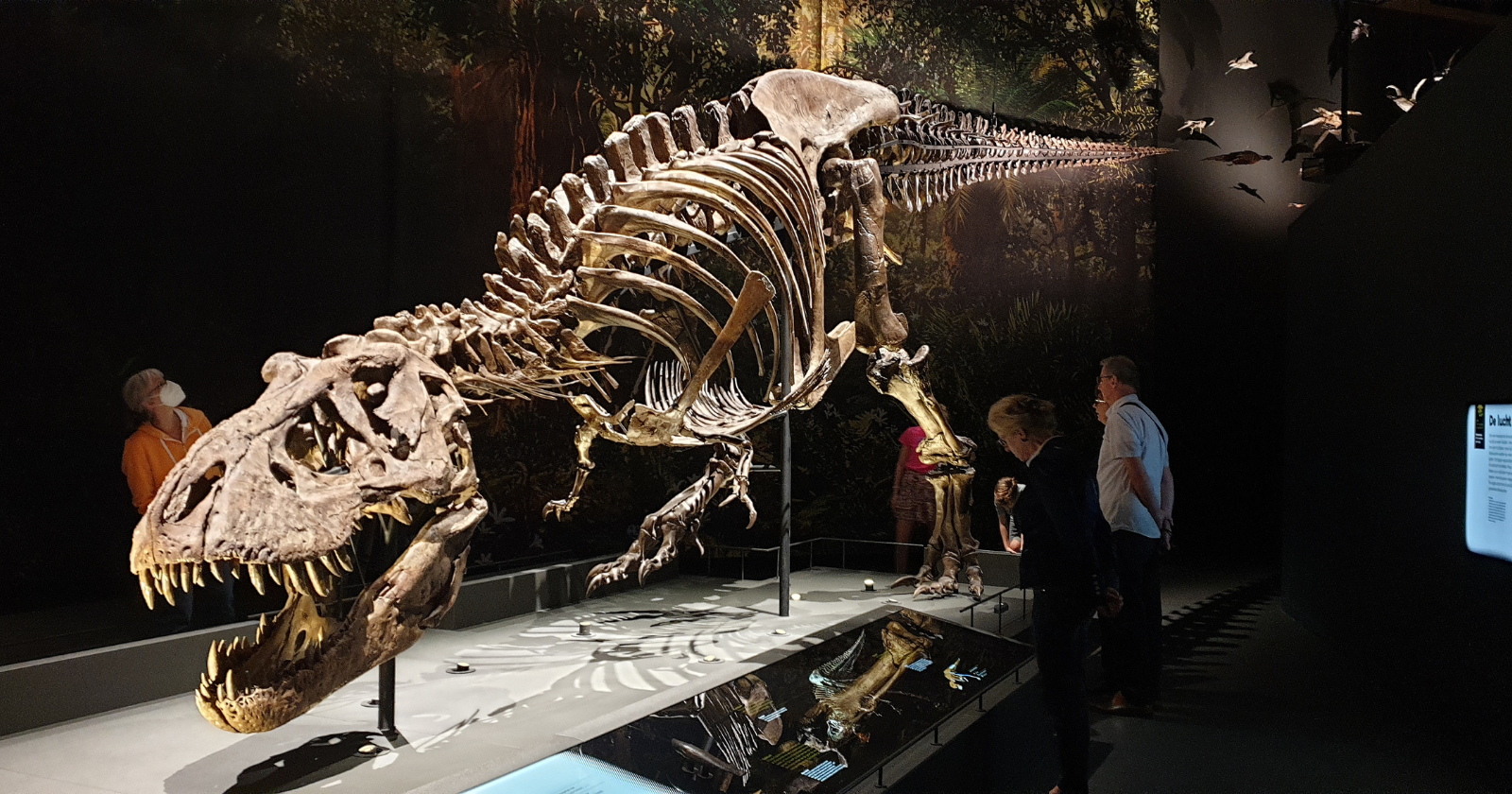
In 2021 a team of paleontologists led by Charles Marshall at Berkeley did something clever: they estimated not how many T. rex we have dug up, but how many ever existed.
Their headline answer was about 2.5 billion, spread across the roughly 2.4 million years the species was around, although the uncertainty ranged from 140 million to 42 billion. At any given moment, the central estimate put about 20,000 adults on the continent at once, generation after generation, for longer than modern humans have existed.
Now set that against how many we have found. The first partial skeleton recognized as T. rex was unearthed by Barnum Brown in Montana in 1902, and it became the name-bearing specimen when Henry Fairfield Osborn formally named the species in 1905.
By 2021, fewer than a hundred T. rex individuals had been found, many represented by a single fossilized bone. Only about 32 were relatively well-preserved post-juveniles held in public museums.
On Marshall’s estimate, that works out at roughly one recovered specimen for every 80 million post-juvenile animals that lived and died. Much of our physical knowledge of the animal rests on that extraordinarily narrow sample.
The math of what is missing
That fossil recovery rate that falls out is comically small.
However, for a T. rex to become a fossil you could visit, it had to die in the right place, get buried fast enough to escape scavengers and rot, survive tens of millions of years of erosion and geological change, and then happen to surface in a spot where a human being was looking. Almost nothing clears all of those hurdles.
The famous individuals bring this home. The great specimens have names, because there are few enough of them to name: Sue in Chicago, Stan, a short list of others that get written about again and again. When a single skeleton can anchor decades of research and a museum’s entire dinosaur hall, you are not looking at a well-stocked archive. You are looking at the handful of tickets that happened to win a very long lottery.
What we build on almost nothing
T. rex is not the poorly documented case. It is one of the better understood dinosaurs we have, a giant, sturdy-boned predator from rock we know how to read, hunted for over a century by people who badly wanted to find it.
If this is what good coverage looks like, roughly one relatively well-preserved post-juvenile in 80 million, then for most creatures that ever lived the record is not thin. It is blank. Whole species, whole families, came and went and left nothing a person will ever hold.
We are not usually reminded of that when we stand in front of the mounted skeleton. The display is confident. The posture, the coloring in the illustration beside it, the running speed on the little plaque, all of it reads as settled fact. A great deal of it is careful, honest extrapolation from a few bones and a lot of comparison with living animals, which is real science and often turns out right. But the certainty of the presentation and the scarcity of the evidence sit in an odd relationship, and I think it is worth holding both in mind at once.
None of this is a knock on paleontology. If anything it is the opposite. The impressive thing is not that our picture of T. rex has gaps. It is that anyone can say something reliable at all, starting from such a tiny fraction of the animals that lived and reasoning outward with that much care.
The wonder is not that we know so little. It is how much we have managed to reconstruct from so nearly nothing.