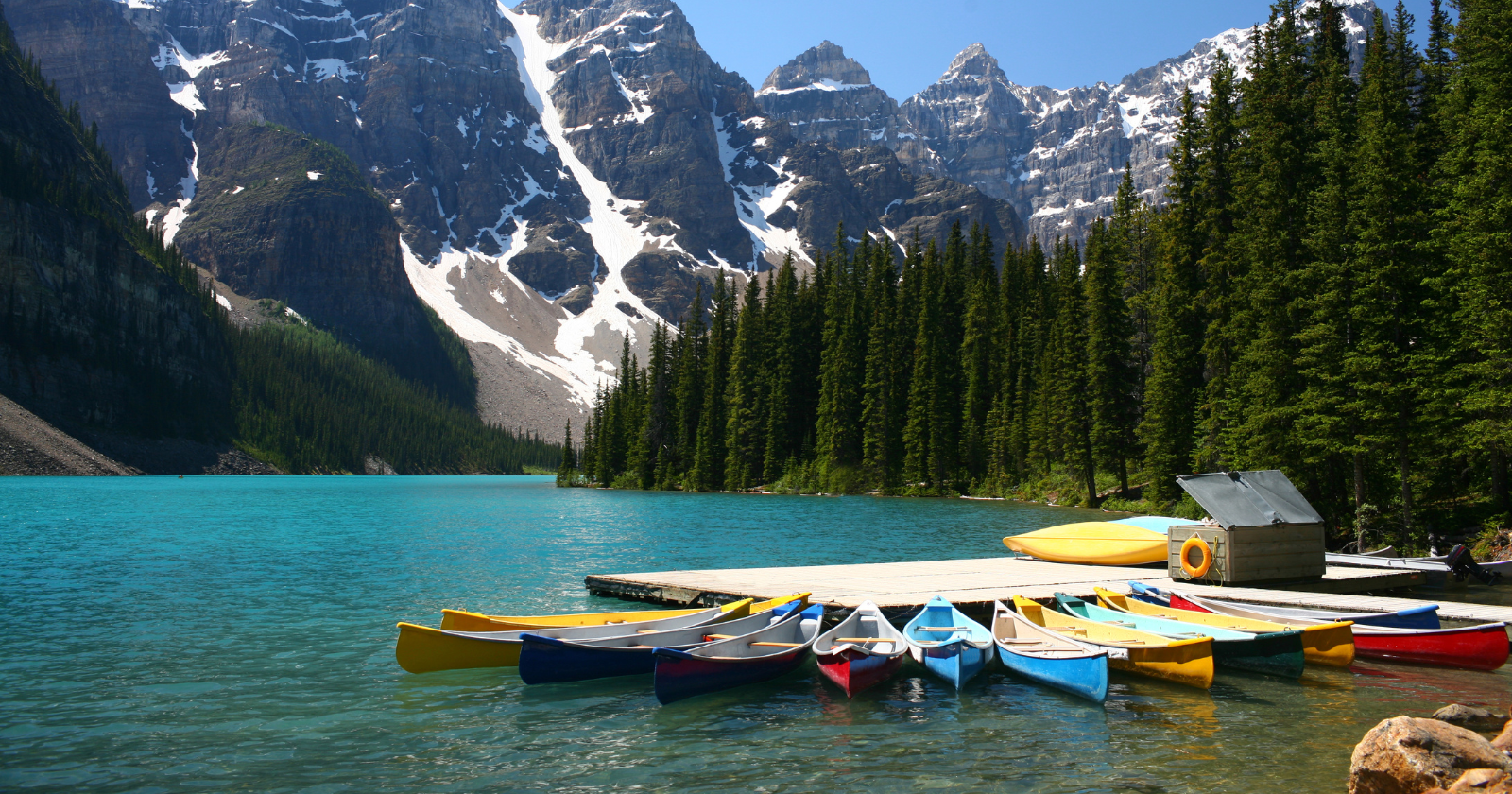
There is something difficult to grasp about the number of lakes in Canada. A few thousand would already seem excessive. Tens of thousands would be hard to picture. Canada has more than two million by federal estimates, scattered across a landscape shaped by ice.
The number is so large that it almost stops meaning anything. You could visit a different Canadian lake every day for an entire lifetime and still see only a small fraction of them. On a map they appear as blue flecks, crowded together across the north, but each one is a real body of water with its own shoreline, islands, depths and surrounding ecosystem.
What does “60 per cent of the world’s lakes” mean?
The often repeated claim that Canada holds around 60 per cent of the world’s lakes needs some qualification. There is no universally agreed count of every lake on Earth, because the result depends on what size of body is included and how lakes are distinguished from ponds, reservoirs and seasonal water.
One of the most widely used global databases, HydroLAKES, maps about 1.4 million lakes and reservoirs with a surface area of at least ten hectares. According to research describing the database, roughly 62 per cent of those water bodies are in Canada.
That does not mean Canada contains 62 per cent of the world’s freshwater. It means that nearly two-thirds of the lakes included in that particular global dataset lie inside Canada. The country nevertheless holds an enormous amount of water, and fresh water covers about eight per cent of its surface area.
What the ice left behind
The explanation lies largely in the Ice Ages. During repeated periods of glaciation, much of Canada was covered by continental ice sheets several kilometres thick. These were not static blocks of ice. They moved slowly across the land, grinding against the bedrock beneath them.
As the glaciers advanced and retreated, they scraped away soil and rock, deepened existing valleys and gouged countless depressions into the surface. When the climate warmed and the ice melted, water collected in those hollows.
The glaciers also carried enormous quantities of stone, sand and clay. As they withdrew, they left behind ridges and irregular piles of debris that blocked rivers and trapped meltwater. Some lakes formed in basins carved directly into rock. Others developed behind natural dams of glacial sediment.
This process happened across an immense area. The Canadian Shield, which stretches around Hudson Bay and across much of central and eastern Canada, is particularly full of exposed rock, shallow soil and water-filled depressions. From the air, much of the region looks less like solid land dotted with lakes than a broken mixture of rock, forest and water.
A landscape made of water
Some Canadian lakes are among the largest in the world. The Great Bear Lake and Great Slave Lake dominate the Northwest Territories, while parts of four of the five Great Lakes lie within Canada. But the extraordinary total comes mainly from the vast number of smaller lakes scattered across the country.
Many are remote enough to have no roads, settlements or permanent names. Some can be reached only by aircraft, canoe or long journeys through forest and tundra. Others sit within sight of towns and cities, forming part of ordinary Canadian life through fishing, swimming, transport, tourism and hydroelectric power.
The abundance of lakes also creates problems. Water may appear limitless, but it is unevenly distributed, often far from the country’s largest population centres. Pollution, warming temperatures, invasive species and changing rainfall patterns can still damage individual lakes, no matter how much water exists elsewhere.
Closing thoughts
Standing beside one cold lake in the Canadian bush, there would be no way to sense that it was one of more than two million. That is the odd thing about scale. From the shore, the lake is simply a place: water against rock, trees reflected on the surface, perhaps an island in the distance. Only from the level of a map or a database does it become part of something almost impossible to imagine.