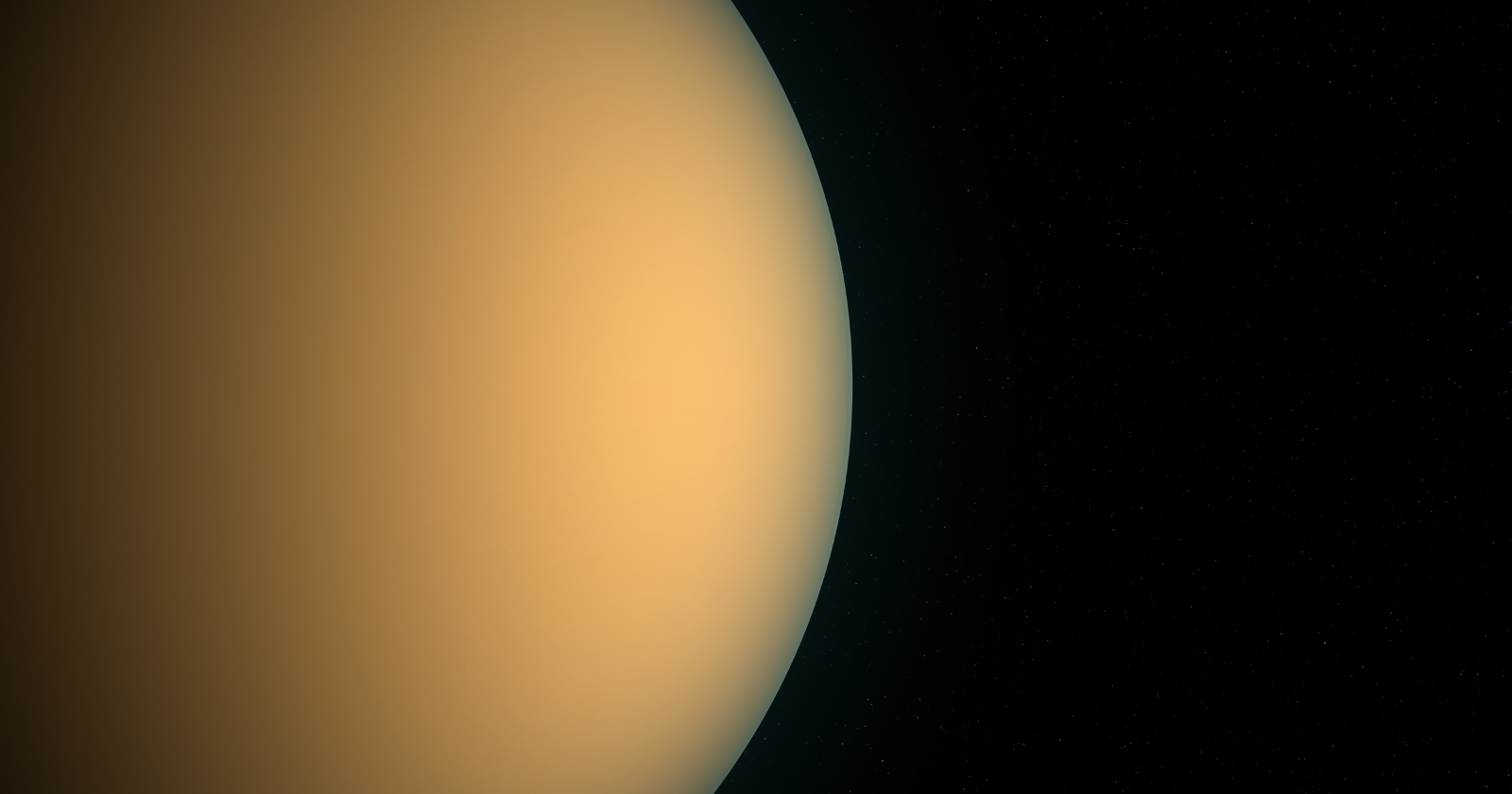
Imagine standing on two spots on the same world. On one, a giant planet fills a good slice of the sky and barely moves. Walk to the far side, and it’s gone. Not setting, not hidden behind cloud, just permanently below the horizon.
That is the situation on Titan, Saturn’s largest moon. And it comes down to something as unglamorous as the length of a day.
The math of a very slow day
Titan takes a long time to circle Saturn. NASA lists the orbit at 15 days and 22 hours. Titan’s spin matches that orbit almost exactly. A 2007 analysis by Benoît Noyelles and colleagues reported the rotation period at 15.9458 days, against an orbital period of 15.945421 days, confirming that the two are synchronized within the measurement uncertainty.
When a moon’s rotation period and orbital period come out the same length, the picture is easy to follow. The moon turns exactly once for every lap around its planet. Broadly, one half stays pointed inward and the other stays pointed away. That roughly sixteen-day turn is the engine behind everything odd about Titan’s sky.
What tidal locking actually does to a world
The name for this is tidal locking, and it’s the same effect that keeps our own Moon showing Earth a single face. Over long stretches of time, the gravity of the bigger body pulls harder on the near side of the moon than the far side. The resulting tidal distortion dissipates rotational energy, gradually bringing the spin into step with the orbit until the system settles into a stable arrangement.
Titan did not stop turning. It turns at just the right average rate to keep one face aimed at Saturn. And this is not a rare accident. As Noyelles and colleagues note, this kind of spin-orbit match is very common in the solar system. Many of the solar system’s large moons are tidally locked to their planets.
There is one wrinkle. Titan’s orbit is not a perfect circle; it is slightly stretched, with an eccentricity of about 0.0289. Because the moon speeds up and slows down as it moves closer to and farther from Saturn, its nearly steady spin slips slightly out of step with its changing orbital pace. This apparent rocking, combined with smaller physical librations, means Saturn does not sit at one perfectly frozen point in Titan’s sky. It traces a small arc.
Two hemispheres, two completely different skies
Stand across most of Titan’s Saturn-facing hemisphere, and the planet stays above the horizon, drifting only within that small wobble. It never rises and never sets. Cross well into the far hemisphere and you would never see Saturn at all under Titan’s present locked rotation. The bulk of Titan itself blocks the view.
The boundary is not perfectly sharp. Near the dividing line between the two hemispheres, libration can make Saturn edge briefly above and below the horizon. But away from that narrow border, two observers on the same world would live beneath fundamentally different skies.
That being said, neither observer would have an easy time actually seeing Saturn from the surface. Titan’s thick orange haze obscures the sky.
Why any of this matters beyond the curiosity
The rate at which Titan turns turned out to be more than trivia. When Cassini’s radar tracked surface features over repeated flybys, the team found landmarks displaced from their expected positions. Ralph Lorenz, who led the study, put it plainly: “Now we see changes in the way Titan rotates, giving us a window into Titan’s interior beneath the surface.”
A separate clue came from gravity. By measuring how Saturn’s pull deformed Titan over its orbit, Luciano Iess and colleagues found that the moon flexed far more than a fully rigid body should. Iess described “a highly deformable layer inside Titan, very likely water, able to distort Titan’s surface by more than 10 metres.” In 2012 he said Cassini’s detection of large tides led to “the almost inescapable conclusion that there is a hidden ocean at depth.”
However the ocean is not something to treat as settled fact. A 2025 reanalysis in Nature argued that Titan’s strong tidal dissipation is incompatible with a global subsurface ocean and proposed a warm, deformable layer of high-pressure ice, possibly containing pockets of melt, instead. The same Cassini measurements now support competing interior models. The question remains open.
What is not open is the basic geometry of the sky, and that carries a wider point. Tidal locking is not just a Saturn curiosity. It is expected for many planets orbiting close to small, cool red dwarf stars, and red dwarfs make up about three-quarters of the stars in our galaxy. If many of their planets are locked, then worlds with one hemisphere beneath a nearly fixed sun and the other in permanent night may be common, making our own continually changing sky the stranger arrangement.