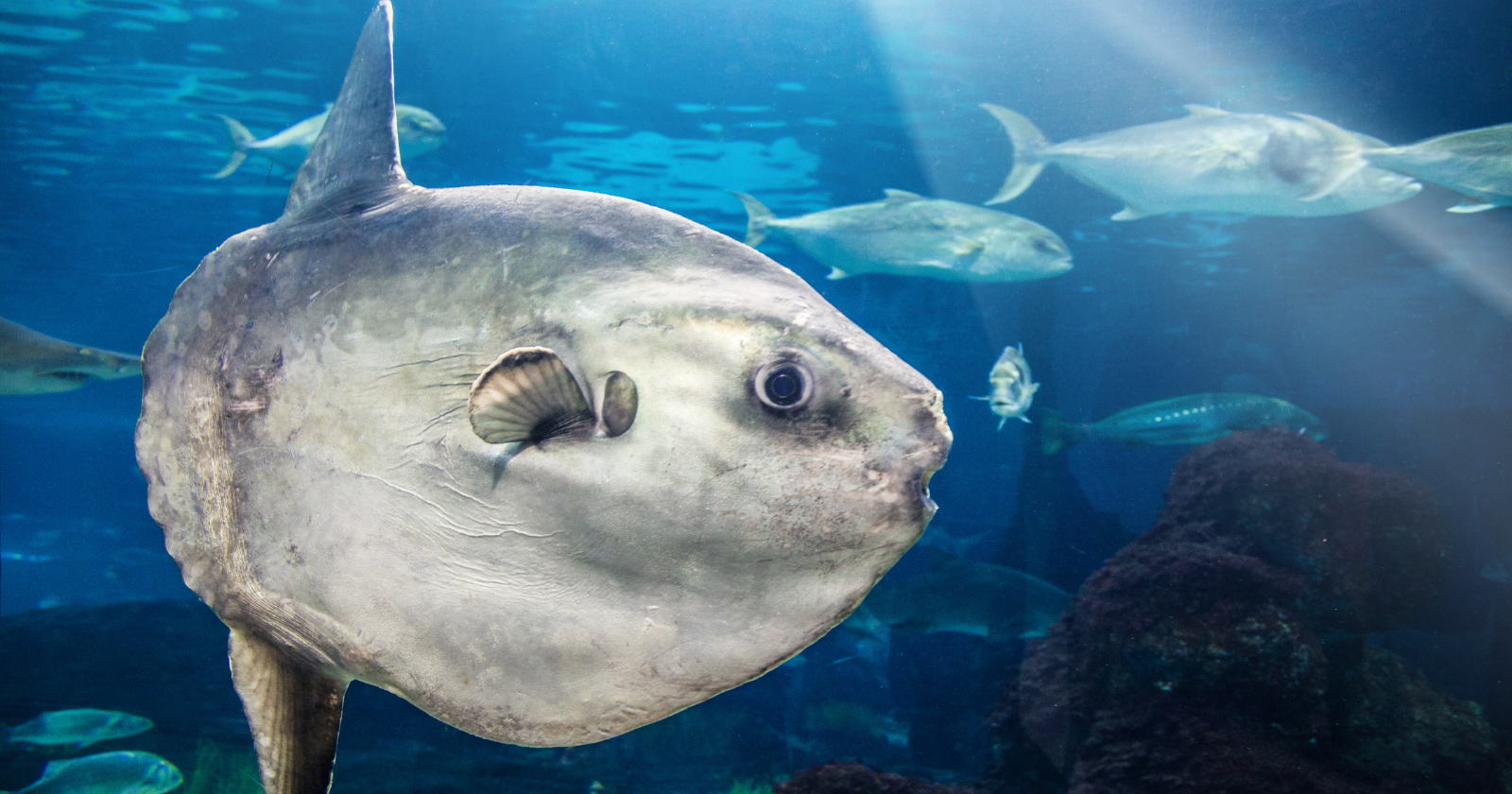
The ocean sunfish is, on almost any measurable criterion, one of the strangest vertebrates alive. It is the heaviest bony fish in the world, capable of reaching two and a half metric tonnes. It has no tail. Its body is essentially a giant swimming head, with two vertical fins sticking out top and bottom and a flat rear edge that scientists call a clavus. Its skin can be more than seven centimetres thick in places. It eats almost nothing but jellyfish, salps, and other soft gelatinous drifters, which contain so little nutritional value that the fish has to consume enormous quantities just to stay alive. Female sunfish produce, in a single spawning event, approximately 300 million eggs, a figure believed to be the highest single-event fecundity of any vertebrate that has ever been measured.
And then, as if all of that were not enough, the sunfish carries the largest confirmed parasite load of any fish on Earth.
According to a 2018 global checklist of the parasites of Mola mola published in Pubvet by de Figueiredo, Lima, Freitas and Silva, drawing together published parasite records for the species from across five phyla and five continents, the ocean sunfish has been documented, across the accumulated records of a century and a half of ichthyological research, as host to more than fifty distinct species of parasite. Some estimates place the figure closer to seventy. The parasites themselves cover almost every anatomical location the sunfish has to offer. Cestodes, or tapeworms, in the intestines. Digenean flukes in the liver and blood vessels. Nematodes in the muscle tissue. Copepods and isopods dug into the skin. Sea lice on the gills. Larval shark tapeworms lodged in the internal organs. Even parasites, on some of the surviving records, that turn out on close examination to be carrying their own hyperparasites, which is a phrase most people never encounter in ordinary conversation and would probably prefer to keep that way.
One example is worth pausing on because it is quietly horrifying. The copepod called Pennella, which is roughly the size and shape of a pale worm, does not merely sit on the sunfish’s surface. It burrows its head into the flesh of the fish, buries itself several centimetres deep, and lives with its body permanently anchored inside the sunfish while its reproductive tract, which resembles a long thin string of eggs, dangles outward into the surrounding seawater. The image, once you have it, is difficult to shake. A creature the size of a small car drifting slowly through the open ocean, its two-and-a-half tonnes of pale flesh studded here and there with the trailing bodies of parasites that have set up permanent residence inside it, spawning openly through the water column that its host is trying to swim through. This is, on the surviving zoological record, an ordinary day for an ocean sunfish.
What the fish does about it turns out to be the interesting part.
The strategy has three main components, and none of them are what most readers would guess. The first is that the sunfish makes deliberate visits to what marine biologists call cleaning stations. These are locations, usually on reefs or around large kelp fields, where small fish of certain species specialise in eating the parasites off larger fish. Cleaner wrasses are the most well-known, but bannerfish, butterflyfish, and various angelfish also perform the service. The sunfish, which is a strong swimmer despite its comical appearance and can dive to depths of more than six hundred metres, will surface after feeding at depth and travel to a known cleaning station, where it hangs motionless in the water column while a swarm of much smaller fish approach it and begin, with tiny concentrated bites, to remove the parasites from its skin, its gills, and the exposed surfaces of its eyes and mouth. This is not a passive event on either side. The sunfish tilts and turns to present different parts of its body. The cleaner fish work in coordinated groups, moving over the enormous surface in patterns that resemble a specialised grooming operation more than any obvious feeding behaviour. On close video observation, the cleaner fish appear to be aware of what parts of the sunfish they are allowed to touch and what parts they are not.
The second strategy is the one that gave the ocean sunfish its English common name in the first place. On sunny days in temperate and tropical waters, sunfish rise to the ocean surface, tilt themselves onto their side, and float there, exposing one enormous flat surface of their body to the air. The behaviour was originally interpreted, going back to nineteenth-century naturalists, as basking for warmth after cold-water dives, and that interpretation is likely part of the story. But according to a 2012 observational paper by Kayoko Abe and Kotaro Sekiguchi published in Communicative and Integrative Biology, based on direct photographic documentation of a school of 57 ocean sunfish in the pelagic waters of the North Pacific Ocean, another purpose of surface basking has now been confirmed. Seabirds arrive.
Specifically, gulls arrive. Albatrosses arrive. In the Abe and Sekiguchi photographs, a Laysan albatross was documented landing near a basking sunfish, walking across the exposed flank of the fish, selecting a large Pennella copepod that had embedded itself near the dorsal fin, and pulling it, with visible effort, out of the sunfish’s flesh. The bird then ate the copepod. The sunfish, on the observational record, did not flinch. It appeared to have positioned itself on the surface precisely so that this could happen. Repeated observations of scarring patterns on other sunfish suggest that the same procedure occurs many hundreds of thousands of times a day across the world’s oceans. The sunfish surfaces, presents its side to the sky, and waits for a bird to arrive, walk on it, and pull the deeper parasites out of its skin with a beak.
The third cleaning strategy is the most physical, and the one that most looks like the fish has finally lost its temper with the situation. Ocean sunfish breach. That is, they swim to the surface, accelerate upward, and hurl their entire two-and-a-half-tonne body out of the water, clearing the surface by three body lengths or more, before crashing back down with an impact that has been recorded at close range by surprised sailors and photographers for centuries. The breach was long assumed to be some kind of display behaviour or communication signal. Current thinking, on the accumulated observational evidence, is that a substantial fraction of these breaches are attempts to dislodge parasites the cleaner fish and the seabirds have not been able to reach, or that are lodged too deeply for either. The impact of the fish’s flat body against the water surface, at the speeds required to clear a jump like that, is high enough to physically shear parasites off the skin. Some sunfish have been observed breaching repeatedly, in sequence, as if working through a checklist of deep-set copepods.
Between the three strategies, an ordinary ocean sunfish spends a considerable proportion of its daily life managing what is, in effect, a moving ecosystem attached to its own body. Cleaner fish for the small stuff. Seabirds for the larger, deeper-set copepods. Repeated breaching for anything that resists both.
What the whole arrangement reveals, on the strongest current reading of the marine biological literature, is that the ocean sunfish is not, as its bizarre appearance and lazy surface behaviour has suggested for most of the last three centuries, a strange evolutionary dead end. It is a remarkably successful animal that has evolved a specific set of behavioural strategies to solve a problem most other large fish do not have on anything approaching the same scale. The problem is that if you are enormous, slow-moving, and covered in seven centimetres of thick collagenous skin drifting through open ocean water full of drifting parasitic larvae, you are, from a parasite’s point of view, an ideal habitat. Almost anything that can attach to a large moving surface has, over evolutionary time, tried. And the sunfish, over the same evolutionary time, has responded not by developing a specialised immune system or a specialised skin defence, but by outsourcing the job. To the cleaner fish. To the seabirds. To the atmospheric distance between its body and the water surface when it launches itself into the air.
The ocean sunfish, on the accumulated evidence, is not really one animal. It is a slow-moving mutual aid arrangement between one very large fish, forty to seventy species of parasite, a dozen species of cleaner fish, and several species of open-ocean seabird, all of whom have arrived at a working agreement about who eats what and who cleans whom. The sunfish is the largest and most visible member of the arrangement. It is also, on the surviving observational record, the one that has quietly organised the whole thing.
Kiran Athar is not a biologist or a marine scientist. She writes about biology, natural history, and the everyday corners of life where the two intersect, drawing on peer-reviewed research and primary-source scholarship.