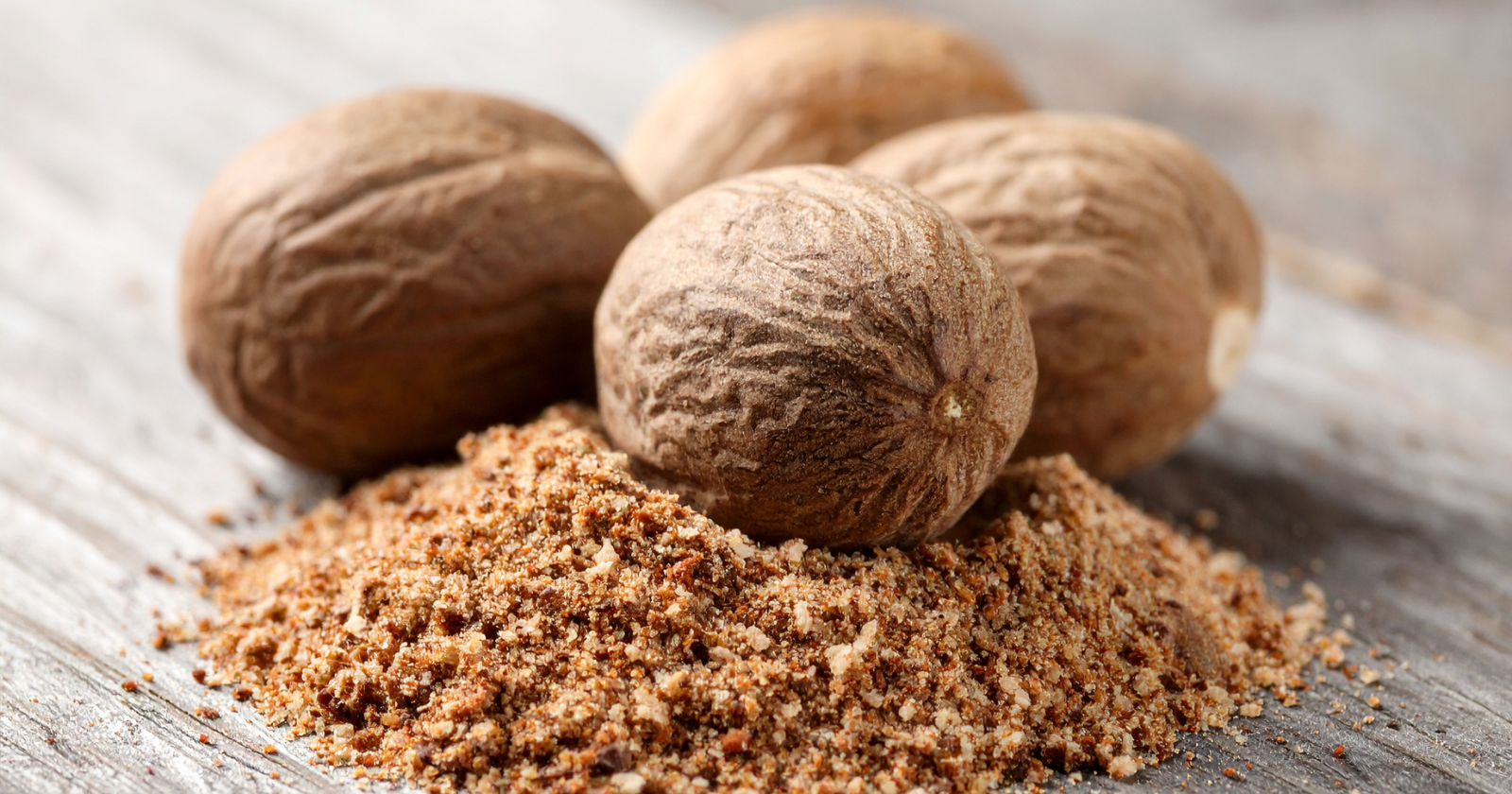
For most of the seventeenth century, every nutmeg on earth came from a handful of volcanic islands you could sail past in an afternoon.
The tree is Myristica fragrans. Kew’s Plants of the World Online gives its native range as Maluku, and specifically the Banda Islands: a cluster in eastern Indonesia that UNESCO’s tentative World Heritage listing describes as eleven small volcanic islands with a combined land area of roughly 8,150 hectares. That was the entire global supply. And the scramble to control it is the reason New Amsterdam is now called New York.
Why a seed was worth a war
Nutmeg reached Europe through a long chain of Asian and Mediterranean intermediaries, and for centuries its buyers had only vague ideas about where it grew. It was valued as much for its supposed medicinal properties as for its flavour; Kew’s entry still records medicinal and toxic uses alongside culinary ones. Scarcity did the rest. John Keay, in his history of the English East India Company, The Honourable Company, puts the mark-up between a Banda wharf and a European market in the tens of thousands of per cent.
That kind of margin attracts fleets. Portuguese ships reached the islands in 1512, as Britannica’s entry on the Banda Islands records, and the Dutch pushed them out early in the following century. The English held two of the outer islands, Ai and a sliver called Run, where in 1616 the East India Company officer Nathaniel Courthope secured a compact with local leaders accepting James I as their sovereign. Run became, on paper, one of England’s first overseas possessions.
What the treaty actually did
Popular retellings have the Dutch handing over Manhattan to get Run. Breda, signed on 31 July 1667 to end the Second Anglo-Dutch War, worked differently.
It was a uti possidetis settlement: each side kept what it already held, as of a cutoff date of 20 May 1667. England had taken New Netherland in 1664. The Dutch, meanwhile, had controlled Run since 1621, even though England had never formally renounced its claim to the island. Breda mostly confirmed two existing occupations and closed off the unresolved claims sitting on top of them, rather than arranging a swap in the way the legend suggests.
What that tells you is where the two sides thought the value actually was. Neither government was speculating on Manhattan real estate. Both were protecting a commercial position, and by 1667 the Dutch position was the one worth protecting: they had cleared the last foreign flag off the only islands where the tree grew.
What the monopoly cost
None of this rested on trade agreements. In 1621, the VOC governor-general Jan Pieterszoon Coen led a campaign to take the whole archipelago and remove the Bandanese as an obstacle to exclusive supply.
Casualty figures vary by source and should be read with that caution. The most commonly cited estimate holds that, of roughly 15,000 inhabitants, some 14,000 were killed, enslaved or driven to neighbouring islands, though narrower counts of those directly executed run to a few thousand. What is not disputed is the outcome. The archaeologist Amy Jordan, in a University of Washington dissertation on the islands’ colonial plantations, describes what followed as an early experiment in mercantile colonialism: a plantation system established in 1621 and worked by imported enslaved labour, run to keep prices high through exclusive control of supply.
Descendants of Bandanese who escaped to the Kei Islands still speak the language of an archipelago where it is no longer spoken.
How a monopoly ends
Biology, in the end, was harder to police than shipping. The VOC restricted planting, destroyed trees on islands it could not garrison, and limed exported seed to stop it germinating elsewhere. It worked for about a century.
Then the French botanist and colonial administrator Pierre Poivre got into the trade. Britannica’s account of his career credits him with smuggling more than 3,000 nutmeg plants and other spice stock out through Timor to Mauritius and Réunion, where the French were assembling their own plantations. The British worked the problem from several directions at once. The East India Company had been seeding nutmeg at Penang since 1796. British forces also captured the Banda Islands outright in 1810, only to hand administration back to the Dutch under the Anglo-Dutch Treaty of 1814, once the disruption of Napoleon’s return from exile in 1815 had cleared and an expedition could finally sail to reclaim the islands. Stamford Raffles planted Singapore’s first nutmeg trees in 1819, on the slopes of what is now Fort Canning Hill. By the 1820s, the tree was growing across colonial networks that had nothing to do with Banda.
Grenada came to the trade later still. A crop profile published by the UN Food and Agriculture Organization traces the island’s first plantings to 1843, with seed brought directly from Banda, and dates proper commercial cultivation to the 1850s. Grenada now puts a nutmeg on its national flag.
Banda still grows nutmeg and mace, on a much smaller scale, for a market where the spice costs a few dollars a jar. The islands were nominated for World Heritage listing in 2015 and remain on Indonesia’s tentative list, which is where the file has sat for over a decade. Whether the plantation landscape gets inscribed, and how the 1621 campaign is described if it does, is the next thing worth watching here.