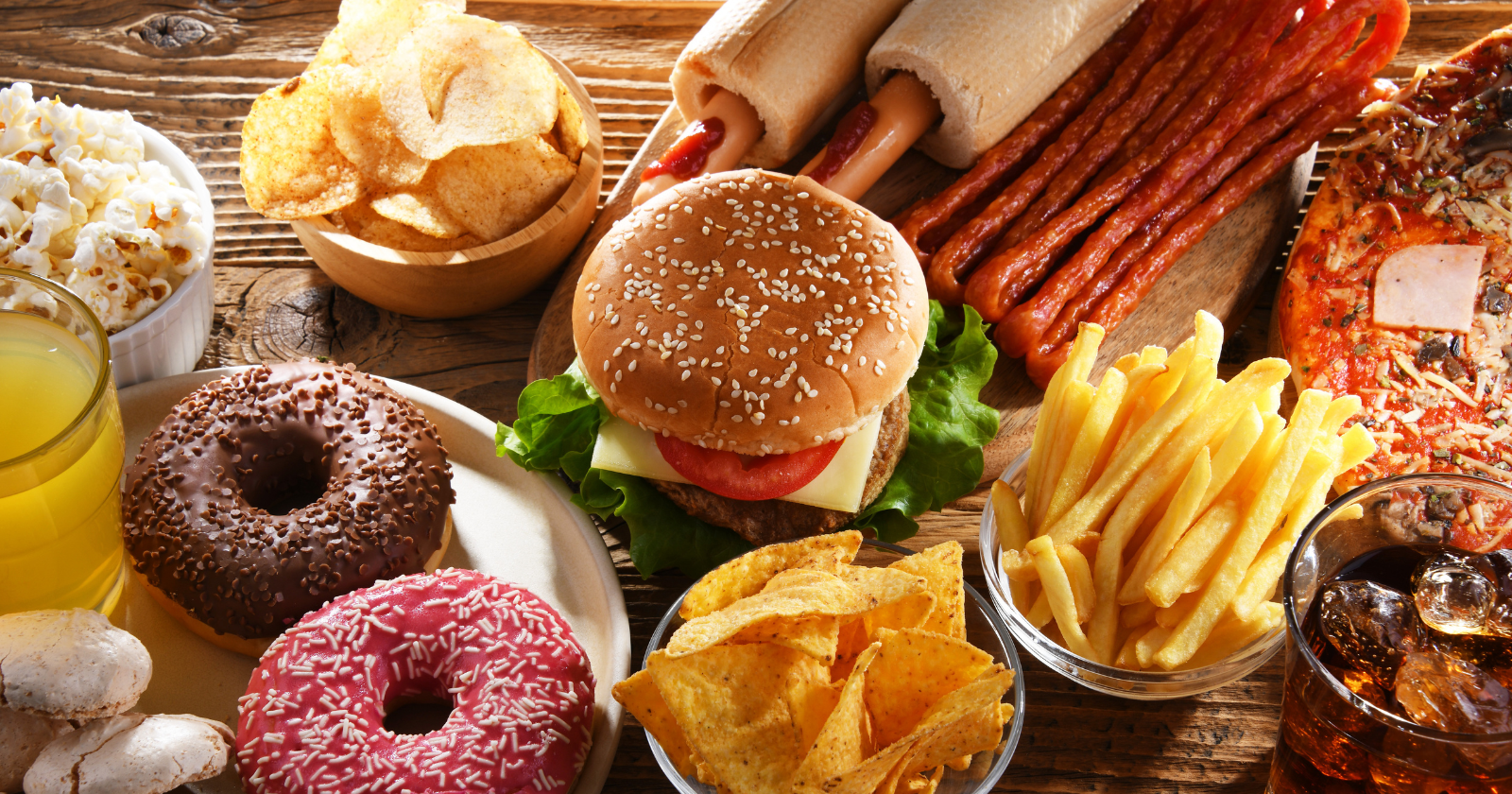
Twenty people spent a month living on a research ward at the National Institutes of Health, eating as much or as little as they liked from trays that had been worked out to the gram.
For two weeks they ate ultra-processed meals. For two weeks they ate unprocessed ones. Both menus were matched for the calories put in front of them, for energy density, and for protein, fat, carbohydrate, sugar, salt and fibre. On the ultra-processed fortnight, participants ate about 508 calories a day more, and they gained roughly 0.9 kilograms. On the unprocessed fortnight they lost about the same. That is the core result of the inpatient trial led by Kevin Hall, published in Cell Metabolism in 2019.
What the trial actually held constant
The design is what makes this study worth sitting with. Nobody was told to lose weight, count anything, or resist anything. Meals plus snacks were provided at roughly twice each person’s estimated maintenance needs, and the instruction was simply to eat to comfort. Because the two menus were nutritionally matched on paper, the extra 508 calories a day cannot be explained by the ultra-processed food being sweeter, saltier, fattier or denser in the way those things are usually measured.
This is one study, not settled consensus. Twenty volunteers, mean age 31, mean body mass index 27, four weeks in a metabolic ward: a small, young, closely monitored sample living in conditions nobody actually lives in.
What it does well is remove the usual excuses. In a supermarket, a person choosing crisps over lentils is choosing convenience, price, habit and taste all at once. Here, price and convenience were held flat and taste ratings came out much the same across both diets. The eating still diverged.
Why willpower is the wrong frame for this result
The paper offers a mundane candidate: people got through the ultra-processed meals faster. Softer, more calorie-dense-per-mouthful food goes down at a higher rate, and the body’s fullness signals arrive on a delay. Eat quickly enough and you have finished the plate before the feedback lands.
This is a plausible explanation, not a demonstrated mechanism, and the paper treats it that way rather than asserting it. What the trial measured was intake and weight, not appetite hormones or reward circuitry. Describing this study as proof of a hijacked brain overstates what twenty people eating breakfast in a research ward can show.
What it does support is narrower. Two people eating until they feel satisfied, putting in equal effort and equal restraint, can still end up five hundred calories apart, purely because of how the food in front of them was built.
What the study does not show
Four weeks is four weeks. The trial cannot say whether the gap persists over a year, whether people adapt, or which specific feature of processing is doing the work. Ultra-processed is a category built around industrial formulation and additives, and it lumps a soft white loaf in with a protein bar and a fizzy drink.
The vagueness matters, and later work has pressed on it. In the UPDATE trial, published in Nature Medicine in August 2025, Samuel Dicken and colleagues at University College London fed people at home for eight weeks on two diets that both met UK dietary guidance, one built from ultra-processed foods and one from minimally processed ones. Participants lost weight on both. They lost about twice as much on the minimally processed diet, but the ultra-processed arm did not produce the weight gain the researchers had expected. The trial has also drawn published methodological criticism in the same journal over its crossover design.
Taken together, the two trials point towards a narrower conclusion than either has been credited with. Processing appears to shift how much people eat, but the UPDATE result shows that composition still matters inside that effect, not instead of it.
The part that is structural rather than personal
One number in the 2019 paper tends to get skipped. Ingredients for the ultra-processed menu cost about $106 a week for 2,000 calories a day. The unprocessed menu cost about $151. The cheaper diet was the one that produced the extra intake, before anyone factors in time, kitchen equipment or the labour of cooking twice a day.
Set that against how Americans actually eat. In the National Center for Health Statistics data brief published in August 2025, ultra-processed foods accounted for 55 percent of total calories across ages one and up, 53 percent among adults and 61.9 percent among young people aged one to eighteen. Sandwiches and burgers, sweet bakery products, savoury snacks and sweetened drinks were among the top contributors. Adult intake was lowest in the highest income group.
None of that is a story about individual discipline.
What is reasonable to conclude
The findings deserve to be taken seriously, not treated as the final word. A four-week ward study and an eight-week home-feeding trial, both small and both contested at the margins, point in the same direction without settling the mechanism.
Anyone weighing an actual change to how they eat, particularly alongside a health condition or a medication, will get more from a GP or an accredited dietitian than from any article about a study, including this one.
What stays with us is the ordinariness of the effect. The volunteers were not tempted, tested, or asked to hold a line. They ate lunch, felt fine, and were half a thousand calories ahead by evening without noticing.