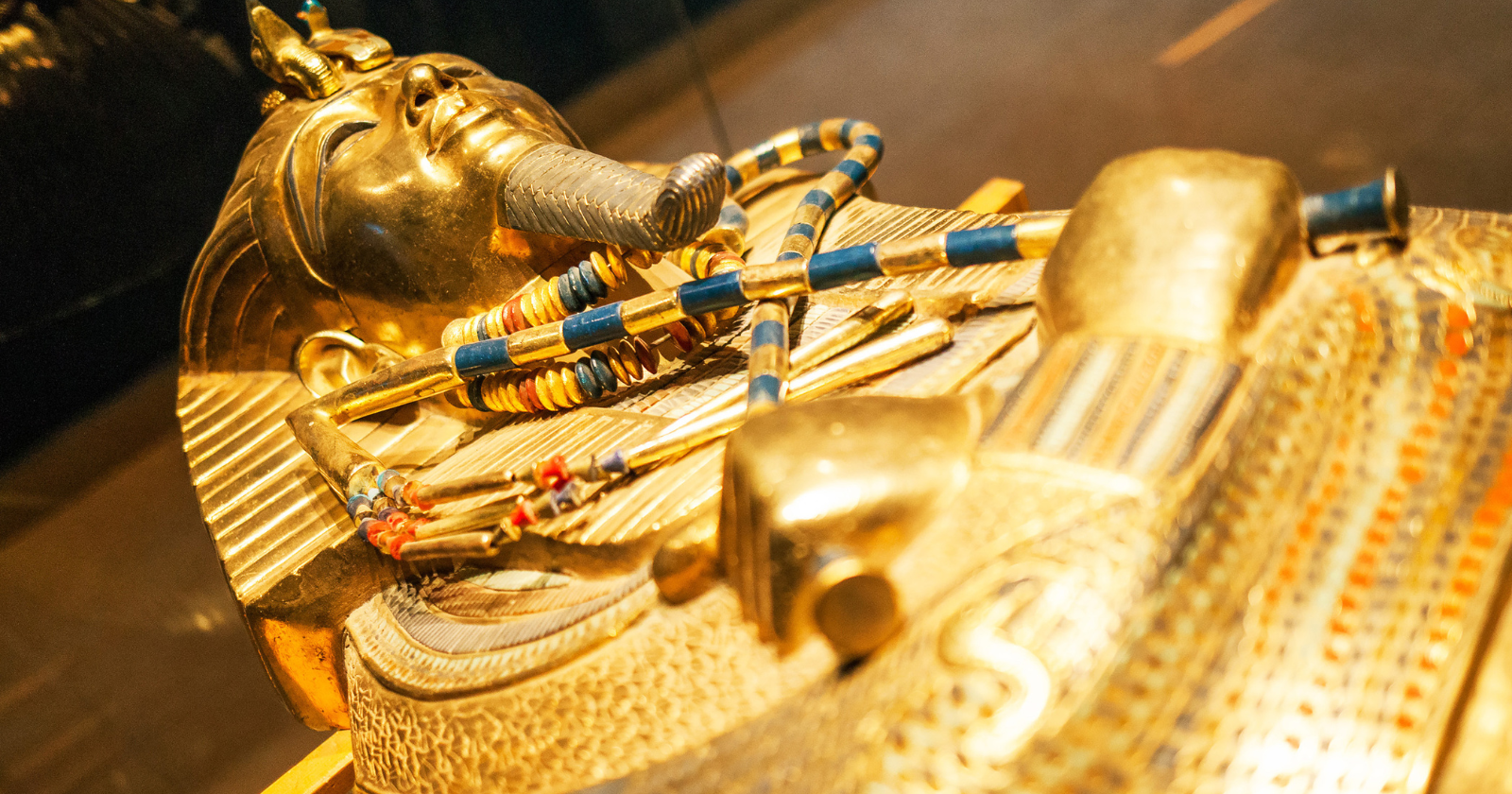
Two daggers were folded into the linen around Tutankhamun’s body when the mummy was unwrapped in 1925. One had a gold blade. The other was iron, a metal that in fourteenth-century BCE Egypt was rarer and more valuable than gold, and which had still not rusted after more than three thousand years in a tomb.
The iron blade lay against the king’s right thigh. It measures 34.2 centimetres, with a gold hilt, rock crystal pommel and decorated gold sheath. For most of the twentieth century its metal was debated rather than measured, and the attempted analyses disagreed with each other.
What the composition actually shows
The measurement that settled the basic question came in 2016, when a team led by Daniela Comelli of the Politecnico di Milano, working with the Egyptian Museum in Cairo, took a portable X-ray fluorescence spectrometer to the blade and published the results in Meteoritics & Planetary Science. The paper reported iron with 10.8 weight per cent nickel and 0.58 per cent cobalt. Smelted terrestrial iron almost never carries nickel at that level; iron meteorites, formed in the cores of differentiated bodies where nickel followed the molten metal downward, routinely do.
The ratio of nickel to cobalt matters as much as the nickel figure, since it is the ratio that separates meteoritic metal from terrestrial ore, and the blade sits with the meteorites on both counts. A 1994 analysis had concluded the opposite, which the 2016 authors put down to better instrumentation. Thilo Rehren, an archaeometallurgist not involved in the study, told Eos that nobody had seriously doubted the meteoritic origin; the new work simply put it beyond doubt.
Kharga is a compatible composition, not a confirmed source
The 2016 paper is usually reported as having found the meteorite. It did something narrower. The team pulled every iron meteorite in the MetBase database recorded within a 2,000 kilometre radius centred on the Egyptian Red Sea coast, spanning the eastern Sahara to Mesopotamia. That search returned twenty finds. Exactly one, a one-kilogram fine octahedrite named Kharga, found near Mersa Matruh in May 2000, had nickel and cobalt within ten per cent of the blade.
One match against twenty modern finds is suggestive, not conclusive: catalogued meteorites are not necessarily the meteorites available to Bronze Age Egypt, and nothing in the analysis dates when Kharga fell.
The 2022 scan complicates the metallurgy
Six years later a group led by Takafumi Matsui of the Chiba Institute of Technology, working with the conservation centre of the Grand Egyptian Museum, mapped the blade’s surface chemistry in two dimensions rather than sampling spots. Their paper, also in Meteoritics & Planetary Science, put the nickel content at 11.8 plus or minus 0.5 weight per cent and reported a feature the earlier study had missed: discontinuous nickel-rich bands, roughly a millimetre wide, arranged with a cubic symmetry consistent with a Widmanstätten pattern. Sulphur-rich spots on the blade are, in their reading, troilite inclusions from the parent meteorite.
Both features are fragile: heat past about 950 degrees Celsius and the banding dissolves. Their survival implies the blade was shaped by low-temperature forging, a statement about technique, not intention.
This sits awkwardly with the Kharga identification: a fine-structured meteorite, once forged, should leave no visible structure, yet the preserved pattern suggests a coarser parent. The two papers agree the metal fell from the sky and disagree, quietly, about which piece of sky it came from. Neither disagreement has gone unchallenged. Albert Jambon published a formal comment arguing the pattern cannot be resolved by mapping with a 0.9 millimetre step, and that the calcium read as ancient adhesive is more likely 1920s limestone cleaning residue.
The hilt points outside Egypt
Matsui’s team also scanned the gold hilt and found calcium without accompanying sulphur, pointing to lime plaster rather than the gypsum Egyptian workshops used as an adhesive, a material that does not appear in Egyptian practice until the Ptolemaic period, more than a thousand years later.
From there the authors reach for the Amarna letters, clay-tablet diplomatic records of the period, one of which lists gifts sent by Tushratta, king of Mitanni, to Amenhotep III, Tutankhamun’s grandfather. Among them is an iron dagger with a gold hilt. The chemistry does not prove the tablet describes this object, and Jambon’s comment adds a complication: the hilt and blade are separate pieces of metalwork that could have been made in different places, so a confirmed foreign origin for the hilt would say nothing about where the blade was forged. The authors call the Mitanni connection a hint, not a proof, and that is the right weight to give it.
Why sky iron was worth the trouble
The dagger is not an isolated curiosity. Albert Jambon’s 2017 survey in the Journal of Archaeological Science ran the same nickel-cobalt test across the known Bronze Age iron corpus: Gerzeh beads from Egypt (c. 3200 BCE), a dagger from Alaca Höyük, a pendant from Umm el-Marra, an axe from Ugarit, Shang dynasty objects from China, and Tutankhamun’s dagger, bracelet and headrest. Every one of them came out meteoritic. Before smelting spread after roughly 1200 BCE, the sky was the only supply.
Whether the Egyptians understood that is a separate question, and the evidence for it is linguistic rather than chemical. In the 19th dynasty, the one after Tutankhamun’s, a composite hieroglyphic term came into use that translates literally as iron of the sky. Comelli’s team read the timing as evidence that the metal’s origin was recognised by the thirteenth century BCE, an inference from vocabulary, not from any written account of where the iron came from.
The rest of the tomb’s ironwork, including sixteen small blades and a headrest, has never had the same scrutiny as the dagger. Comelli said in 2016 that analysing those objects was the obvious next step. Ten years on, that work is still the open question, and the objects sit in a museum that now has a conservation lab attached to it.