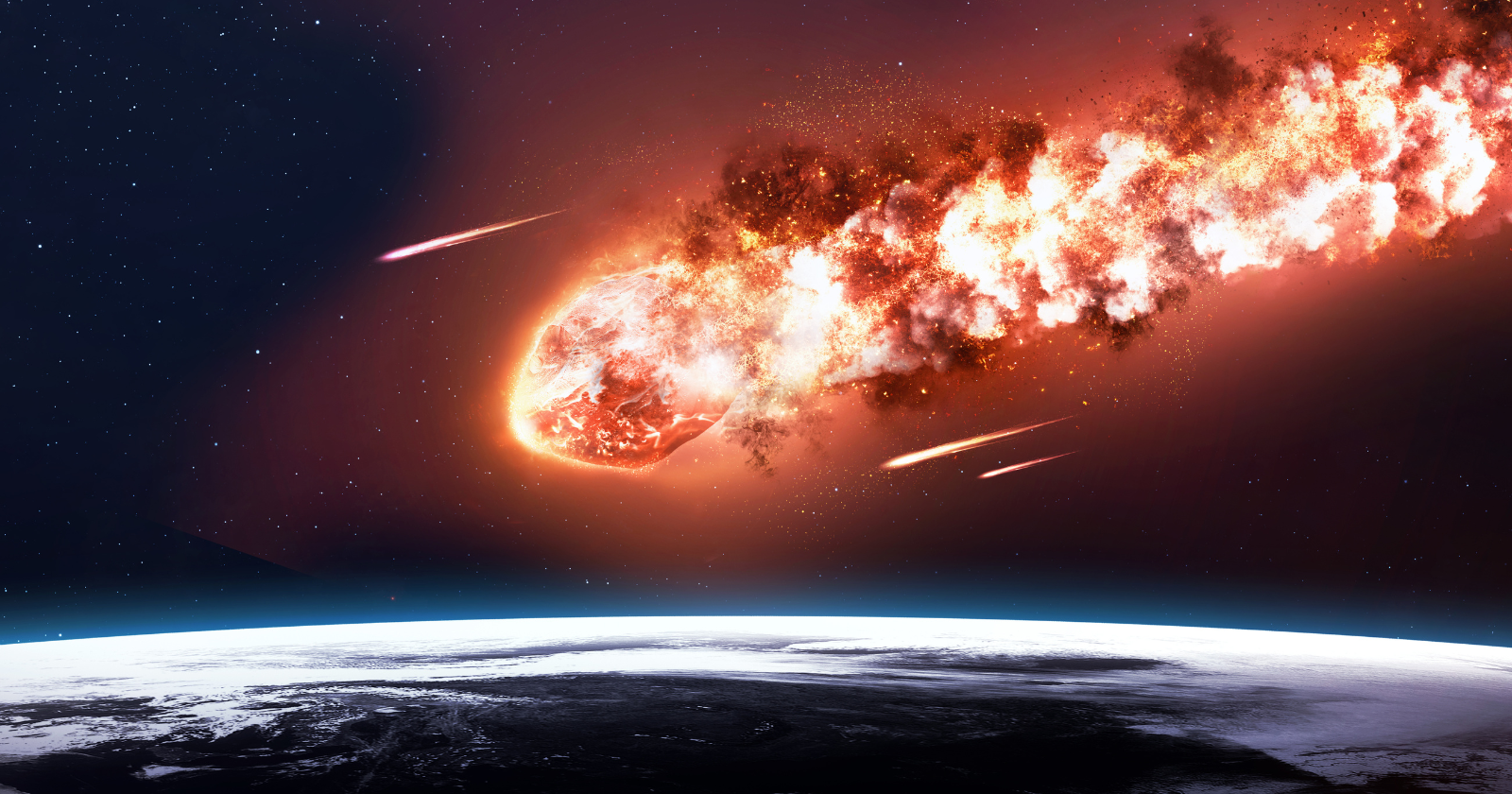
The rock that broke apart over Chelyabinsk on the morning of 15 February 2013 came in from the one part of the sky no telescope on Earth can search.
Blame geometry. Ground-based surveys find asteroids by the sunlight they reflect, so they work at night, looking away from the Sun. Anything approaching from the sunward side is washed out well before it can be catalogued. Two minutes after the flash, the shockwave reached the ground, damaging thousands of buildings and breaking windows across the region.
What actually hit the Urals
By the standards of things that worry planetary defence offices, the object was small. NASA’s Jet Propulsion Laboratory revised its estimates twice in the weeks afterwards, settling on a body of 17 to 20 metres across entering the atmosphere at a shallow angle and releasing close to 500 kilotons of energy. Set against the 15-kiloton yield conventionally assigned to the Hiroshima bomb, that is a figure in the region of thirty of them, released high in the atmosphere rather than at the surface. ESA puts the pre-entry mass at about 13,000 tonnes and the entry speed above 18 kilometres per second, with the main disintegration at an altitude near 30 kilometres.
Around 1,500 people were injured, almost all of them by flying glass. Nobody was killed. That outcome had a great deal to do with the altitude of the airburst and the shallow trajectory, and not much to do with anything anyone on the ground did.
It also produced an unusually rich dataset, because it happened over a city full of dashcams. Two papers in Nature and one in Science reconstructed the event in detail. Jiří Borovička and colleagues recovered the trajectory and orbit from video analysis. A separate PNAS paper traced the dust plume in the stratosphere using Earth-observing satellites.
The number that mattered more than the fireball
In the Nature analysis led by Peter Brown, titled “A 500-kiloton airburst over Chelyabinsk and an enhanced hazard from small impactors”, the authors argued that objects in the tens-of-metres range appear to strike more often than telescopic survey data alone had implied. Most near-Earth asteroids larger than a kilometre are catalogued. Almost none of the ones in Chelyabinsk’s size class are. Brown and co-authors noted that only about 500 objects between 10 and 20 metres had been found at the time, against a population plausibly numbering in the tens of millions.
That shifts where the residual risk sits. Extinction-scale impacts are rare and largely accounted for. The harder category is the object big enough to shatter a city’s glazing and small enough to stay invisible until the moment it arrives. ESA’s head of planetary defence, Richard Moissl, has put the recurrence interval for Chelyabinsk-scale events at every 50 to 100 years.
What early warning looks like now
Detection before impact has happened, and it is getting less unusual. When Krisztián Sárneczky picked up a one-metre object from Konkoly Observatory in Hungary in January 2024, it struck the atmosphere west of Berlin about three hours later. That was, in ESA’s count, the eighth asteroid ever spotted before it hit the atmosphere, and several more followed within the same year.
Every one of those catches was made on the night side, hours out, on objects a metre or two across. They show an alert pipeline that works once something has been seen. Seeing it is the part that has not been solved.
Two telescopes, two stated schedules
Closing the daylight gap requires looking from above the atmosphere, in the infrared, from a vantage point where the Sun can be blocked rather than avoided.
NASA’s NEO Surveyor is the nearer of the two. A 50-centimetre infrared telescope behind a six-metre sunshade, it is in integration and testing, with launch listed as no earlier than September 2027. That date has moved before: earlier planning documents carried 2026, and Caltech’s IPAC still cites a commitment of no later than June 2028. Its congressional mandate concerns objects larger than 140 metres. Bodies the size of the Chelyabinsk rock fall inside its reach but outside its brief.
ESA’s NEOMIR is the one built for this specific problem. Stationed at the Earth-Sun L1 point, it is intended to sweep the region around the Sun and pick up bodies of 20 metres and larger, with a design goal of about three weeks’ notice. Modelling by the mission team, described publicly by ESA’s Luca Conversi, indicates NEOMIR would have picked up the Chelyabinsk object roughly a week before impact. Launch is not imminent: agency and mission material variously give the early to mid 2030s, and the mission has not been through the full adoption and procurement sequence that would make that a firm date.
A week of warning deflects nothing of that size. What it buys is an instruction, and the instruction is mundane. Stay away from the windows.
What to watch is the hardware. NEO Surveyor’s sunshade is being tested against the spacecraft bus at BAE Systems in Boulder, and the integrated telescope and enclosure are due to join it there. Until one of the two instruments is on station, the daylight side of the sky stays as unwatched as it was in February 2013.