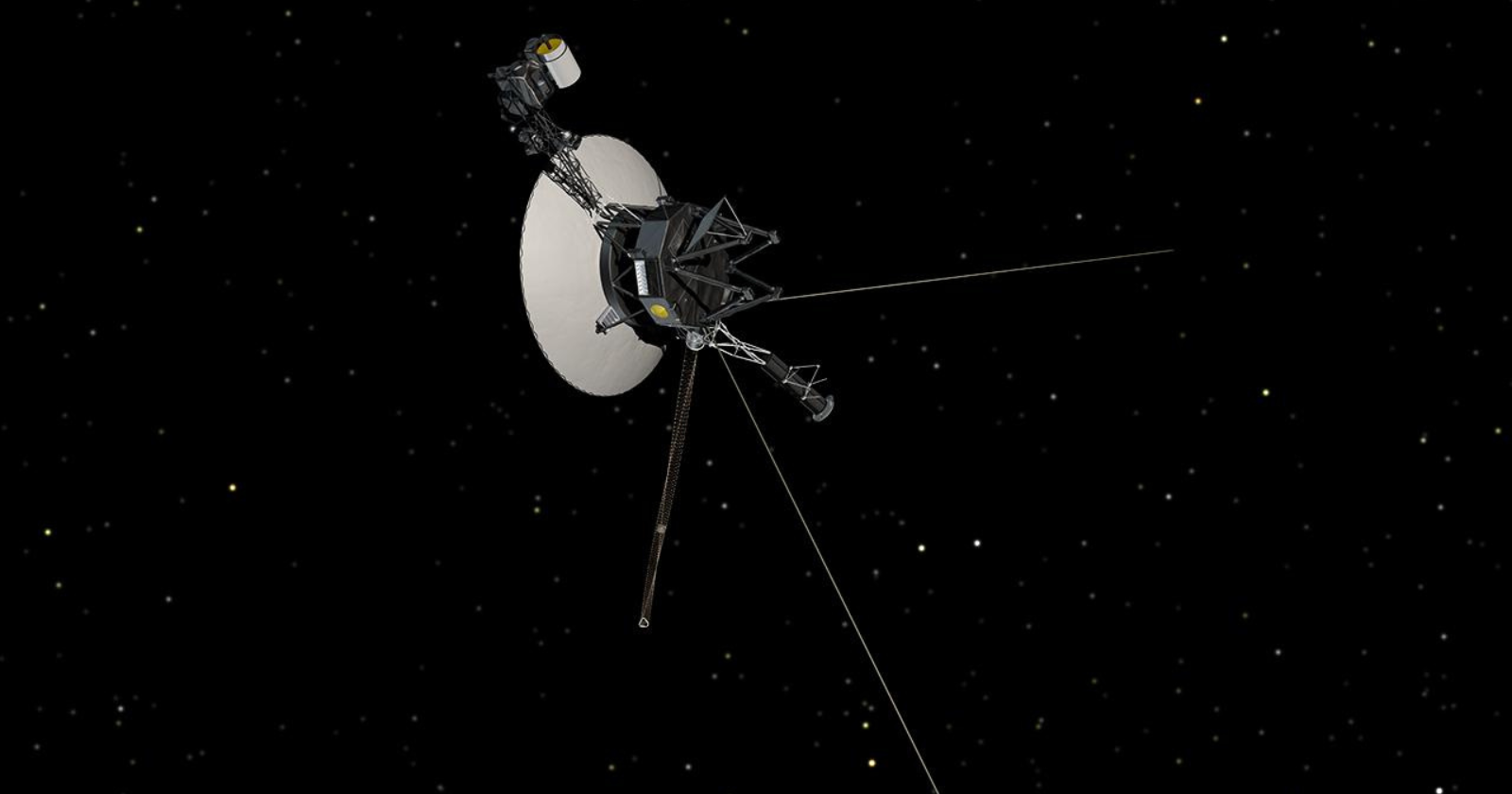
If you pointed Voyager 1 at the nearest star and let it fly at its present speed, you would be waiting more than 73,000 years for it to arrive. That’s not a typo. Tens of thousands of years for one of the fastest spacecraft ever sent outward to reach the closest star to our own.
Just how fast are they, really
According to NASA’s Voyager 1 mission page, the probe was moving at 38,026.79 mph, about 17 kilometres a second relative to the Sun, as of August 2024. That works out to roughly 3.5 astronomical units per year. One astronomical unit is the average distance from Earth to the Sun. Voyager 2 is a little slower, travelling at about 3.1 astronomical units per year.
So Voyager 1 is the faster of the twins, but it does not hold the outright speed record. That belongs to the Parker Solar Probe, which has reached about 430,000 mph while sweeping extremely close to the Sun. Parker gains that speed as it falls deep into the Sun’s gravity, while the Voyagers are steadily heading outward. NASA calls Voyager 1 the most distant human-made object.
So “fast” is fair. The trouble is what fast means once you leave the neighbourhood.
Why that speed still means almost nothing
The nearest star to the Sun, Proxima Centauri, sits about 4.25 light-years away. Light covers that distance in a little over four years. Voyager, moving at only a tiny fraction of light speed, does not. NASA’s Goddard team puts the comparison plainly: “If Voyager were to travel to Proxima Centauri, at this rate, it would take over 73,000 years to arrive.”
That is an illustrative calculation, not a flight plan. It answers a hypothetical: point Voyager 1 directly at the closest star and clock the trip at its current speed. The answer comes back in tens of thousands of years.
Whatever “fast” means across distances on Earth or even between planets, it begins to dissolve against the distances between stars. The Voyagers are not slow. Space is simply that large.
Where the Voyagers are actually headed
Neither probe is aimed at Proxima Centauri. Voyager 1 is travelling north out of the plane of the planets, in the general direction of the constellation Ophiuchus. Voyager 2 is moving south toward Sagittarius and Pavo at about 3.1 astronomical units per year. In about 40,000 years, it is expected to pass within roughly 1.7 light-years of the star Ross 248.
The journey of more than 73,000 years to Proxima Centauri is therefore a thought experiment about a trip neither Voyager is taking. Even the stars they will eventually pass were not chosen as destinations. They are simply the stars that will come relatively close to the probes’ paths as everything continues moving through the galaxy.
The star Voyager 1 will pass, in about 40,000 years
Voyager 1 does have one projected stellar encounter, though “encounter” is generous. NASA estimates that in about 40,000 years it will pass within roughly 1.6 light-years of a red dwarf called Gliese 445, also known as AC+79 3888. That is still more than 100,000 times the distance between Earth and the Sun.
NASA’s Voyager FAQ gives the more specific year 40,272 and a distance of 1.7 light-years, so the figures are best treated as approximate projections rather than a precise appointment. The star currently sits about 17.6 light-years from Earth. The future pass happens because stars are moving as well as spacecraft. By then, Voyager 1 will come within about 1.7 light-years of Gliese 445, and NASA notes that the probe will then be closer to that star than to our own Sun.
However, Voyager 1 will almost certainly have fallen silent long before then. Its radioisotope power supply weakens steadily, and both probes lose about four watts of power each year. NASA engineers are already shutting down heaters and scientific instruments to conserve what remains. Once communication ends, the spacecraft will continue coasting through the galaxy, dark and silent.