Most of us get this wrong about space suits. We think of them as an air supply, and they are that. But much of the engineering goes into a different problem: pressure.
Out in the vacuum of space, or on a thin-air world like Mars, the suit is basically a pressurized bubble holding your body together. Without it, gases would rapidly expand and water in exposed tissues could begin to vaporize. The suit’s main job is not simply to feed you oxygen. It is to keep your body pressurized.
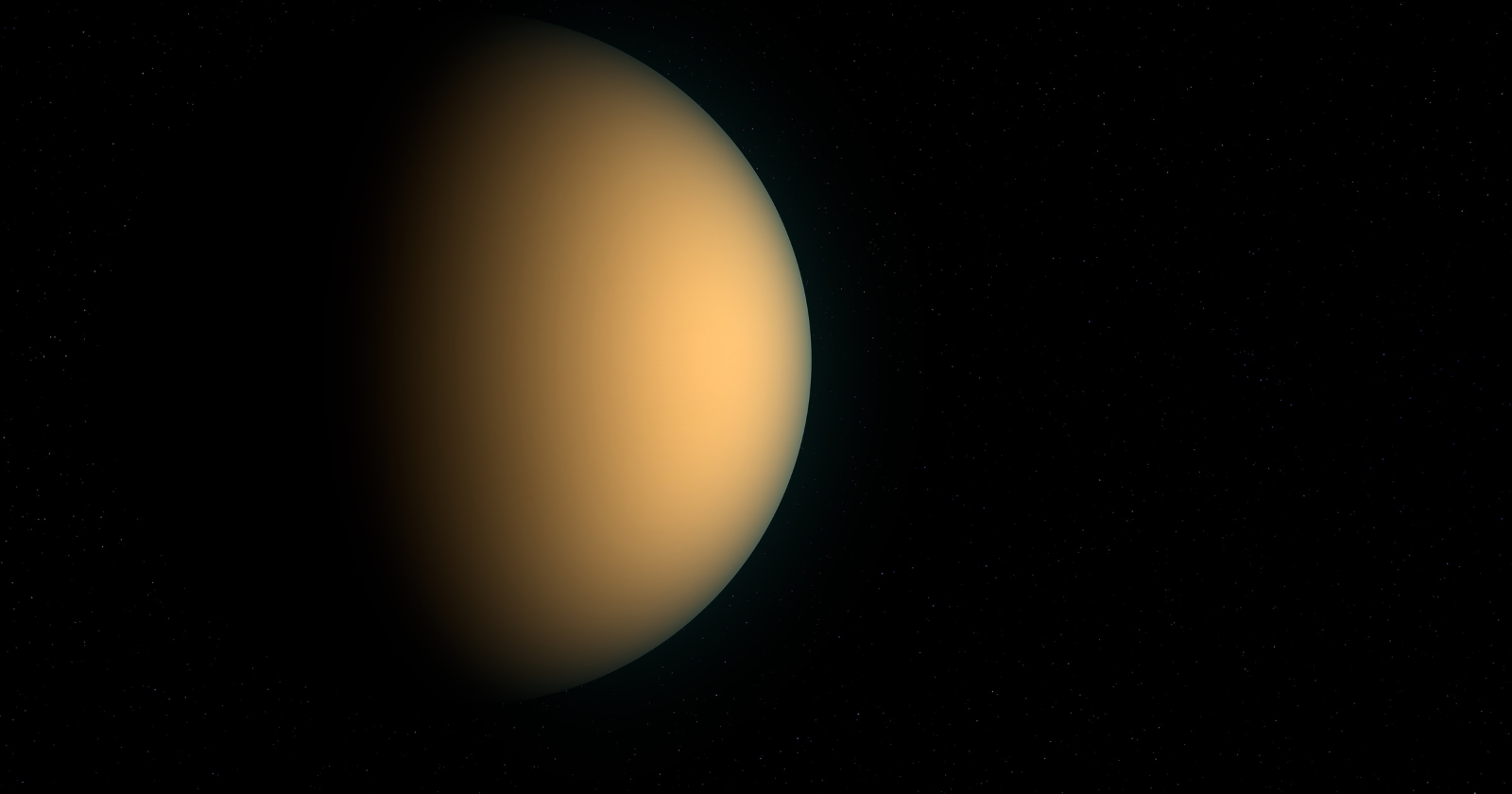
Which is why Titan is such an odd exception. On Saturn’s largest moon, you would not need the pressurized bubble at all.
What Titan’s atmosphere actually does for you
Titan is the only moon in the solar system with a thick atmosphere, and its surface air is denser than our own. At the surface, the air pressure is about 60% higher than on Earth. That one fact is what removes the need for a pressure suit. Your body would not be fighting a vacuum. It would be sitting under a column of air heavier than the one you are under right now.
The image to hold is not an astronaut in a rigid white suit. It is closer to a diver, or a mountaineer dressed for extreme cold, moving through a hazy orange world. The gravity helps the picture too. Titan’s surface gravity is only about 14% of Earth’s, light enough that, as some scientists like to point out, you could strap on wings and flap your way into the air.
What it cannot do: the cold and the oxygen
That is where Titan’s hospitality ends. The air is thick, but it is the wrong stuff at the wrong temperature.
Start with the cold. Titan’s surface sits at around minus 179 degrees Celsius (minus 290 Fahrenheit). So cold that water ice behaves like rock and forms the moon’s bedrock. Antarctica has never come close. Whatever you wore would have to be heated, hard and constantly, or you would not last.
Then the air itself. Titan’s atmosphere is predominantly nitrogen, with methane making up most of the remainder, and it contains essentially no oxygen you could breathe. So what you would leave behind on Titan is the pressurized shell. You would still have to bring your own oxygen. No pressure suit, but heavy protection from the cold and your own air to breathe.
Why Titan keeps drawing our attention
None of that makes Titan a place we would want to live. What makes it interesting is chemistry, not comfort.
That same nitrogen-and-methane air, broken apart by sunlight, recombines into complex carbon-based compounds that drift down and settle on the ground. A whole world running a slow chemistry experiment.
Sarah Hörst, a planetary scientist at Johns Hopkins, won’t pick a single reason it matters. “There isn’t one specific thing about Titan that’s interesting,” she has said. Instead she points to how many familiar Earth-like processes, a weather cycle, erosion, liquid moving across a surface, “are also happening every day on Titan.” The liquid is not water, it is methane and ethane, but the basics of our working world is there.
As NASA astrobiologist Melissa Trainer put it, “We think of Titan as a real-life laboratory where we can see similar chemistry to that of ancient Earth when life was taking hold here.”
Which is why NASA is sending Dragonfly, a nuclear-powered flying craft, to move between sites on the surface. Elizabeth Turtle, the mission’s lead scientist, is careful about what it is and isn’t looking for. “Dragonfly isn’t a mission to detect life,” she has said, “it’s a mission to investigate the chemistry that came before biology here on Earth.” The question is whether the steps that may lead to life happen on a world this different from ours.