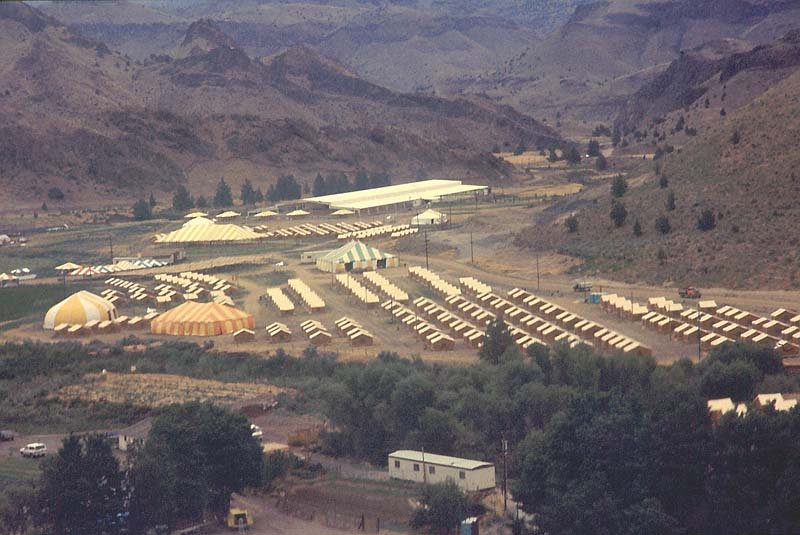
If you drive north from the small town of Antelope, Oregon, and follow the dirt road out into the John Day River basin, you will eventually reach a Christian youth summer camp called Washington Family Ranch. Middle schoolers arrive by bus. They swim in a large man-made lake. They stay in cabins. They pray at the flagpole in the morning and eat in a cafeteria that could easily seat six thousand people.
The cafeteria was not built for middle schoolers. Neither was the airstrip. Neither was the sewage reclamation plant, the dam that holds back the lake, the paved roads that run for miles across the sagebrush, the meditation hall that used to seat ten thousand people at once, or any of the rest of the infrastructure that the camp now uses. All of it was built between 1981 and 1984 by roughly seven thousand followers of an Indian spiritual teacher named Bhagwan Shree Rajneesh, later known as Osho. They arrived at what was then called the Big Muddy Ranch as a group of people in flowing red robes with a vision. Three years later, most of that vision had turned into a set of felony indictments, and the city they built was on its way to becoming what it is now, which is a well-run Christian summer camp with a very unusual set of bones underneath it.
The stranger question, when you actually stand on the site, is not what happened to the city. It is what possessed the people who built it.
What Bhagwan was selling
Rajneesh arrived in the United States in May 1981 on a tourist visa. He had spent the previous decade running an ashram in Pune, India, where he had built a substantial international following on the basis of a spiritual teaching that combined elements of Hindu and Buddhist thought with a specifically Western therapeutic sensibility. His talks, of which he gave many hundreds and later thousands, argued that the standard human life of family, work, and social obligation was a form of unconscious sleep. That the mind was a mechanism for missing the point of being alive. That meditation, sexual freedom, laughter, and total surrender to a living master could snap a person out of the sleep and into something he called awareness.
By 1980 his teaching had drawn a specific kind of Western seeker. Not the fringe cases you might expect. Doctors, lawyers, engineers, teachers, therapists, wealthy heirs, PhDs in philosophy. People with functional lives who had concluded, on reading Rajneesh’s books or listening to his talks on tape, that the functional lives were part of the problem. When he moved to Oregon and began quietly buying land through his American secretary Ma Anand Sheela, thousands of these people quit their jobs, sold their houses, and moved to the Big Muddy Ranch to help build what he called the New Man.
The New Man was, on the promise, a human being who had shed the accumulated conditioning of family, nation, religion, guilt, and shame. Sannyasins wore red or maroon to mark their commitment. They took new Sanskrit names. They gave up their previous identities. They meditated together. They worked twelve to fourteen hours a day on construction crews for what they called Buddhafield energy. Many of them, on the surviving contemporary accounts, describe those years as the happiest and most alive of their lives.
What they built during those years is genuinely difficult to overstate.
We came across a video that dives into the psychology behind how cult recruitment works – it’s worth a watch:
The construction itself
According to the comprehensive Wikipedia record of Rajneeshpuram, drawing on contemporaneous Oregonian reporting, Frances FitzGerald’s extensive 1986 New Yorker essays, and Carl Latkin’s later academic studies, the Rajneeshees transformed roughly one hundred square miles of Oregon high desert into a functioning city within thirty-six months of arrival. They incorporated Rajneeshpuram as its own municipality in May 1982 with its own mayor and its own police force. They built a 4,200-foot airstrip and started their own regional airline, called Air Rajneesh, which ran regular commuter service from Portland. They built a public bus system. They built a sewage reclamation plant and a reservoir. They built streets, townhouses, a shopping mall, restaurants, and their own post office with ZIP code 97741. They built a dam that created a 360-million-gallon artificial lake in what had been dry high desert. They built a meditation hall the size of an aircraft hangar. They planted vegetable gardens and set up their own agricultural production. They ran their own psychiatric hospital, their own school, and their own university.
They also, in the middle of all this, bought Rajneesh 93 Rolls-Royces, five private jets, and a helicopter, and paid for them in cash.
The scale of the construction was such that Oregon’s state government, which was watching the whole enterprise with increasing alarm from the governor’s office in Salem, initially had trouble believing the population figures the commune was reporting. Contemporary state investigators concluded that the actual population may have exceeded the seven thousand publicly reported, and that beds and residents were sometimes hidden during inspections. What no one disputed was that a functioning city had appeared in the Oregon desert in almost exactly the same amount of time it takes an ordinary American residential development to move from planning permission to occupancy.
Where the vision curdled
The turn, when it came, came fast. Sometime in the summer of 1984, on the account later assembled by state and federal investigators, Sheela and a small group of senior commune officials arrived at a specific tactical problem. Rajneeshpuram’s aggressive land-use disputes with Wasco County had generated coordinated opposition from local ranchers, farmers, and 1000 Friends of Oregon, a well-organised land-use advocacy group. The commune’s attempts to expand its urban footprint were being systematically blocked in court. The Rajneeshees had responded, in 1983, by moving enough sannyasins into the neighbouring town of Antelope, population under sixty, whose full history as the site of Rajneeshee political capture is documented in the Oregon Encyclopedia’s entry on the city of Antelope and Muddy Ranch, to win a local referendum and briefly rename the town Rajneesh. That had worked. But Wasco County itself, with a much larger voting population, was harder to capture.
The solution Sheela and her team arrived at was a bioterror attack.
Beginning in August 1984, in a makeshift laboratory inside a Rajneeshpuram outbuilding known internally as the Chinese Laundry, a nurse named Ma Anand Puja began culturing large quantities of Salmonella typhimurium bacteria obtained from a Seattle medical supply company. Over the following weeks, commune members contaminated salad bars at ten restaurants in the town of The Dalles, the Wasco County seat, with the cultured bacteria. According to the encyclopaedic record of the attack, which drew on FBI investigative files and contemporaneous CDC public-health documentation, seven hundred and fifty-one people fell ill. Forty-five were hospitalised. Nobody died, though several local officials came close. The purpose of the attack, on the account later given by the perpetrators themselves and confirmed in federal court, was to incapacitate enough of the Wasco County voting population to swing the November 1984 county elections toward Rajneeshee candidates.
The attack was, at the time, the largest bioterror incident on American soil, and it remains so. It backfired completely. Local residents, suspecting the commune, turned out in unprecedented numbers to vote against every Rajneeshee candidate on the ballot.
Once you know that this happened, and you look at what else Sheela and her team were quietly doing in the same period, the whole trajectory of Rajneeshpuram becomes something other than a story about a utopian community that went wrong. It becomes the story of a specific ideological arrangement, built around total surrender to a charismatic leader, that produced first an astonishing act of civic construction and then, within a few short years, a wiretapping operation, an attempted murder of Rajneesh’s own physician, a bussed-in homeless population used to inflate voter rolls, an armed Peace Force with military-grade weapons, and an assassination plot against the United States Attorney for the District of Oregon.
What the ruins point at
Sheela and her closest associates fled to West Germany in September 1985. They were arrested six weeks later. Rajneesh himself was picked up on a private jet at a North Carolina airport as he attempted to leave the country, entered an Alford plea to immigration fraud, was deported to India in November 1985, and died in Pune in 1990. The commune disbanded within weeks. The ranch was sold at a sheriff’s auction in 1988 for $4.5 million, roughly a sixth of what the Rajneeshees had spent building it. It bounced through a few private owners before being donated to the Young Life Christian youth organisation in 1996, which has run it as a summer camp ever since.
Most of the buildings the sannyasins put up have been either dismantled, repurposed, or left to be reclaimed by the sagebrush. The airstrip is still in use. The lake still holds. The old meditation hall is a cafeteria. The old townhouses are cabins for teenagers.
What is worth sitting with, on the primary-source evidence of what happened here, is the strangeness at the centre of the story. Seven thousand largely successful, largely educated, largely functional adults arrived at this specific ranch believing that they were building a new kind of human civilisation, and inside four years they had constructed a genuine city, poisoned hundreds of their neighbours, plotted the assassination of a federal prosecutor, and left behind a landscape whose only surviving use is as a summer camp for Christian teenagers whose parents mostly do not know what used to be here.
The reason they built it is not, on the accumulated evidence, that they were foolish or gullible or unusually credulous. The reason they built it is that Rajneesh’s teaching offered a specifically compelling answer to the question of how to live, and thousands of accomplished adults concluded, on their own reasoning, that the answer was worth giving their entire lives to. The ideology that made the construction possible was the same ideology that made the accountability impossible. Surrender to the master built the dam and the airstrip. Surrender to the master also meant that when Sheela ordered the culturing of Salmonella, the people in the Chinese Laundry did not question the order. The building and the poisoning came from the same source.
The Oregon desert is patient. Given enough decades, it will finish the job the Rajneeshees inadvertently started when they walked away in 1985. The dam will silt up. The buildings will subside. The airstrip will crack. The evidence that a city ever stood on this land will slowly be returned to the sagebrush, which is what the desert does to almost everything humans put on it.
What is harder to erode is the specific proposition the site quietly stands for, which is that the human capacity for coordinated construction, and the human capacity for coordinated harm, are not opposite tendencies. They are, on this evidence, the same tendency, arriving from the same place, running through the same people, in the same red robes, at the same time.
Kiran Athar is not a psychologist or a historian. She writes about psychology, cult behaviour, and the corners of history where the two intersect, drawing on peer-reviewed research and primary-source scholarship.