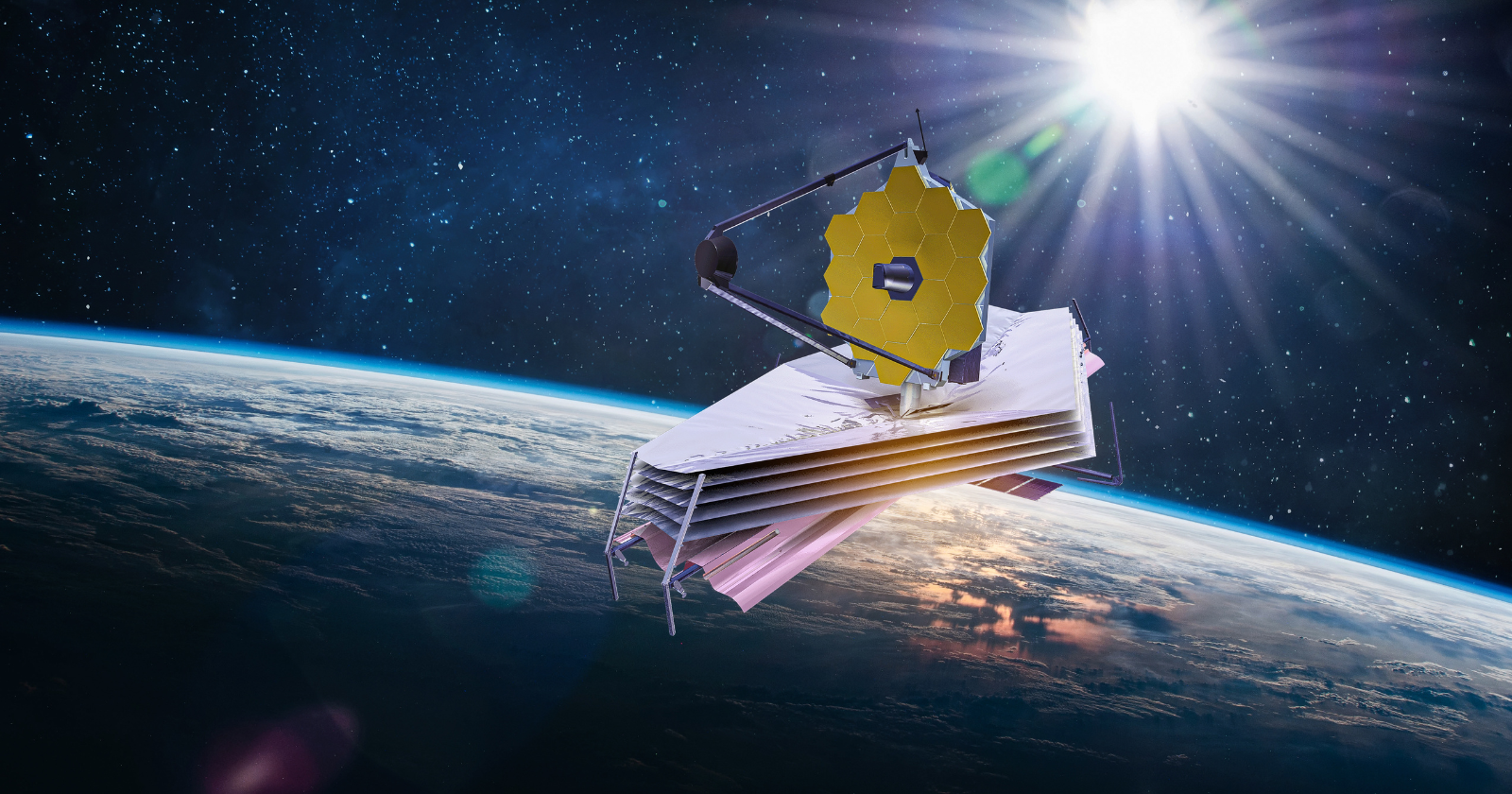
Most of us first learn to think of a telescope as a magnifier, pulling the far-off close so a smudge becomes a planet. That works fine for the Moon. It breaks down once you point a big enough mirror at the edge of the observable universe. At that scale the instrument is not really a magnifier at all. It is closer to a time machine, and the farther it looks, the deeper into the past it reaches.
That is not a poetic flourish. It comes straight out of a simple fact: light moves fast, but not infinitely fast. So everything you see is already old news.
How distance turns into delay
Light takes time to cross space. The sunlight you feel now left the Sun about eight minutes ago. Push that out to the scale of galaxies and the delays get staggering, until “how far away is it?” and “how long ago are we seeing it?” become tightly linked questions.
NASA puts it plainly: “Because light takes time to travel through space (at a consistent 186,000 miles or 300,000 kilometers per second), there is a delay between when we see something and when it actually happened.”
So when a mirror catches light that has been traveling for billions of years, it is not photographing what is out there now. It is receiving a picture that was, in effect, sent long before Earth existed. The galaxy that gave off that light may have changed beyond recognition or merged with another.
The image is real. The thing it shows may no longer exist in that form.
What Webb sees at the edge
This is where Webb, launched in December 2021 and returning science since mid-2022, does something genuinely new. It is built to see infrared light, and that matters more than it sounds. The universe is expanding, which stretches light from the earliest galaxies out of the range our eyes can see and into the infrared. Catch that stretched light and you are catching the deep past.
How deep?
Let’s take the current record holder. Webb confirmed a galaxy called MoM-z14. Its light traveled for about 13.5 billion years to reach us. Rohan Naidu of MIT, who led the work, put the significance plainly: “With Webb, we are able to see farther than humans ever have before, and it looks nothing like what we predicted, which is both challenging and exciting.”
The “most distant” crown keeps moving as Webb breaks its own records. The galaxy MoM-z14 displaced, JADES-GS-z14-0, is seen less than 300 million years after the Big Bang. A University of Arizona account noted that this puts the view at two percent of the age of the cosmos. These ages are estimates derived from redshift measurements and a model of cosmic expansion, not stopwatch readings, but the scale is not in doubt.
What unsettles theorists is that these galaxies are unexpectedly bright and chemically enriched for how early we are seeing them. The MoM-z14 survey found more than 100 times as many bright galaxies at similar redshifts as pre-Webb consensus models predicted.
Why Hubble couldn’t show us this
Hubble was, and is, a magnificent instrument but it simply couldn’t reach this far.
The difference starts with the mirror. Webb’s main mirror spans 6.5 meters against Hubble’s 2.4 meters, giving it more than six times the light-collecting area. That lets Webb detect objects up to 100 times fainter than Hubble can.
Add its infrared vision, and Webb can see galaxies whose light Hubble would miss because much of it has shifted beyond the wavelengths Hubble was optimized to detect.
You can watch the gap open in a single image. In NASA’s side-by-side view of the galaxy cluster MACS0416, Webb’s infrared image used about 22 hours of exposure against Hubble’s 122 hours, and it reveals galaxies too distant or too dusty for Hubble to register.
The practical result is access to a stretch of time NASA calls Cosmic Dawn, roughly 50 million to one billion years after the Big Bang, parts of which we can now observe rather than only model.
A photograph of something that isn’t there
What I keep circling back to is this. Every one of these images is two things at once. A record made by the instrument as it is now. And a portrait of a universe that stopped looking like that more than thirteen billion years ago.
The galaxy in the frame evolved for billions of years before its ancient light finished the trip. The farther out you push, the older the news gets, until you are reading a message from a cosmos that has since become something else entirely.