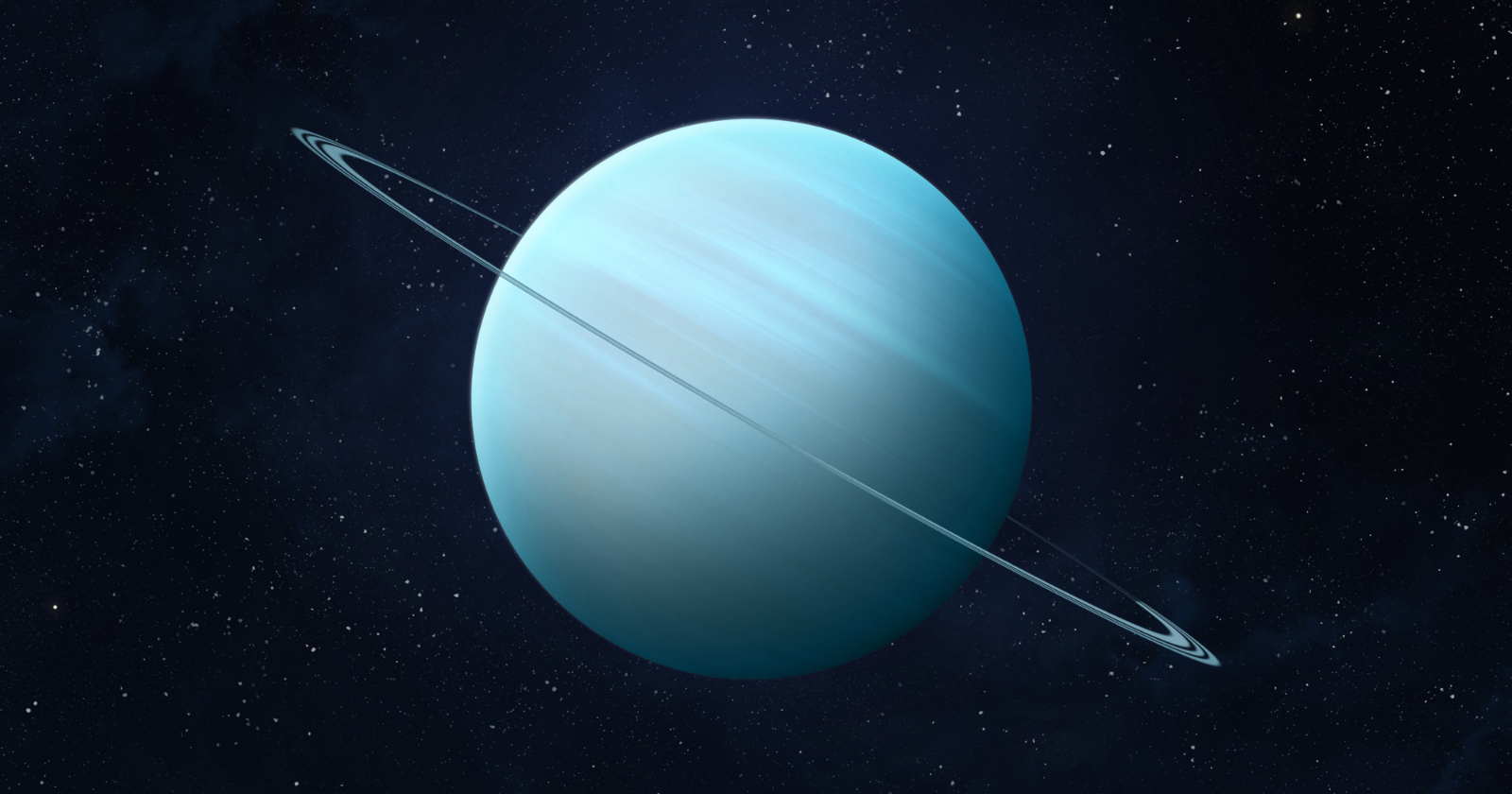
Imagine standing at the north pole of a planet and watching the Sun remain above the horizon for four decades without setting. Then the Sun slides down, and the same pole goes dark for another forty-odd years, with no sunrise in that stretch.
That is what happens on Uranus. The reason is one number so far outside the solar system norm that it reads like a typo.
The tilt that broke the rulebook
Every planet leans to some degree. Earth leans about 23.4 degrees, which is why we have seasons. Uranus leans roughly 97.8 degrees, meaning it lies almost flat compared with its path around the Sun. Instead of spinning upright like a top, it lies on its side and rolls around the Sun like a ball along a table.
Jacob Kegerreis, then a Ph.D. student at Durham University’s Institute for Computational Cosmology, put it plainly: “Uranus spins on its side, with its axis pointing almost at right angles to those of all the other planets in the Solar System.”
Most other planets rotate with axes much closer to upright. Uranus ignored the memo.
Uranus still spins fairly fast, once every 17 hours. But at the poles, that spin does not control whether the Sun rises or sets. What controls the light is the planet’s slow crawl around the Sun.
Forty-two years of nothing but night
The planetary atmospheric group at the University of Wisconsin-Madison’s Space Science and Engineering Center describes it this way: “Uranus has an 84-year orbital period and a spin-axis tilt of 97 degrees from its orbit normal, so that its poles alternate between 42 years of sunlight and 42 years of darkness.”
One pole sits in constant daylight while the other remains in constant night. Over the orbit, they trade.
That gives Uranus the most extreme seasons in the solar system. Earth’s poles get a rough version, with months of midnight sun and months of darkness, but not decades. On Uranus, a person born at one pole under a Sun that never set could reach middle age before it finally dipped below the horizon.
Why the weather hasn’t caught up
You would expect a planet lit like this to have violent, obvious seasons. Keep one pole facing the Sun for decades and the atmosphere should respond dramatically. Instead, its response is neither simple nor immediate.
The Wisconsin group’s explanation comes down to how slowly Uranus absorbs and releases heat. Its early model suggested that the atmosphere’s “response to that forcing should be delayed nearly a full season.” But observations around the planet’s 2007 equinox found some atmospheric changes lagging the sunlight by only a few years. Uranus does not respond to seasonal sunlight on the schedule a simple picture would suggest.
Part of the trouble is that we have barely looked. Only one spacecraft, Voyager 2 in 1986, has ever flown past, catching the planet at one moment in that 84-year cycle. Uranus is also brutally cold, with a mean temperature of about minus 195 degrees Celsius.
Why Uranus ended up this way
So what knocked the planet over? The leading idea is an early, enormous collision.
Kegerreis and colleagues ran more than fifty impact simulations. As he put it, “the most likely outcome was that the young Uranus was involved in a cataclysmic collision with an object twice the mass of Earth, if not larger, knocking it on to its side.”
The same caution the researchers apply is worth keeping. This is one modelling study, a most-likely result rather than a recovered fact. Kegerreis was careful: “This was almost certainly caused by a giant impact, but we know very little about how this actually happened and how else such a violent event affected the planet.”
The collision story is not the only one. A 2022 paper by Lu and Laughlin notes problems involving Uranus’s spin rate and prograde satellite system, and offers an alternative: a gradual spin-orbit resonance driven by the outward migration of the still-hypothetical Planet Nine. The authors also note a major caveat: the result requires Uranus’s spin axis to have precessed much faster in the past than it does today.
Final words
Here is the most extreme seasonal forcing anywhere near us, decades of unbroken light traded for decades of unbroken dark, and an atmosphere whose response we still cannot fully explain. We do not even agree on what tipped the planet over. After a single flyby forty years ago, most of the real questions are still waiting.