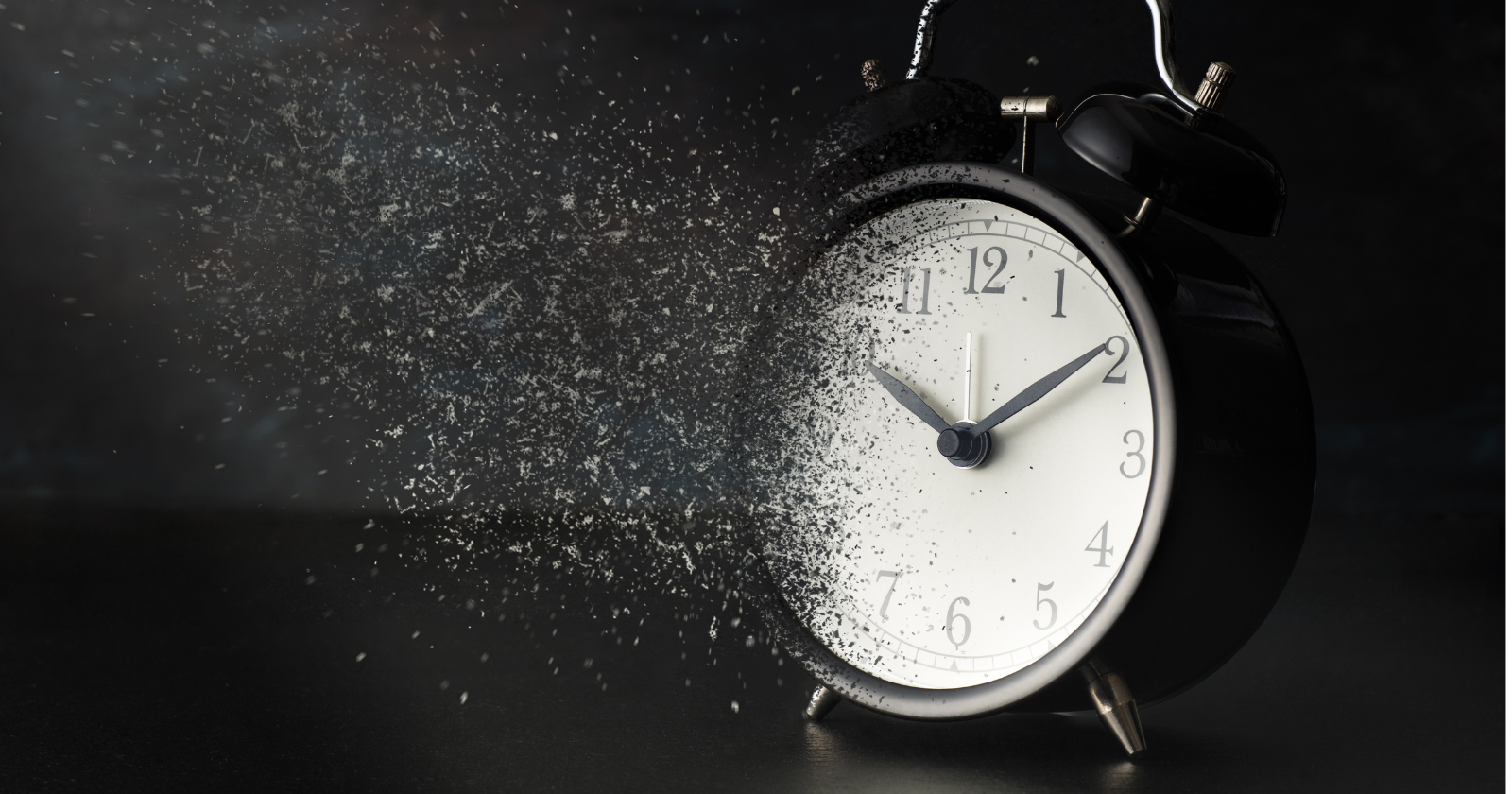
The day you are living through right now is longer than any day a dinosaur ever saw. Not by much, and not in a way you could feel, but the number is real and it keeps climbing.
Nearly 3,000 years of eclipse and astronomical records show that Earth’s average length of day has increased by about 1.8 milliseconds per century. The tides that the Moon and Sun raise in our oceans are slowing us down.
Tiny over a lifetime. Enormous across the age of the planet.
We treat 24 hours as a fixed fact of the universe. Really it’s just what the clock happens to read at our moment in time. Rewind far enough and the clock runs noticeably faster.
How the Moon acts as a brake on Earth’s spin
The mechanism is gravity and friction. The Moon’s pull raises bulges in Earth’s oceans. Because the planet spins faster than the Moon orbits, those bulges get dragged slightly ahead of where the Moon sits. That misalignment tugs back on Earth’s rotation, transferring angular momentum from Earth’s spin to the Moon’s orbit. As Earth slows, the Moon drifts outward, moving away at about 4 centimeters a year.
Geophysicist Ross Mitchell puts it more vividly. Over the long run, Mitchell says, “Over time, the moon has stolen Earth’s rotational energy to boost it into a higher orbit farther from Earth.”
That’s the trade at the heart of all this. The day gets longer, the Moon gets farther away, and the two are locked together.
The slowdown isn’t perfectly steady, and that’s worth flagging. Astronomers found the measured rate came in gentler than earlier predictions of 2.3 milliseconds a century. Other things partly push back, including the slow rise of land once crushed under ice-age glaciers and shifts deep in Earth’s core. So the day lengthens on average, but more than one force is at work.
What ancient shells and rocks tell us about the old clock
If days were shorter in the past, a year contained more of them, and some living things kept count.
In 2020, a team led by geochemist Niels de Winter sampled a 70-million-year-old clam shell with a laser. The shell recorded 372 daily growth rings per year. That means the day near the end of the dinosaurs’ time ran about 23.5 hours, roughly half an hour shorter than ours, and earlier in that era it was shorter still.
The clam itself was unusual. De Winter described the group, called rudists, this way: “Rudists are quite special bivalves. There’s nothing like it living today.” Nothing like it survives now, which is part of why the shell was so useful. It grew fast, and it grew in fine layers you can still count.
Rocks tell the same story from further back. Tidal sediments point to a day of about 21.9 hours around 650 million years ago, and ancient coral records suggest something near a 23-hour day about 350 million years ago. The deeper you dig, the faster the planet was spinning.
How short did it get, and where does it end?
Near the Moon’s formation, roughly 4.5 billion years ago, a day may have lasted less than 10 hours. That’s the picture most models draw: shorter and shorter the further back you look, a slope down toward the beginning.
One recent study argues the slope had a long flat stretch in the middle. A 2023 paper by Mitchell and geophysicist Uwe Kirscher gathered dozens of ancient day-length estimates and concluded that Earth’s day got stuck near 19 hours for roughly a billion years.
Kirscher notes that most models of Earth’s rotation predict progressively shorter days deeper in the past. Their finding cuts against that; as the phys.org write-up puts it, a slow and steady change going back in time is not what they found. This is one 2023 study proposing a mechanism, not settled agreement, so I’d hold the stalled-day idea loosely for now.
Looking forward is easier to state and slower to arrive. Using the 1.8-millisecond-per-century average as a simple extrapolation, it takes something like 3.3 million years to add a single minute to the day, and around 200 million years to add a whole hour.
What I keep coming back to is the framing. We build calendars, schedules, and whole civilizations on the 24-hour day as if it were carved into the structure of things. It isn’t. It’s a snapshot of a process that was already running before shells or corals or anything with a heartbeat existed, and it will keep running long after us, the Moon inching away, the day quietly stretching, the clock never once holding still.