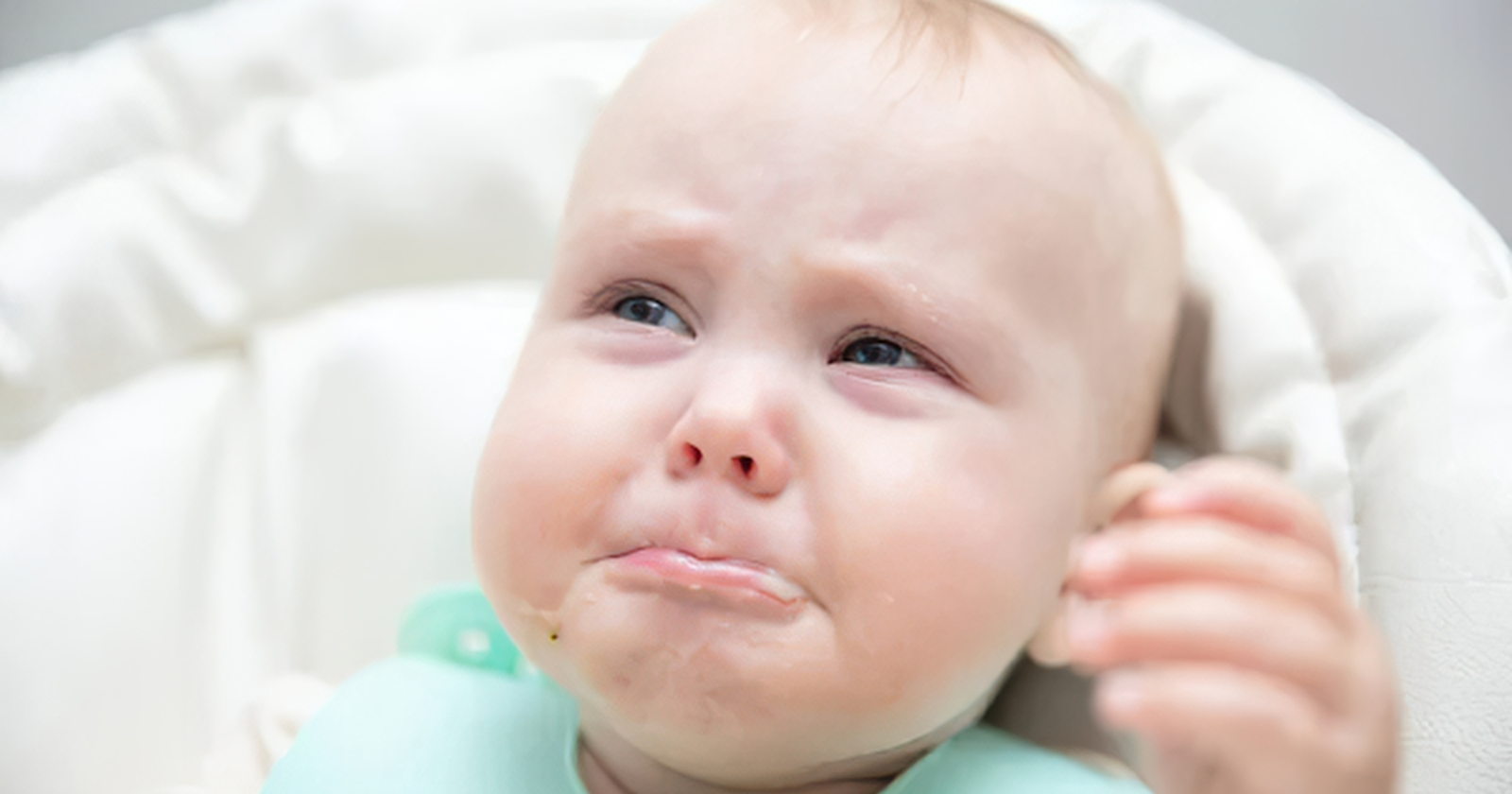
A parent sits knee to knee with their baby and plays for two or three minutes. Then, at a signal from the experimenter, the play stops. The parent keeps facing the child and holds a neutral expression. No smile, no voice, no response of any kind.
From there the sequence is documented well enough to have become the canonical description of the procedure. The infant smiles, and when nothing comes back, smiles harder. Points. Reaches with both hands. Makes the small insistent sounds that have reliably produced a face before. The effort builds and then falls away. The baby arches back, fixes on a light or a corner of the room, puts a hand in its mouth, and stops trying.
We are writers, not clinicians. This is a reading of the research, not guidance for anyone’s family.
The procedure is the Face-to-Face Still-Face paradigm, developed by Edward Tronick, Heidelise Als, Lauren Adamson, Susan Wise and T. Berry Brazelton at the Child Development Unit of Children’s Hospital Medical Center in Boston, and published in the Journal of the American Academy of Child Psychiatry in 1978. It rests on more than a single finding. By the time Judi Mesman, Marinus van IJzendoorn and Marian Bakermans-Kranenburg published their review and meta-analysis in Developmental Review in 2009, the paradigm had appeared in more than eighty empirical studies. Their meta-analyses confirmed the group-level pattern: reduced positive affect, reduced gaze at the parent, increased negative affect, and a partial carry-over into the reunion episode that follows.
That averaged picture flattens a good deal of variation. The same Leiden group returned to the question in Infant Behavior and Development in 2013 and found the expected pattern for positive affect in roughly half the infants they observed, while only a small minority showed the classic changes in negative affect and gaze that appear so cleanly in the aggregate. Individual response patterns were not stable between three and six months. The effect holds firmly across a group and much less tidily in any individual baby.
Blank faces on their own are ordinary. Infants look at ceilings, at furniture, at strangers in shops, at parents concentrating on something else, and none of that produces the sequence above. The distress in the still-face episode is narrower, and pinning down what exactly it responds to has taken decades.
The identity of the face
Strangers produce the still-face response as well. Unfamiliar adults have often served as the unresponsive partner, and infants sober, avert their gaze and protest with them too. At issue is intensity: how much a familiar face raises the stakes.
The most direct test we have found is a longitudinal study by Annika Melinder, Danielle Forbes, Edward Tronick, Linn Fikke and Gustaf Gredebäck, published in Infant Behavior and Development in 2010 under the title “The development of the still-face effect: mothers do matter”. Thirty-nine infants went through the procedure at two, four, six and eight months, with the still face presented either by the mother or by a stranger. Negativity was expressed less in response to a stranger, a result the authors call the identity effect. Their developmental finding, that stranger-induced protest levelled off between six and eight months while mother-induced protest declined, presupposes protest in both conditions.
Familiarity appears to set the volume, not the switch.
Earlier work points the same way. Maria Legerstee, Andrée Pomerleau, Gérard Malcuit and Helga Feider followed eight babies from three to twenty-five weeks, presenting each of them at every visit with their mother, a female stranger and a doll, alternately active and inactive. The 2009 meta-analysis reports from that study that infants of around seventeen weeks produced negative vocalisations significantly more often to an inactive mother than to a stranger who was either inactive or active.
Thirty-nine dyads in one Norwegian laboratory is a modest sample. Eight babies in one Canadian laboratory is smaller still, and we are not going to flag the first figure while quietly leaning on the second. Recurrence is what earns the identity effect its place in the record: the same asymmetry keeps turning up across studies run decades apart, with different methods and different samples.
What the double-video studies added
A second line of work removed coldness from the experiment altogether. Lynne Murray and Colwyn Trevarthen, in a 1985 chapter in Field and Fox’s collection Social Perception in Infants, set mothers and infants to interact over closed-circuit television, then switched the infant’s monitor to a replay of the mother recorded a minute earlier. The mother on screen was warm, animated, smiling. She was simply not responding to this baby, now. Gaze and positive affect declined.
That original sample was four infants aged between six and twelve weeks, and the replication record is uneven. Philippe Rochat, Ulric Neisser and Viorica Marian found no trace of the effect in 1998 in a larger attempt that controlled for the order of conditions. Jacqueline Nadel and colleagues recovered it in Developmental Science in 1999 after altering the procedure so that the shift from live interaction to replay was seamless and the infants were demonstrably engaged beforehand. The sample was small, and the design changes that produced the result are also the reason it does not sit cleanly alongside the attempt that failed. Kjell Morten Stormark and Hanne Cecilie Braarud reported in a 2004 double-video study that infants looked significantly more at their mothers during live sequences than during replays, with controls suggesting that neither fatigue nor memory of the earlier footage accounted for it.
Taken together this is suggestive without being decisive. It points at the breakdown of an exchange the infant was already conducting, more than at the blank expression itself.
Where the effect does not hold
Tanya Broesch, Emily Little, Leslie Carver and Cristine Legare set out a three-population comparison in Infant Behavior and Development in 2022, testing the still-face task in Bolivia, the United States and Fiji. Infants in the American and Fijian samples showed the familiar response. Infants in the Bolivian communities, where caregiving runs on near-continuous physical contact instead of face-to-face vocal exchange, did not. Broesch and her co-authors also built a body-to-body version of the task to match Bolivian caregiving more closely, and the pattern held.
Their argument is that the literature has been assembled almost entirely in Western industrialised settings, where one style of visual and vocal reciprocity is the norm, and that this has been mistaken for a description of infancy in general. The criticism is fair, and it cuts in an interesting direction. If the response depends on the interaction style an infant has actually had, then the expectation is something an infant acquires.
What the paradigm does not show
It does not show that ordinary lapses in attention damage children. In practice the episode runs for a couple of minutes under observation, with a reunion phase written into the protocol, and Tronick’s later work on mismatch and repair established that falling out of step is the ordinary condition of parent and infant interaction. The carry-over the 2009 meta-analysis identified is a within-session measure. Positive affect is lower and negative affect higher at reunion than at baseline. That is a real result, and it carries no implication about anything lasting.
The reunion is where most of the developmental interest lies.
The resemblance adults notice
Footage of these sessions is uncomfortable to watch for reasons that have little to do with developmental psychology. Adults recognise the shape of it. The escalating attempt, the pause, the recalibration, the decision to look somewhere else. Being met with nothing by someone whose response you had been counting on is not an experience anyone outgrows, and the version that stings comes from someone in particular.
Nothing here establishes that the infant sequence explains the adult one, and we would not push it that far. The resemblance is worth naming and best left there.
Whatever else is going on, the infants appear to be working with a prediction about one face in particular, held tightly for some faces and loosely for others, and the two minutes are spent finding out that the prediction has stopped holding. Then the parent smiles again, and most of them come back.