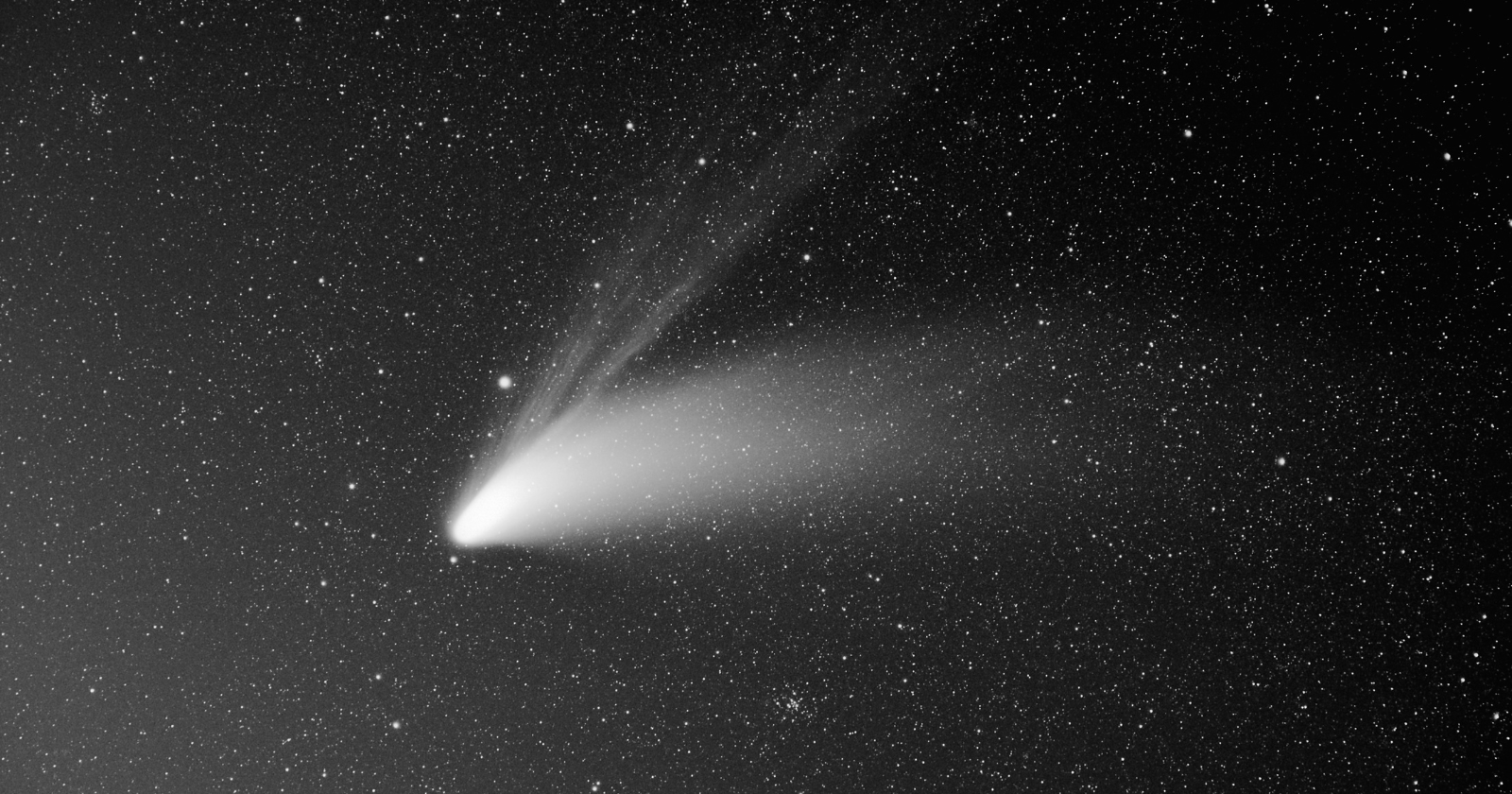
The spring of 1997 was, for those who saw it, the season of Hale-Bopp. The comet was one of the brightest of the twentieth century. For weeks it hung in the northern sky, bright enough to see from a suburban back garden, and most of the people who looked up at it did so with the unforced awe reserved for things that only happen once in a lifetime.
For 39 people in a rented house in Rancho Santa Fe, an affluent suburb of San Diego, the comet was something else. It was a boarding call. It was, according to their own written statements posted to the internet in the final days before their deaths, the vehicle that was going to carry them home.
What is remembered about them, if anything, is the ending. What is worth understanding, and what almost no one who read the news coverage in April 1997 took the time to work out, is who they actually were, and how a group of functioning, educated, professionally accomplished adults ended up believing that a comet was a shuttle service.
Who they actually were
The bodies were found on 26 March 1997. According to Rolling Stone’s twenty-years-later retrospective, drawing on contemporaneous New York Times and CNN reporting, San Diego County sheriff’s deputies entered the 9,200-square-foot mansion after receiving an anonymous tip from a former member who had received a package containing farewell videotapes from the group. Inside, they found 39 bodies: 21 women and 18 men, aged between 26 and 72, dressed in identical black shirts and sweatpants and matching Nike Decade trainers. Each carried a five-dollar bill and three quarters in their pockets, which former members later explained was the amount they carried whenever they left the house, and which they had chosen to keep on them as they left the planet.
What popular retellings almost always miss is who these people were before they were bodies on beds in a Rancho Santa Fe mansion. Among the dead was Thomas Nichols, brother of the actress Nichelle Nichols who played Uhura in the original Star Trek series. The group itself included former teachers, former nurses, former real estate agents, and a number of software developers. In the years leading up to the deaths, the group had earned its living by operating a legitimate professional web development company under the trading name Higher Source, which took paying commercial clients and delivered functioning websites on time. This was not, on any of the surviving contemporary or later evidence, a group of vulnerable drifters. It was a group of capable, functional adults who happened, within their internal belief system, to have arrived at a conclusion that from the outside looked like a category of madness.
For more on the “types of people” who are likely to fall for a cult like Heaven’s Gate, watch this short video below:
The two people who built the belief
The group had existed, in various forms and under various names, since 1974. Its founders were Marshall Applewhite, born 1931, a former chair of the music department at the University of St. Thomas in Houston who had lost that role in 1970 under circumstances involving a relationship with a student and a subsequent period of psychological distress, and Bonnie Nettles, born 1927, a Houston nurse with a long-standing interest in Theosophy and Biblical prophecy. They met in 1972. According to Applewhite’s later writings, the two of them felt an immediate recognition, as if they had known each other in a previous life, and concluded within a matter of weeks that they were the two witnesses described in the Book of Revelation who would prophesy at the end of the world.
They took the names Do and Ti, pronounced Doe and Tee, from the musical scale. They travelled the country together throughout the mid-1970s under various names, most notably The Two and Human Individual Metamorphosis, gathering a small following of committed believers who abandoned families, possessions and professional lives to join them. In September 1975, a public meeting in Waldport, Oregon, resulted in approximately 20 people disappearing from their lives entirely to follow The Two. Walter Cronkite reported the disappearances on the CBS Evening News: “A score of persons from a small Oregon town have disappeared. It’s a mystery whether they’ve been taken on a so-called trip to eternity — or simply been taken.”
Nettles died of cancer in 1985. Her death forced a revision of the group’s theology, because the original doctrine had held that members would be lifted physically into space aboard a spacecraft while still alive. The revised doctrine, which Applewhite worked out over the following decade, held that the human body was merely a container or vehicle for the soul, that the consciousness could leave the body and transfer to a Next Level body aboard the arriving craft, and that death, correctly framed, was not death at all but a kind of graduation.
The graduation ceremony would require the right sign.
What Hale-Bopp actually was to them
By late 1996, the group was living communally in a rented mansion in Rancho Santa Fe, paying $7,000 a month in cash, running the Higher Source web development business by day, and preparing for the event they had been anticipating for years. That event, when it did arrive, took the form of a rumour that circulated through the UFO and New Age communities in late 1996 and early 1997, which held that a large artificial object was hidden in the tail of the newly discovered Comet Hale-Bopp. The rumour was amplified on the late-night radio programme Coast to Coast AM, hosted by Art Bell, and was subsequently taken by Applewhite as the sign the group had been waiting for.
Between 19 and 20 March 1997, Applewhite recorded a videotaped statement titled Do’s Final Exit, in which he framed the coming days as the moment for the group to shed their containers and board the arriving vehicle. The deaths began on 22 or 23 March, coinciding with the closest approach of the comet to Earth, and unfolded in coordinated waves over three days. The group’s website was updated one final time with a message stating that Hale-Bopp had brought closure to Heaven’s Gate and that their 22 years of classroom on planet Earth was coming to a conclusion. The message ended with the phrase “we are happily prepared to leave” — the internal vocabulary of a belief system that had spent decades reframing death as a graduation.
What the case actually reveals
The story is remembered, in popular retellings, as a story about brainwashing. That is the framing that dominated the media coverage in the weeks after the deaths, and it is the framing most viewers of the subsequent documentaries have absorbed as the explanation. The analytical problem with it, on two decades of academic work on the group, is that it does not match what the primary sources show.
One of the most influential academic studies of the case, Dr Janja Lalich’s 2004 University of California Press book Bounded Choice: True Believers and Charismatic Cults, developed an analytical framework for understanding how a functioning adult arrives at the final decision the Heaven’s Gate members took. Lalich, herself a former member of a different high-demand group — the Democratic Workers Party, which she studied comparatively in the same book — analysed the group’s extensive internal documents and interviewed former associates and family members of the deceased. What she documented was not, on the evidence, a story of brainwashed people who could not think for themselves. It was a story of intelligent, committed, high-agency adults operating inside a system of beliefs which, once accepted at the outer boundary, generated a chain of internally rational conclusions that led, over years, to a place from which the final decision looked like the most sensible thing available.
Lalich’s term for the pattern is “bounded choice.” Inside the bounds of the belief system, the choice to graduate to the Next Level with the arriving spacecraft was, given every other proposition the members had come to accept over the preceding decades, the correct action. The choice was free, in the ordinary sense of the word. It was also bounded by a worldview that had been carefully constructed, tested, revised, and gradually made airtight over 22 years of shared communal life. The psychological mechanism, on Lalich’s reading, was not the destruction of the members’ rational faculties. It was the pruning of what those rational faculties were allowed to reason about.
What makes the Heaven’s Gate story difficult, on Lalich’s framework and on the primary sources, is not that the members were exceptional. It is that they were, in almost every measurable respect, ordinary. Before they encountered Applewhite and Nettles, they were people who held down jobs, ran a successful small business, cared for each other, and loved each other in the asexual way the doctrine required. They came to a decision that from outside their belief system looked like madness, and from inside it looked like a graduation. The process by which they got from the outside to the inside was not sudden. It took, in most of their cases, 22 years.
That is the part of the case the psychology of belief has still not finished thinking about. Astronomy has demonstrated, at this point conclusively, that the comet was not carrying anything at all. The group that had spent 22 years preparing for its arrival was not, however, making an astronomical claim. It was operating inside a system in which the astronomical facts and the doctrinal facts occupied different registers, and the doctrinal register, for them, was the one that mattered. That the two registers can coexist so completely, inside the same functioning adult mind, is the observation the psychology of belief has yet to fully absorb.
Kiran Athar is not a psychologist or a neuroscientist. She writes about psychology, brain science, and the ordinary corners of life where the two intersect, drawing on peer-reviewed research, primary-source scholarship, and published studies. This piece discusses mass suicide. If you or someone you know is struggling, help is available in most countries via a national mental health helpline; in the United States, dialling 988 connects to the Suicide and Crisis Lifeline.