

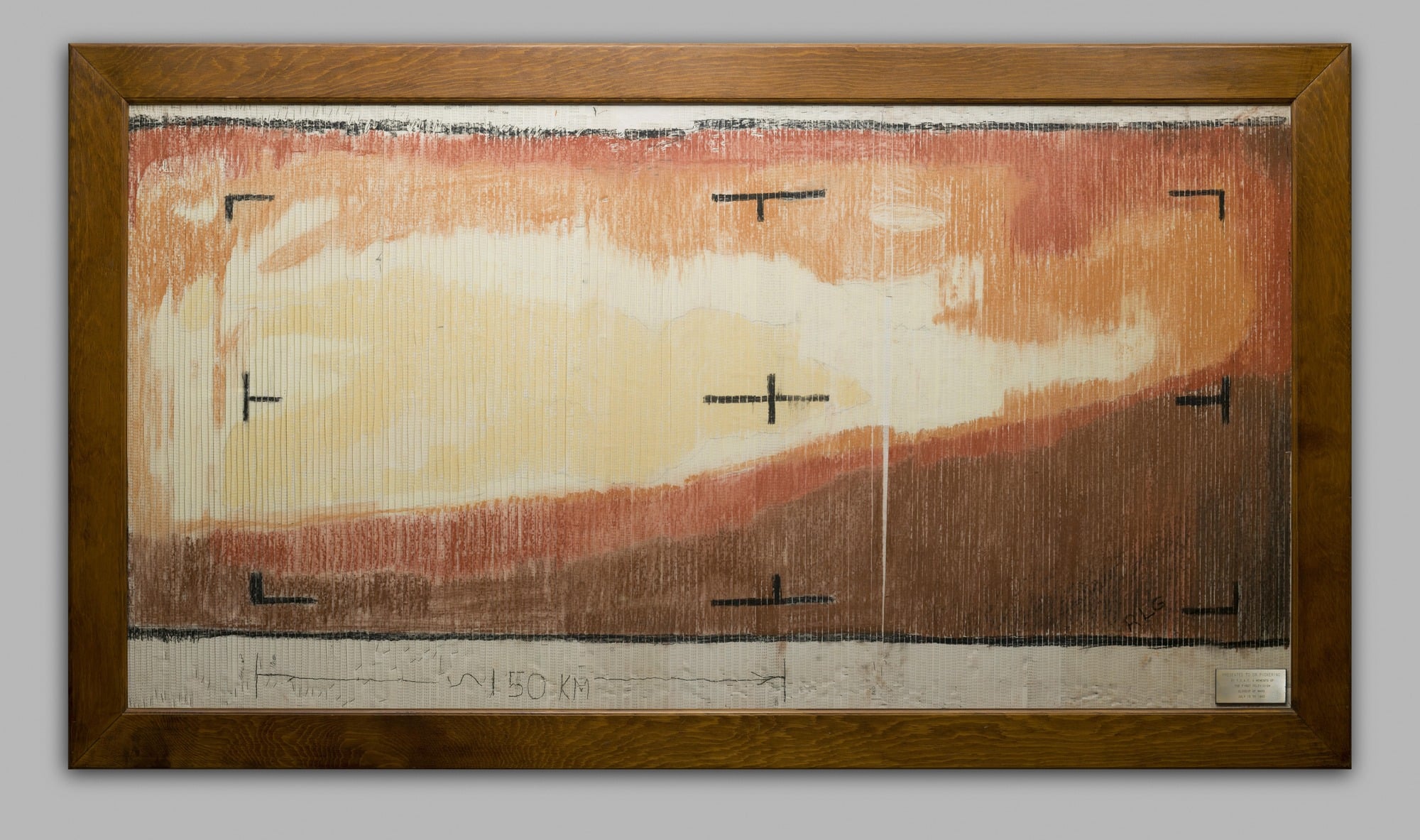
The first close-up photograph of another planet was hand-drawn with art pastels on strips of ticker tape.
This is not a metaphor. It is what actually happened.
On the evening of 14 July 1965, after a 228-day journey from Earth, NASA’s Mariner 4 spacecraft made its closest approach to Mars. It flew past the planet at a distance of about 6,000 miles, snapped 21 photographs with a small television camera bolted to its underside, encoded each image as a stream of numerical values, and beamed the data back to a receiving station on Earth.
The data arrived at the Jet Propulsion Laboratory in Pasadena as sequences of numbers, printed onto long strips of teletype paper by a device called a real-time data translator. The numbers represented brightness values — each digit corresponding to the darkness or lightness of one pixel in the photograph. To convert those numbers back into a viewable image, JPL’s computers needed to process the data, apply grayscale values, and render the final photograph. This was expected to take approximately eight and a half hours.
The engineers waiting for the image did not want to wait eight and a half hours.
The improvisation
The person who had the idea was Richard Grumm, the JPL scientist in charge of the tape system that was receiving Mariner 4’s data. Grumm looked at the strips of numbers coming out of the printer, thought about how long the official processing would take, and came up with a plan that would have been familiar to anyone who had done a paint-by-numbers kit as a child.
He would assign colours to specific number ranges. The team would print the data strips, staple them to a display board on the wall, and hand-colour each number according to the assigned colour key. If they moved fast enough, they could produce a visible image of Mars before the official processed photograph was ready.
The problem was that JPL did not, obviously, stock coloured art supplies in the middle of a Mars mission. Grumm walked out of the building and down to a local art store to buy what he needed.
He had planned to buy chalk — plain grey chalk, so that the resulting image would match the greyscale palette of the actual black-and-white photograph they were expecting the computers to produce. The clerk at the art store, upon hearing what the chalk was for, upsold him. Given the gravity of the task, the clerk suggested, Grumm should really buy proper artists’ pastels. Rembrandt pastels, in fact. The good ones.
Grumm agreed. He bought a box of Rembrandt pastels — in yellows, reds, oranges, and browns — and walked them back to JPL.
The colouring
Back at the lab, the telecommunications team got to work.
They cut the printouts into strips, stapled them side by side to a display panel roughly the size of a garage door, and began hand-colouring each number according to Grumm’s key. Lower numbers became darker shades. Higher numbers became lighter ones. The team worked in shifts as the data continued to arrive, colouring in row after row of numerical values, matching each digit to its assigned pastel colour.
The finished image took several hours to complete. When it was done, it looked, from a distance, like a coloured cross-section of the Martian surface — the curved edge of the planet against the black of space, the muted oranges and reds and yellows of its cratered face, the ticker-tape strips still visible as vertical lines running through the composition.
There is a specific irony about the colours the team ended up with. Grumm and the engineers had wanted grey — plain grey — because they knew the actual photograph would be in black and white. The clerk at the art store had upsold them into yellows, reds, and oranges. But those colours turned out, entirely by accident, to match the actual hues of the Martian surface almost perfectly.
Mars really does have that palette. The rust-red of the iron-oxide-rich soil, the dusty yellows and oranges of the surface dust, the browns of the rockier regions — these are the colours that later, higher-resolution photography would reveal Mars actually to be. The engineers had chosen those colours essentially at random, based on what a shop clerk happened to sell them. They had, coincidentally, produced the first accurately-coloured image of another planet in human history.
The first Mars image the world saw
The pastel drawing was finished several hours before the official processed image was ready. It was framed on the wall of the JPL telecommunications lab.
Then something unexpected happened. Journalists arrived to cover the mission’s success. Someone at JPL let them see the pastel drawing before the official black-and-white photograph was released.
The pastel image made it onto television before the actual photograph did. For a brief window in July 1965, the first up-close image of Mars that most Americans saw was not the greyscale television photograph that Mariner 4 had actually taken. It was a hand-coloured paint-by-numbers rendering, made from an eight-hour improvisation with art-store supplies.
The colours were wrong for the data. The palette was right for the planet. The whole thing had been assembled by impatient engineers with pastels and ticker tape.
The completed image was later cut carefully off the wall, framed, and presented as a gift to JPL Director William Pickering. It remains, six decades later, on display at JPL in Pasadena. Visitors can still see it — the ticker tape running vertically through the image, the numbers still visible beneath the pastel shading, the hand-coloured curvature of another planet as it appeared in the imagination of a small team of engineers who did not want to wait for their computers to do the work for them.
Why this story matters
The Mariner 4 pastel image is a specific reminder about what science actually looks like from the inside.
The popular version of scientific work is orderly. Data arrives. Computers process it. Results appear. Everything happens through the proper channels. The reality, at least during moments of genuine discovery, is often much less orderly than that. Scientists get impatient. They improvise. They walk down to the art store. They talk shop clerks into selling them expensive pastels. They colour in numbers by hand because they cannot wait to see what they have been working toward for years.
Mariner 4 had cost approximately $80 million. Its cameras had been engineered to the tolerances of the early space age. Its data transmission systems had been the state of the art in 1965. And when the images finally arrived, the engineers who had built and operated all of this equipment reached for a box of art pastels because they wanted, personally, to see what Mars looked like.
That first pastel image is the record of what that impatience produced. It is the first close-up image of another planet in human history. It was made by hand.
