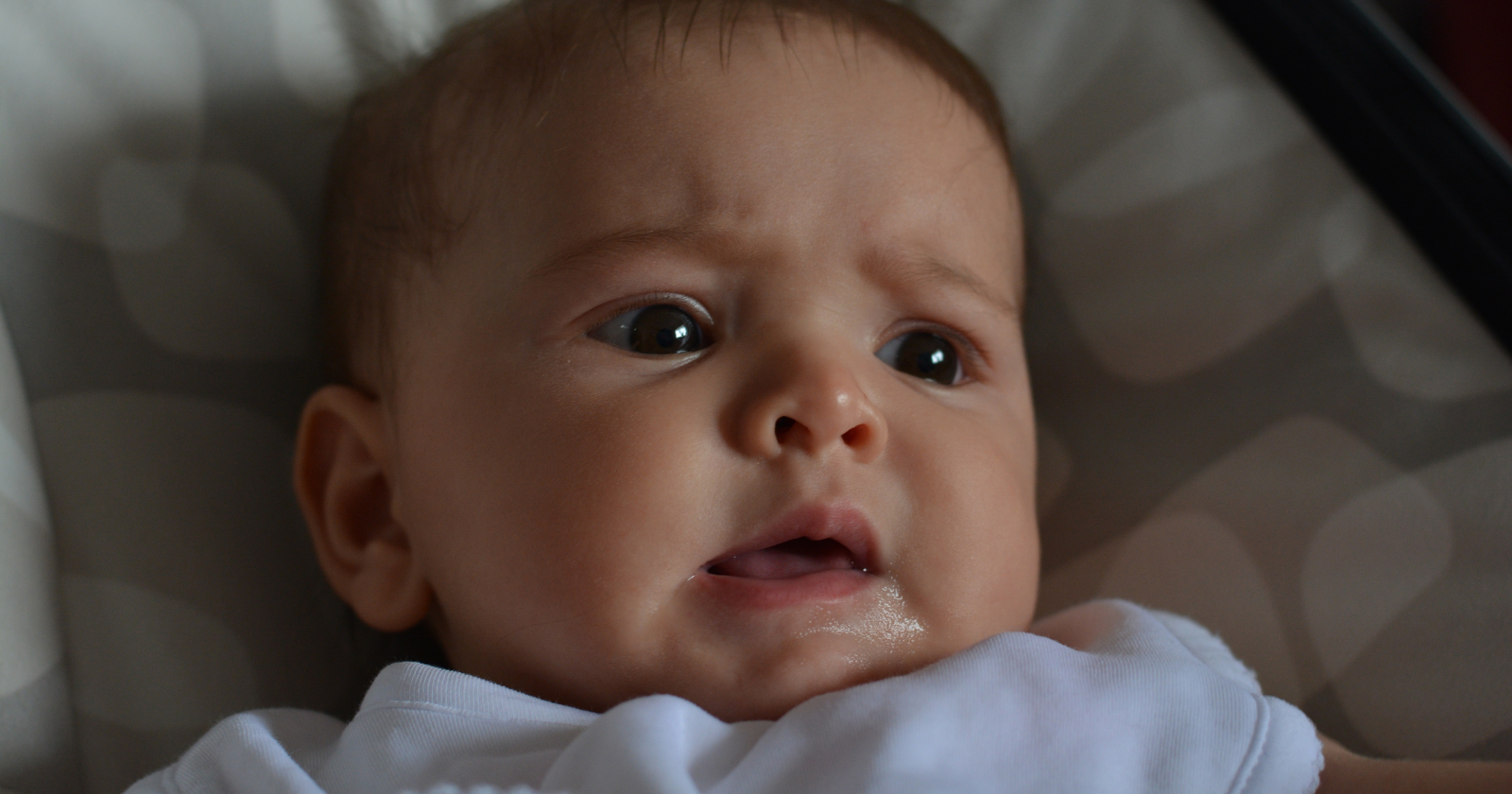
Four researchers sat sixteen six-month-old babies on their parents’ laps in a windowless room in Uppsala, Sweden, and showed them photographs of spiders. Interleaved with them, in a pseudorandom order, were photographs of flowers. An infrared eye tracker recorded the babies’ pupils throughout. In the analysis window between 2.5 and 3.5 seconds after each image appeared, the spiders produced an average pupil dilation of 0.14 millimetres. The flowers produced 0.03 millimetres.
The paper is by Stefanie Hoehl, Kahl Hellmer, Maria Johansson and Gustaf Gredebäck, of the Max Planck Institute for Human Cognitive and Brain Sciences in Leipzig, the University of Vienna and Uppsala University. It ran in Frontiers in Psychology on 18 October 2017, under the title “Itsy Bitsy Spider…: Infants React with Increased Arousal to Spiders and Snakes”.
This is one study, not settled consensus. It is also, in our reading, one of the more carefully engineered small studies in the literature, and the engineering is where the interest sits.
What the matching was for
Pupils respond to light before anything else. Any study measuring a pupil against an image has to rule out that the image was brighter, or busier, or larger. Hoehl and colleagues went at this hard.
Eight spider photographs were paired with eight flower photographs. Pairings were chosen first for natural similarity of colouring, then the colour content of one photograph in each pair was duplicated onto the other in software, rendering the two identical in colour. Each item was resized on screen to occupy 60,000 pixels, give or take a thousand. Luminosity was levelled across the set to 245 units, so the total light leaving the screen stayed the same whichever image showed. Each image was held for five seconds, preceded by three seconds of white screen.
The parents wore sunglasses covered with opaque plastic sheeting. They had been told what the pictures contained, and were shown examples afterwards, but during the run they could not see the screen and so could not react.
That last detail matters more than the millimetres do.
Most six-month-olds are not yet crawling, and have limited opportunity to meet a spider, but a six-month-old is already an attentive reader of the adult holding them. Blocking the parent’s view closes off the most obvious alternative explanation, that the baby was responding to a small involuntary flinch from above.
The snake result is the more interesting one
The same sixteen infants also saw snakes paired with colour-matched fish, in the same session, order counterbalanced. Here the result came out flat. Pupil dilation averaged 0.16 millimetres for snakes and 0.16 for fish, with no significant difference.
Two readings of that appear in the paper. One is that infants are aroused by animals generally, whatever the animal, which would point to something broader than a threat detector. The other is that arousal to the snakes carried over onto the fish, matched to the snakes so closely in colour and shape that the two categories may not have separated cleanly when intermixed.
Study 2 was run to tell those apart. Thirty-two more six-month-olds were split into two groups of sixteen, one group seeing only snakes and the other only fish. Under that design the difference appeared: 0.29 millimetres for snakes against 0.17 millimetres for fish.
Set the four figures side by side and the ordering runs flowers lowest, then spiders, then fish, then snakes in isolation. The authors matched luminance only within each pair, not across the whole set, which means the four numbers cannot be compared statistically. They note the pattern anyway, and so do we, because it is the part most likely to be flattened in summary. A reader who takes away that the ancestral threats produced the stress and the controls did not has lost the fish, which sat closer to the snakes than to the flowers.
What a widened pupil can and cannot be read as
Pupil dilation of the kind measured here is linked to activity in the noradrenergic system, and the authors cite that literature directly. They describe what they measured as arousal and increased focused attention, and in the paper’s conclusion they use the phrase stress response. Hoehl, in the Max Planck Institute’s announcement of the paper, framed the argument as a mechanism that identifies these shapes quickly and predisposes a person to learn them as dangerous, with fear or phobia arriving later, only when other factors compound it.
Not everyone accepted the interpretation. Wolfgang Denzer published a commentary in Frontiers in Psychology in April 2018 pointing out that pupil dilation has been known since Hess and Polt in 1964, and Kahneman’s work in 1973, to track the complexity of whatever the eye is doing. A spider photograph is a more complex object than a flower photograph, whatever their shared colour and total luminance. His argument is that the same data would support a duller hypothesis about visual complexity, or a broader one about animals being more arousing than plants, and that the ancestral threat reading is one candidate among several rather than the one the data selects.
The authors say something adjacent in their own limitations section. Their spider and flower images were not perfectly matched for features and complexity, because they wanted real photographs, not schematics. They suggest a future version built from constructed stimuli instead: a body with legs against a body with petals.
That approach has precedent. David Rakison at Carnegie Mellon and Jaime Derringer at the University of Minnesota showed five-month-olds schematic spiders against reconfigured versions of the same images in Cognition in 2008, with a flower template as a control. The infants looked longer at the spider arrangement.
Arousal early, fear much later
The strongest reason not to read this as a paper about infant fear is that a separate line of research has spent years arguing infants show no such fear.
Vanessa LoBue at Rutgers has published a long run of work on rapid detection of snakes and spiders by young children, and her review with Karen Adolph of New York University, published in Developmental Psychology in 2019, argues against the traditional interpretation. Behaviours routinely labelled fearful in infants confronted with these animals, with heights, and with strangers are better described, on their account, as stimulus-specific responses, heavily dependent on context, learning and the perceptual features of what is shown.
Some of the supporting evidence is unglamorous. In three experiments published in the British Journal of Developmental Psychology in 2013, LoBue, Megan Bloom Pickard, Kathleen Sherman, Chrystal Axford and Judy DeLoache gave young children free-play sessions in a room holding attractive toys and caged live animals. The second added a snake and a spider for children aged eighteen to thirty-six months, to test whether behaviour would differ for benign and threatening animals. Across all three, the children went to the animals more than the toys. Hoehl and colleagues cite that paper themselves, for the point that there is little evidence of toddlers at that age fearing or spontaneously avoiding either animal in the flesh.
Where Hoehl and colleagues land is narrower than much of the coverage suggested. What they argue for is prepared learning, in the tradition of Martin Seligman’s 1971 proposal: an early bias in attention and arousal that makes fear of these particular animals easy to acquire given the right experience, rather than fear that arrives preinstalled. Clinical phobia of spiders or snakes runs at roughly one to five per cent of the population by the paper’s estimates, while more than a third report strong dislike. A mechanism that produced fear on its own would show up at far higher rates.
The size of the sample
Sixteen infants per condition is not a number to hang a species-wide claim on, and the authors set it from an a priori power calculation for a moderate effect size, fixed before recruitment. Each baby contributed fewer than six usable trials out of eight on average, because babies look away. All came from families in one medium-sized Swedish city who answered an invitation letter.
The sex split goes unaddressed in the paper. Eleven of the sixteen infants in Study 1 were boys, while nine of the thirty-two in Study 2 were, and Rakison’s own 2009 paper, asking whether women’s greater fear of these animals originates in infancy, found its effect only in girls.
The measurement stands. It was taken under unusually tight control, and earlier work at this age tracked where infants looked, not how aroused they were. What produced it is open, and three candidates have come up here. One is a sensitivity to the arrangement itself, a compact body with legs radiating off it. Another is a broader reaction to anything animate, which the fish results invite. The third is visual complexity, Denzer’s objection. Forty-eight babies cannot separate them.
Constructed stimuli could, and the Rakison and Derringer design is the place to start. They measured looking time. As far as we can find, nobody has run it with pupillometry.