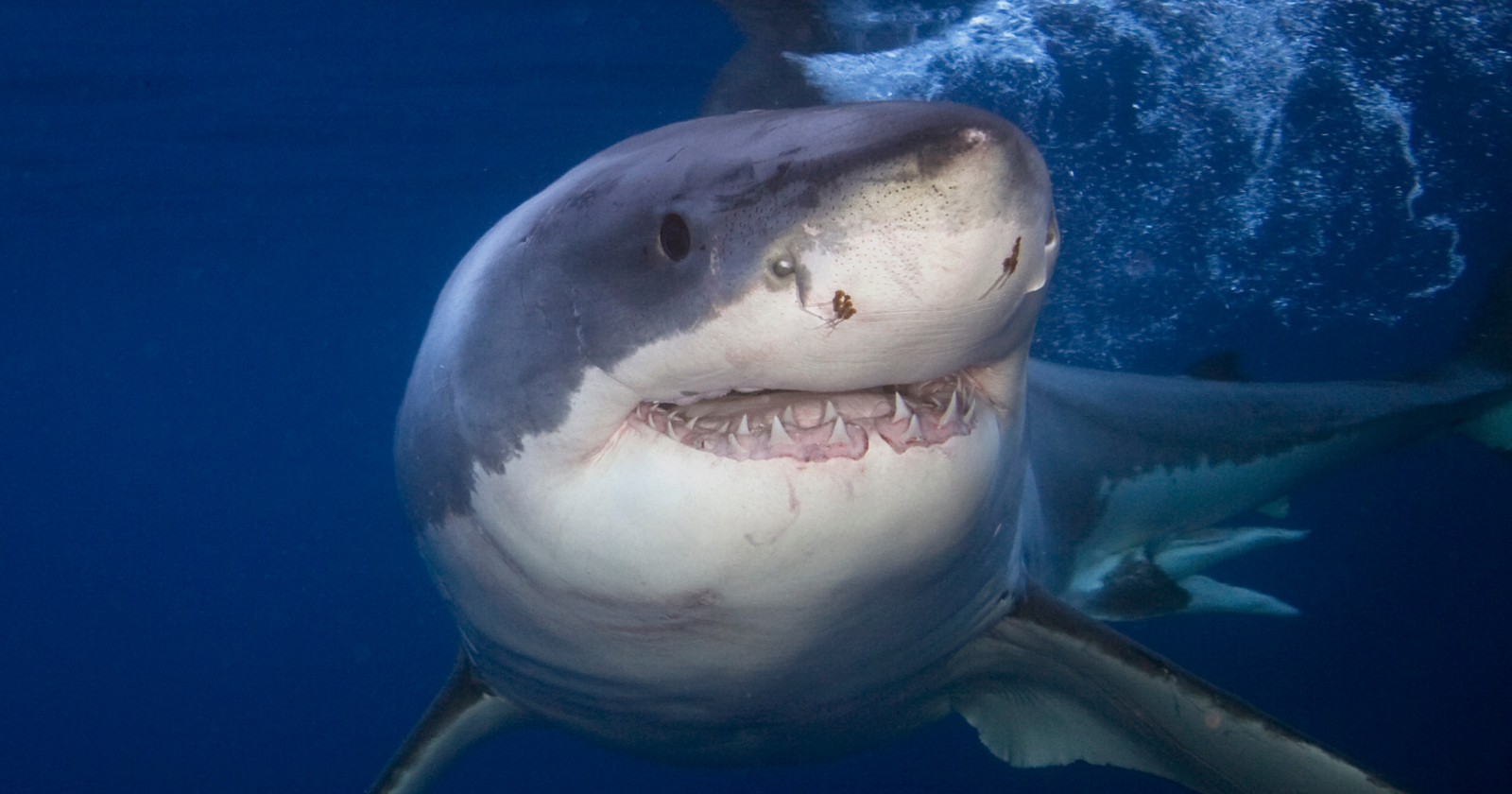
A deep-water shark’s liver can account for up to 30 per cent of its total body mass, and most of that mass is oil. Bony fish hold their depth with a gas-filled swim bladder. Sharks, rays and chimaeras never evolved one, and the liver is what stands in for it.
The problem it solves is a simple one of density. Shark tissue is heavier than seawater, so muscle sinks, and cartilage sinks too, though at roughly half the density of bone it sinks less. Storing low-density oil in bulk is the correction, and the organ that stores it is functionally a buoyancy organ that happens to also do the work of a liver.
What the oil actually does
Most of the lift comes from squalene, a hydrocarbon that sits partway along the biochemical route to cholesterol. Its density is 0.86 grams per millilitre against seawater’s 1.026, a figure tabulated by Jason Treberg and Ben Speers-Roesch in a 2016 commentary in the Journal of Experimental Biology. Their summary of the older literature also gives the threshold: chondrichthyans approach neutral buoyancy once the hepatosomatic index, meaning liver weight divided by body weight, passes roughly 15 per cent and liver lipid makes up more than half the organ’s wet mass, a finding traced to Bone and Roberts in 1969.
Across sharks as a whole the index runs from 10 to 30 per cent, and oil content from a third of the organ to over four fifths. Nicolas Pinte and colleagues collected both ranges in Comparative Biochemistry and Physiology Part A in 2019, drawing on earlier work by Corner, Wetherbee and Nichols, and Pethybridge published between 1969 and 2010. Those figures cover shallow-water species too, which is why the spread is so wide. Depth is what sorts them: liver size climbs with it, peaking at about a quarter of body mass around 2,000 metres in that trend, with individual reported figures running higher, and the deep-water sharks are the ones at the top of the range.
The same oil doubles as a fuel reserve, which is why liver size varies with feeding condition as well as species.
What the liver does not do in shallow-water species is finish the job. It lowers overall density without erasing the deficit, and forward motion across rigid pectoral fins makes up the difference. Adrian Gleiss, Jean Potvin and Jeremy Goldbogen analysed body composition across 32 shark species in a 2017 paper in Proceedings of the Royal Society B, and found liver volume scaling steeply with body size, producing a continuum from larger-livered, more buoyant sharks in deeper water to denser sharks with proportionally smaller livers near the surface. Their modelling puts a trade-off behind it: neutral buoyancy lowers drag and suits steady cruising, while negative buoyancy appears more efficient during acceleration.
Why oil works at depth
A swim bladder is demanding to own below a few hundred metres, because gas compresses and the animal must keep topping it up or venting it. Liver oil behaves differently. A team led by Imants Priede at the University of Aberdeen measured pressure, volume and temperature relationships for the liver oils of ten deep-water chondrichthyan species, and their 2020 paper in the same journal reports that the density difference between oil and seawater stays almost constant with pressure all the way to 1,100 bar, or full ocean depth.
Temperature is the variable that matters more. Combined pressure and temperature effects can reduce oil buoyancy by up to a tenth between the surface and 3,500 metres, across the warm and cold water interfaces of the Rockall Trough. That is a real cost, though a manageable one, and it leaves the pressure advantage intact.
The sharks that glide upwards
In some species the liver overshoots. Itsumi Nakamura, Carl Meyer and Katsufumi Sato fitted accelerometer and magnetometer loggers to five bluntnose sixgill sharks and one prickly shark off Oahu. They reported in PLOS ONE in June 2015 that the animals worked harder swimming down than up, and could glide uphill without beating their tails for several minutes at a stretch. These were positively buoyant sharks, which was not what the authors expected.
Their own instruments were buoyant, which is the obvious confound, and with a sample of two species in one location the result carries the limits of its setting. The paper addresses the instrument problem directly. Two of the packages carried detachable counter-weights so the assembly was neutrally buoyant while attached, and the calculated density shift from an uncounterweighted package came to well under a tenth of a per cent.
The liver made the shark worth catching
Economics followed anatomy. The soupfin shark, known in Australia as school shark and elsewhere as tope, has among the highest vitamin A concentrations of any fish on the Pacific coast, and a targeted fishery began in 1937. From 1939 the Second World War curtailed European cod liver oil supplies, and demand climbed. California’s fisheries status report records more than 24 million pounds landed between 1936 and 1944. Accounts collected by Bay Nature put the price movement at roughly US$50 a short ton before the rush to about US$2,000 at its peak.
Fishermen took the livers and discarded the carcasses at sea.
The fishery ended about as abruptly as it began once vitamin A was synthesised in the laboratory, as Cailliet and Bedford record in the CalCOFI reports. What happened to the population afterwards is less well documented than the boom, and no measured pre-fishery baseline exists to compare against. The Monterey Bay Aquarium notes there is very little information on west coast stock status. The IUCN lists the species as critically endangered globally.
What the CITES listings change, and when
Squalene for cosmetics is the modern version of the same trade. The French conservation organisation BLOOM estimated global shark liver oil demand at roughly 2,000 tonnes in 2012, and the figure of about 3,000 sharks per tonne is widely repeated in that literature. Grand View Research put the whole squalene market at $150 million in 2023, most of it plant-sourced. Deep-water gulper sharks, at the oily end of the range, have absorbed much of the pressure.
At the 20th Conference of the Parties to CITES, held in Samarkand from 24 November to 5 December 2025, parties agreed Appendix II listings for gulper sharks, smoothhound sharks and the tope. Whale sharks, oceanic whitetips and the mobulid rays were uplisted to Appendix I. Notification to the Parties 2026/005 sets out the amendments and their entry into force. Most took effect on 5 March 2026, but all three shark listings carry an 18-month delay and begin on 5 June 2027, as the Australian environment department’s summary sets out.
Appendix II is a permitting regime, not a ban. Appendix I prohibits commercial international trade outright; Appendix II allows it, provided the exporting state can show the trade will not harm the species’ survival in the wild.
That showing is the obligation arriving in June 2027, and the difficulty is already in the record. A Secretariat assessment of the gulper shark proposal found insufficient information to assess one of the listing criteria, a conclusion the United Kingdom contested in writing. Whether range states can assemble adequate catch and population data by then, for a family of slow-growing sharks whose fisheries have gone largely unmonitored, is the open question.
Liver oil moves through supply chains as a processed commodity, so enforcement will turn on traceability more than identification.