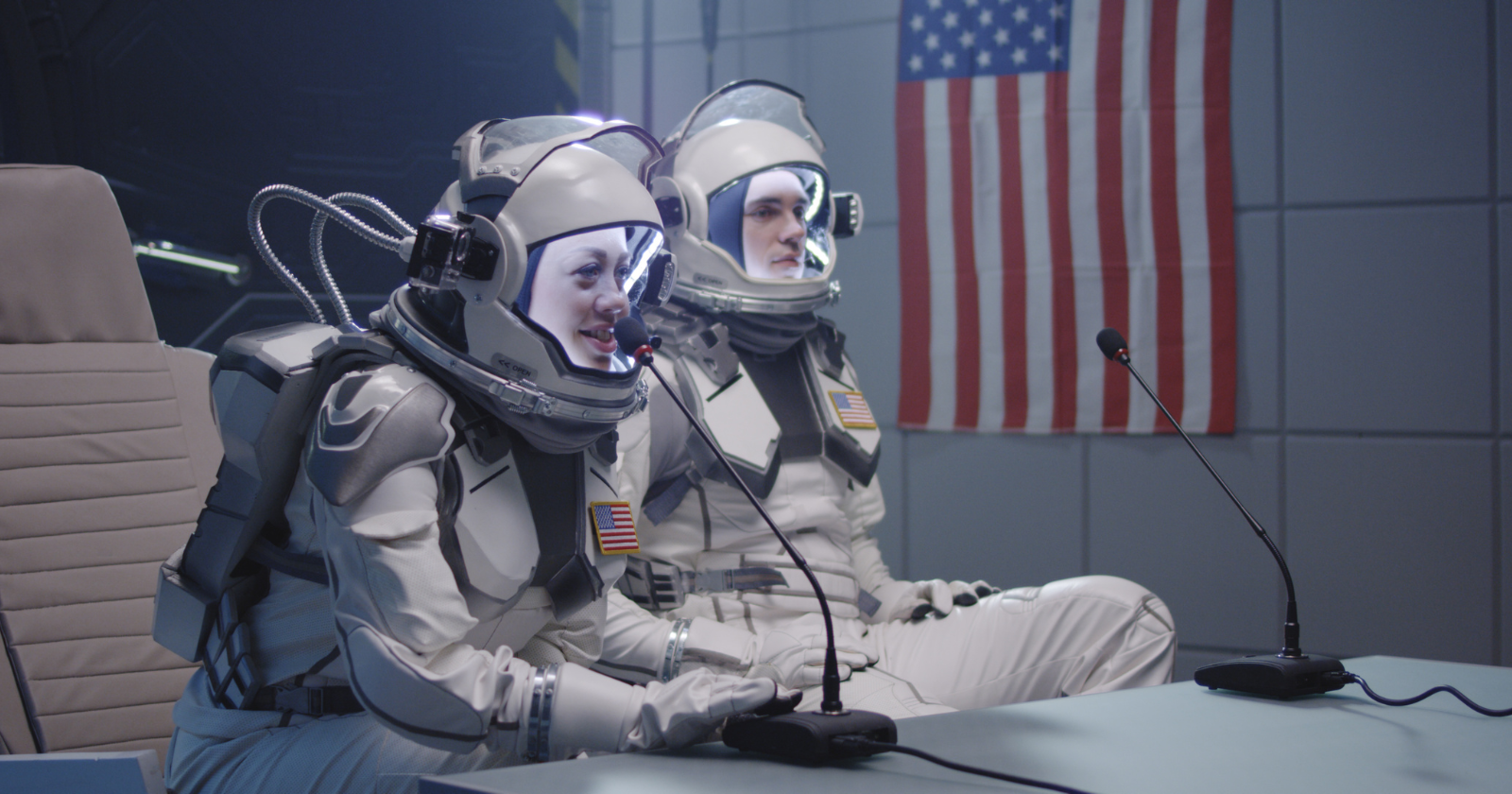
Astronauts come home from long stays in orbit measurably taller than when they launched. The usual figure is one to three per cent of standing height, which for someone around 1.8 metres works out at roughly five centimetres, and the gain disappears within days of landing as body weight starts pressing down through the spinal column again.
Nobody in the business finds this surprising. What is less widely appreciated is that the number exists in the literature mainly because spacecraft seats and spacesuits have to be built around it.
What the measurements actually show
Early data came from awkward improvisation. During the nine-day Apollo-Soyuz Test Project flight in 1975, stature was recorded with the crewmember’s feet against the docking module hatch and body supine along the control and display panel, a colleague reading off a measurement decal taped to that panel. Those readings showed increases of up to three per cent within about two days, after which stature held steady, a history summarised in Karen Young and Sudhakar Rajulu’s paper in Applied Ergonomics.
On the 84-day Skylab 4 mission, William Thornton measured one crewmember to the sixteenth of an inch. That astronaut gained 3.8 centimetres by the end of the mission, with the increase plateauing at around day 29.
In their review in Frontiers in Physiology, David Green and Jonathan Scott give the same range, noting older reports of gains as large as seven centimetres. They set that against the ordinary overnight increase of about one per cent, to make the point that months of unloading produce something larger than a long sleep, not merely more of the same.
Where the disc explanation stops
Swelling of the intervertebral discs in the absence of compressive load is the standard account, and the imaging record complicates it.
Douglas Chang and colleagues at the University of California San Diego published an MRI study of six crewmembers in Spine in December 2016, before and after six-month ISS missions. Lean paraspinal muscle content fell from 86 per cent of total muscle cross-sectional area to 72 per cent immediately after flight, and about two thirds of that loss had been recovered by a follow-up scan 46 days later, which still left lean content below preflight levels. Lumbar disc heights showed no appreciable difference at any point measured.
Those are post-flight scans, so they cannot describe what the discs do in orbit. Reviewing the evidence for the European Space Agency, Daniel Belavý and colleagues put it plainly: increased disc swelling during spaceflight has not been shown directly, only inferred from the height gain and from bed-rest studies. NASA’s write-up of the seated height experiment names a second contributor, without gravity the natural curve of the spine straightens, and a straighter column is a longer one.
Why the number is a hardware requirement
Spinal elongation became a design constraint before it became a research question. Young and Rajulu note that some crewmembers have had trouble donning spacesuits after extended periods in orbit, and that an allowance of 2.54 centimetres is added to suit torso length as standard. Soyuz crew fly in a pre-moulded Kazbek seat liner sized on the ground.
Seat layout is the tighter squeeze. Orion stacks four crew two by two, which limits headroom for the lower pair, and the Applied Ergonomics paper puts the clearance at stake at 6.6 centimetres. Its sample was 29 crewmembers, eight from ISS increments and 21 from Shuttle flights. An earlier NASA abstract on the same work reported in-flight seated height rising by roughly two to six per cent, a larger proportional change than the figures quoted for standing height. Seated height and stature are different measurements, and it is the seated one that governs whether a helmet clears the structure above it.
An astronaut who grows in orbit and cannot fit the seat is a re-entry problem, not a curiosity.
The reloading is the part that matters
Coming back down is where the clinical interest lies. The Skylab 4 crewmember whose height Thornton tracked reported back pain on landing day, associated with a herniated disc.
Chang and colleagues cite the figure that has driven much of the recent work: a 4.3 times higher rate of herniated discs in the astronaut population than in matched controls, reported by Smith Johnston and colleagues in Aviation, Space, and Environmental Medicine in 2010. The dataset behind it deserves attention. As Jojo Sayson and Alan Hargens describe it in Acta Astronautica, the analysis drew on NASA’s Longitudinal Study of Astronaut Health, covering 321 astronauts from April 1959 to December 2006, which makes it largely a record of the Apollo and Shuttle era.
That distinction does real work. The same ESA review reports that Apollo-era and Shuttle crews had a higher incidence of disc injury than ISS and Mir crews, and puts much of the difference down to what happens once the vehicle opens. Shuttle crews landed seated and walked away. Soyuz crews are carried out and spend considerably longer lying down. Seven of the post-flight herniations in the Johnston data occurred within a week of landing and 14 within the first year, the window its prevention advice targets.
Green and Scott are blunt about what is missing. There are few contemporary reports of in-flight back injury and no recent studies of post-flight injury incidence, so the size of the current risk under current exercise regimes is not well characterised.
What to watch
Stature is no longer measured routinely aboard the ISS. It is taken before spacewalks, for suit fit, and otherwise largely left alone, which is part of why Green and Scott called for routine in-flight measurement, pre- and post-flight imaging, and injury tracking for at least two years after landing.
The open question is the one Chang’s group flagged at the end of their paper: whether an exercise countermeasure aimed specifically at the lumbar paraspinal muscles can be performed usefully with the equipment available on orbit, and whether it shortens recovery. That matters more for Artemis surface operations and any Mars-class transit than it does for low Earth orbit, because the reload would happen a long way from a rehabilitation team.