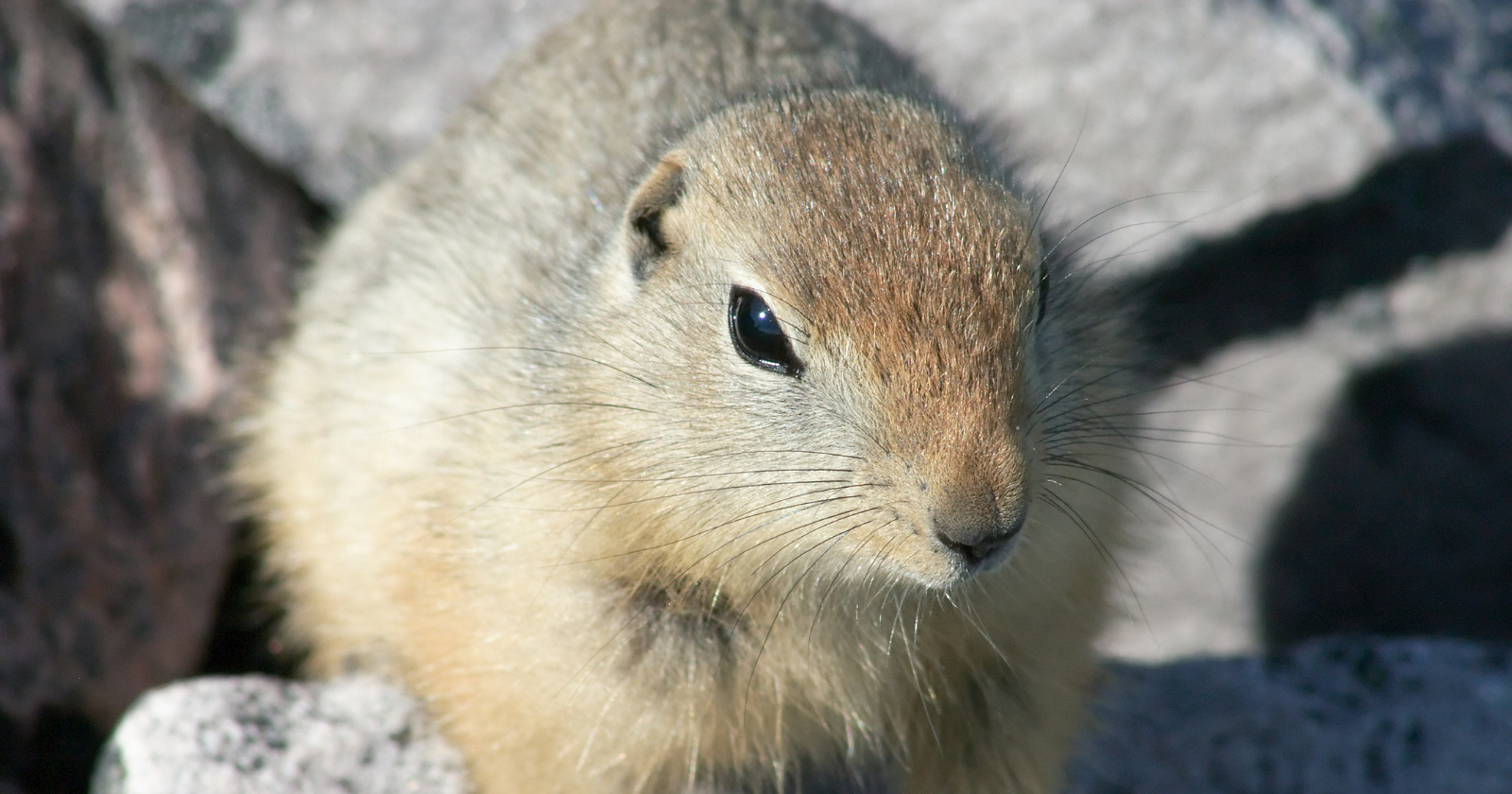
The Arctic ground squirrel holds the lowest core body temperature ever measured in a mammal. During hibernation its body can fall to around minus 2.9 degrees Celsius, close to three degrees below the point at which fresh water freezes, and it does this without turning its blood to ice.
That measurement comes from Brian Barnes of the University of Alaska Fairbanks, whose 1989 paper in Science, “Freeze avoidance in a mammal: body temperatures below 0 degrees C in an arctic hibernator,” remains the reference point for the claim. In August 1987 Barnes captured twelve squirrels, implanted temperature-sensitive radio transmitters in their abdomens, and let them dig burrows and hibernate in outdoor enclosures near Fairbanks. When the readings came back, the animals had spent long stretches of winter at a body temperature below zero.
That single detail is what earns the species its place in the record books. No other warm-blooded animal is known to hold a subfreezing core temperature and survive it.
What supercooling actually is
Supercooling is the word doing the work here, and it is worth being precise about what it means.
Water does not automatically freeze the moment it drops below zero degrees Celsius. Freezing needs a trigger, usually a speck of grit, a rough surface, or an existing ice crystal, around which the first ice forms. This is called nucleation. Remove those triggers, keep a liquid clean and undisturbed, and it can be chilled several degrees below its normal freezing point while staying liquid. That metastable state is supercooling.
The Arctic ground squirrel appears to manage exactly this inside its own body. According to the account maintained by the University of Alaska Fairbanks, the animal allows its body fluids to drop below their freezing point during torpor without ice forming. Nothing sets off nucleation, so nothing crystallises.
This is a different trick from the one used by animals such as wood frogs, which actually let parts of themselves freeze solid and tolerate the ice. The squirrel does the opposite. It avoids freezing altogether. In our reading, that distinction is the part most often lost when the fact gets passed around, because “frozen squirrel that comes back to life” is a cleaner story than “squirrel that keeps its fluids liquid at a temperature where they should have frozen.”
The waking that costs almost everything
This subfreezing state is not continuous. Every two to three weeks through the winter, still without waking in any ordinary sense, the squirrel shivers itself back up to a normal mammalian body temperature of roughly 37 degrees Celsius, holds there for a short period, then cools down again.
These episodes are called interbout arousals, and they are expensive. Work from the same UAF research lineage estimates that the repeated rewarming can account for the large majority of the animal’s total energy expenditure across a full torpor and arousal cycle, even though the animal spends most of the season cold. Holding the cold state is cheap. What burns the fat reserves the squirrel spent all summer building is the transitions back to warmth.
Why the arousals happen at all is not fully settled. That pattern is well documented across hibernating species, and several explanations have been proposed, but the underlying reason a deeply torpid animal periodically pays a heavy metabolic price to warm up remains an open question in the field.
Why the interest goes beyond the record
Laboratories keep returning to this animal for reasons beyond the temperature figure. It is what the body does around that figure.
During deep torpor the squirrel’s brain loses many of its neural connections, and its organs operate through long stretches of reduced blood flow and low oxygen that would damage most mammalian tissue. On rewarming, as reported by Scientific American, the brain reconnects. That capacity to shut down and recover has drawn attention from researchers interested in stroke, in the handling of tissue under low oxygen, and in what protects a nervous system through such extremes.
We would flag the usual caution here. This is animal physiology under study, not a settled route to any human treatment, and the gap between “a ground squirrel’s brain recovers from torpor” and “here is a therapy” is wide and still largely unbridged. Work continues. Any application is, for now, a hope and not a result.
What to keep straight
The core claim holds up.
Minus 2.9 degrees Celsius is a real measurement, the lowest recorded in a mammal, and supercooling is the accepted explanation for how the blood stays liquid there.
What remains to be worked out is the mechanism and the meaning: precisely how the animal keeps nucleation from starting, why it pays for those costly arousals, and whether any of it can be carried across to human medicine. That record is not in dispute. It has simply proved easier to measure than to explain.