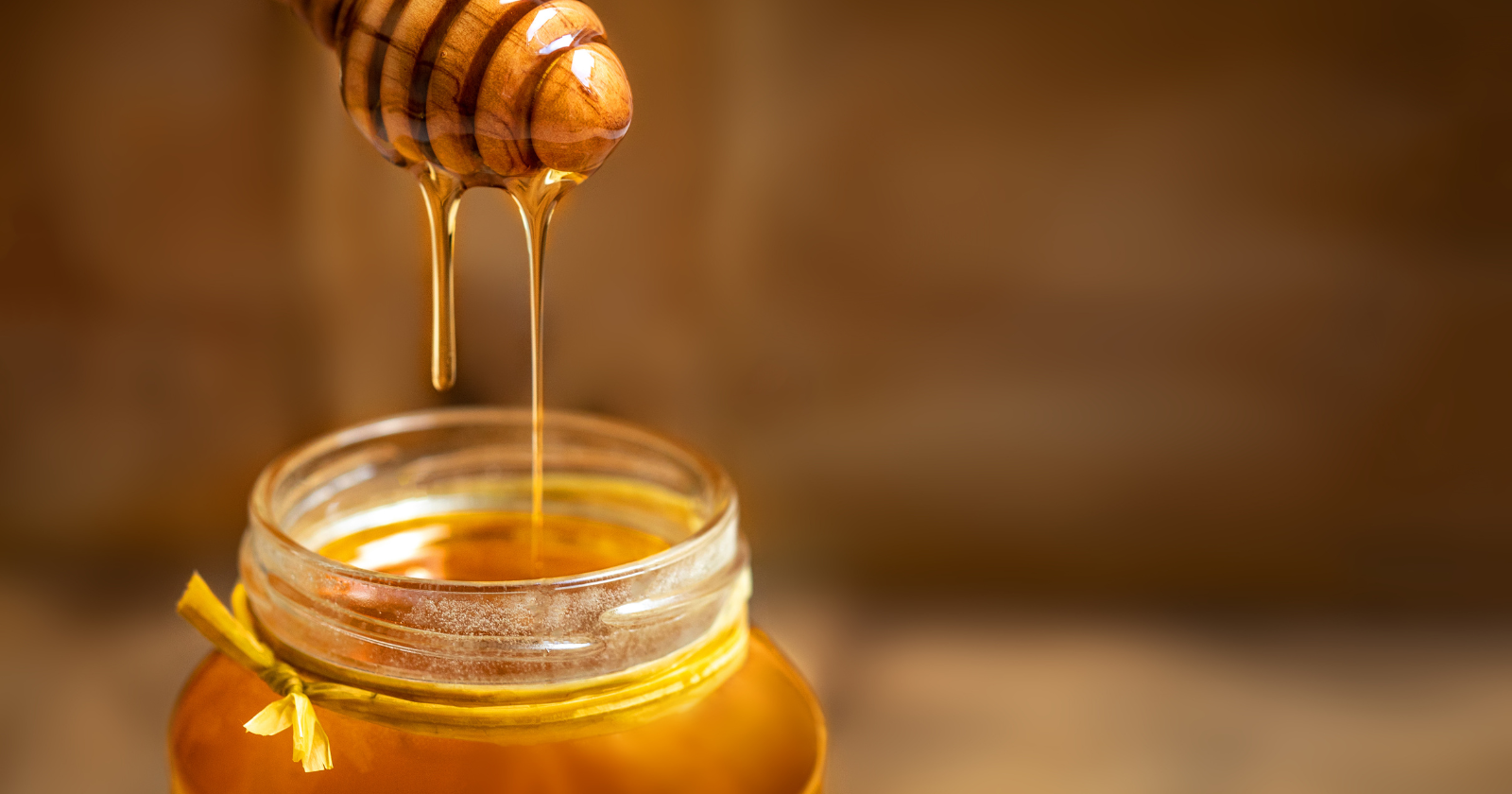
A quick note before going further: we are not doctors, pharmacists, or wound-care specialists. What follows is reading and reflection on the science, not medical advice. The clinical evidence is uneven, and nothing below should be treated as a reason to put kitchen honey on a wound at home.
Honey can remain stable for remarkably long periods when it is sealed against moisture. The ancient Egyptians harvested it and prescribed it in medical texts.
There are four main reasons for this.
The first defence is simple physics. Honey is mostly sugar, about 80% by weight, which leaves little freely available water for microbes to use. Its high sugar concentration creates osmotic pressure that draws water out of bacterial cells and makes multiplication difficult. It is the same basic principle that helps preserve jam and other high-sugar foods.
Second, honey is acidic. Its natural pH generally sits between roughly 3.2 and 4.5. Many wound-associated bacteria grow best closer to neutral pH, so honey’s acidity adds another obstacle.
Third, honey can make its own antiseptic. Bees add the enzyme glucose oxidase, which becomes active when honey is diluted by water or wound fluid and produces low concentrations of hydrogen peroxide. Rather than arriving as one strong dose, the peroxide can be generated gradually. A 2016 review led by microbiologist Dee Carter describes how this mechanism combines with acidity and osmotic pressure.
Fourth, some honeys carry an extra antibacterial component. Manuka honey, produced from nectar collected from Leptospermum shrubs, contains methylglyoxal, or MGO. It contributes activity that remains even when hydrogen peroxide is neutralised. MGO concentrations vary widely among honeys, which is one reason an ordinary retail jar cannot provide the consistency expected of a medical product.
From the hive to the hospital ward
The honey used in a clinic is not the honey in your pantry, and the difference matters. Table honey is not sterile and can contain bacterial spores. As UCLA Health physicians Elizabeth Ko and Eve Glazier explain, medical-grade honey is processed and formulated for safety and consistency. It is commonly sterilised with gamma irradiation, which can inactivate spores without destroying its antibacterial activity, and then incorporated into gels or dressings designed for controlled use.
In the United States, these products are regulated as medical devices rather than sold as folk remedies. MEDIHONEY primary dressings containing active manuka honey were cleared by the FDA in November 2007. Medical honey products are now used under clinical guidance on selected burns, chronic ulcers and other difficult wounds.
What it can and can’t do
The evidence is not uniform.
A 2015 Cochrane review found that honey appeared to shorten healing time for partial-thickness burns compared with some conventional dressings, but the evidence for many other wound types was low or very low quality.
A 2024 meta-analysis of eight chronic-wound studies reported faster healing times and greater wound closure with honey dressings, while rating the certainty of the evidence very low and finding no clear advantage in complete healing rate or bacterial-clearance time.
Wounds, signs of infection, and any burn beyond the minor should be assessed by a doctor or wound-care nurse rather than treated at home.
What keeps pulling at me is the age of the idea. Honey was applied to wounds in ancient Egypt, disappeared from much of mainstream medicine, and returned in sterile, regulated dressings. The substance is ancient; the standards around it are modern.