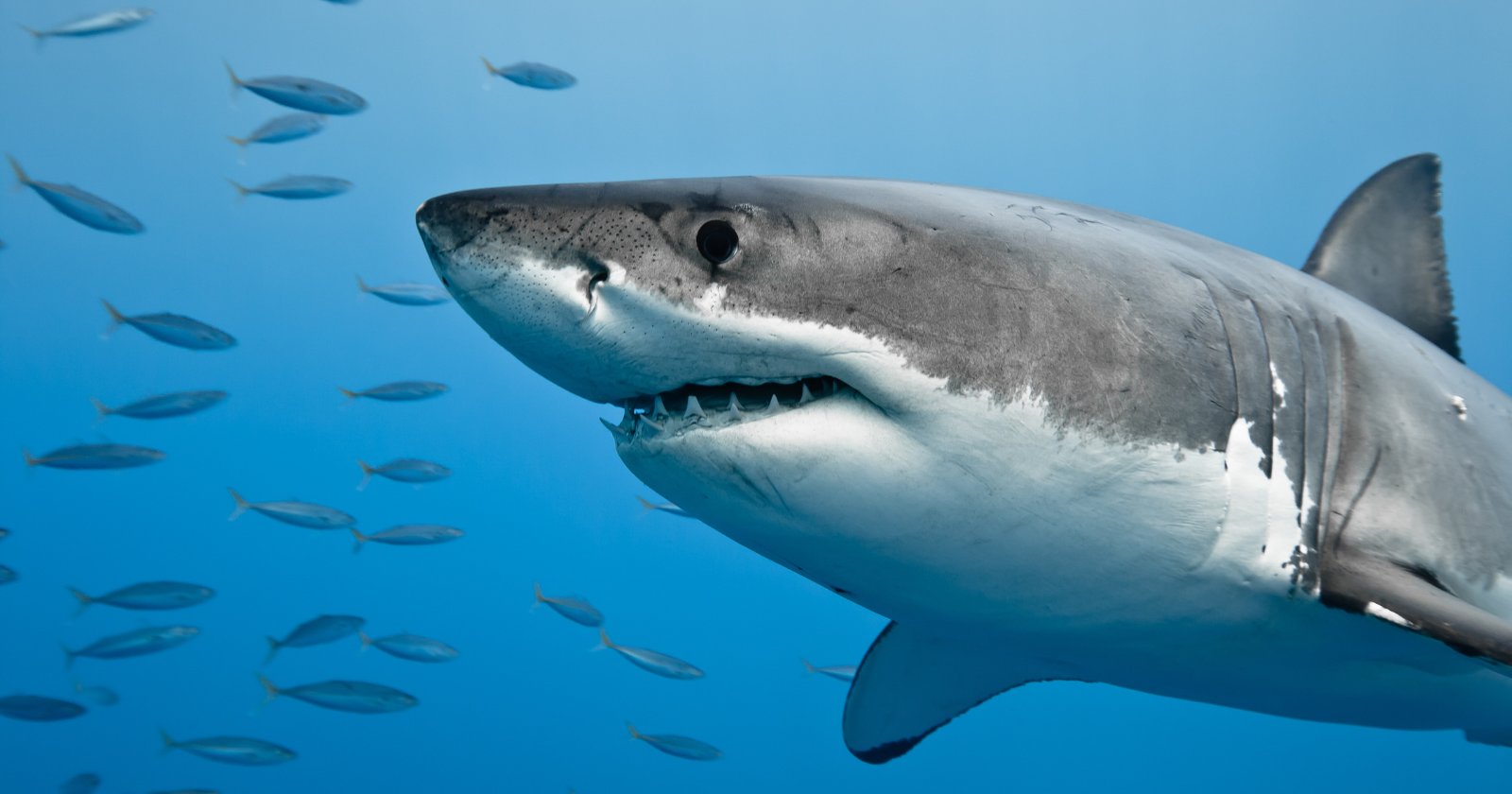
Ask most people what a fish is made of and they will get to “bones” pretty quickly. Fish have skeletons, skeletons are bone, so a shark, the most famous fish of all, must be a rack of bones with teeth on the front.
A reasonable guess. Also wrong, and the way it is wrong tells you something interesting about how loosely we use the word “fish.” A shark has no true bone in its skeleton. Not in the spine, not in the skull, not in the jaws.
The Natural History Museum in London puts it plainly: “Sharks don’t have bones. Their skeletons are made of cartilage – the same soft, flexible stuff as your ears and the tip of your nose are made of.” Press your fingers on the end of your nose and wiggle it. That is the same general type of tissue, though shark cartilage is often far more heavily reinforced.
What the skeleton is actually made of
Sharks belong to the cartilaginous-fish group Chondrichthyes, which also includes rays, skates and chimaeras. The whole internal framework is cartilage: the spine, braincase, fin supports and jaws. There is no hidden bony core underneath.
Why does that work? Cartilage is about half as dense as bone, so a cartilaginous skeleton is lighter than a bony one. Most bony fish use a gas-filled swim bladder to control buoyancy; sharks do not have one. Instead, their relatively light skeleton and large, oil-rich liver help reduce their tendency to sink, while swimming and their fins can provide additional lift.
Cartilage is not necessarily soft, either. Sharks deposit calcium salts in parts of the skeleton, especially where strength is needed. Their vertebrae and jaws are built from mineral-reinforced cartilage.
The one exception everyone brings up
Someone always says: but what about the teeth? Yes, shark teeth are hard, they last for millions of years, and beaches are littered with fossil ones. But teeth are not bone. They are made mainly of dentin with a hard outer layer of enameloid, tissues broadly comparable to those in our own teeth rather than the bone in a thigh.
This is also why the shark fossil record is so lopsided. Cartilage generally needs exceptional conditions to fossilize, so the vast majority of shark fossils are teeth, although vertebrae, scales and rare body impressions also survive. Sharks continually replace teeth throughout life, allowing one animal to leave many behind while most of its skeleton decays.
Losing bone was probably an upgrade
Here is the part that flips the usual story.
It is tempting to read a boneless skeleton as primitive, as if sharks never got around to evolving bone. Fossil evidence increasingly suggests that the common ancestors of jawed vertebrates possessed more bone than modern sharks do, and that the cartilaginous-fish lineage later lost much of it. But the exact sequence remains debated.
A striking piece of evidence arrived in 2020, when a team led by Martin Brazeau at Imperial College London described Minjinia turgenensis, a roughly 410-million-year-old armoured fish close to the branch leading to modern jawed vertebrates. Its skull preserved extensive endochondral bone, the kind that forms much of the internal skeleton in bony vertebrates. The discovery supports the possibility that this tissue was present before sharks and bony fish diverged and was later lost in the shark lineage.
An earlier find points in a similar direction. The roughly 380-million-year-old Australian fish Gogoselachus, examined by John Long and colleagues, preserved an unusual form of mineralized cartilage. Its microscopic structure differed from the neat tessellated cartilage of living sharks and may represent an early stage in the evolution of the shark skeleton. It does not by itself prove that modern sharks directly discarded a fully bony skeleton, but it helps show that the transition was more complicated than a simple march from cartilage to bone.
What this does to the word “fish”
Put all this together and “fish” starts to look less like a tidy biological group and more like a practical label for several vertebrate lineages that live in water. A tuna and a shark both look like fish to us, but they sit on deeply separated branches and are built from different skeletal tissues: one with bone, the other with mineralized cartilage.
The shark lineage extends back more than 400 million years. If the ancestors of modern cartilaginous fish retained more bone and their descendants later lost it, then the boneless shark body is not something evolution failed to finish. It is a highly specialized design that has endured through repeated changes in the oceans.