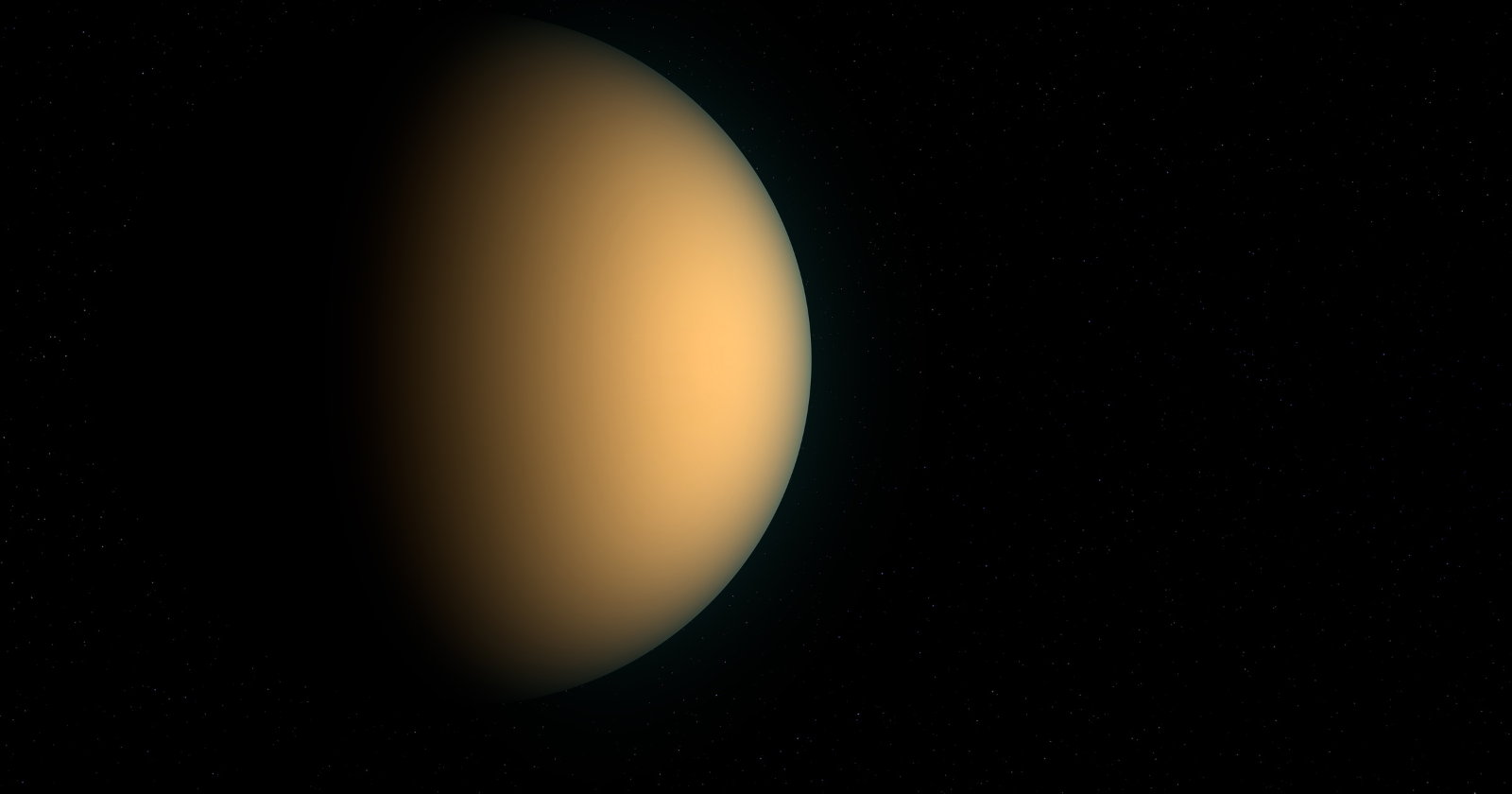
A moon in our solar system is wider than a planet. Saturn’s largest moon, Titan, is about 5,150 kilometers across. Mercury, a full planet orbiting the Sun in its own right, is smaller than that. The moon wins on width. And yet Mercury is the heavier, denser object by a wide margin. Both things are true at once, and that tension is what makes this worth looking at.
The moon bigger than a planet
“Bigger” turns out to be a slippery word. Measured by width, Titan beats Mercury. Measured by mass, it isn’t close. Titan has only about 40 percent of Mercury’s mass, even though it’s the larger ball. The reason is what each world is made of. Mercury is a dense mix of metal and rock. Titan is roughly half water ice and half rock. Ice is light. Pack a world with it and you get something large but airy, a beach ball next to a cannonball of similar size.
Titan is a good reminder of how much our sense of size is really a sense of weight. We call something “big” and half mean heavy. Space keeps pulling the two apart.
What makes Titan so outsized
Being wide isn’t even the strangest thing about Titan. It is the only moon in the solar system with a thick atmosphere. The air at its surface pushes down at about 1.47 times Earth’s surface pressure. That air is mostly nitrogen, about 95 percent, with roughly 5 percent methane and small amounts of other compounds. No other moon comes close.
The cold is part of why it all holds together. Titan’s surface sits around minus 290 degrees Fahrenheit, or minus 179 Celsius. That is cold enough for water ice at the surface to behave like solid rock and for methane and ethane to pool as liquids. Titan is the only world besides Earth known to have stable bodies of liquid on its surface.
That methane is one of Titan’s open puzzles. Sunlight should slowly break it apart, so something must be replacing it, and where it comes from isn’t settled. Jonathan Lunine, a Cassini scientist at Cornell, put it plainly: “The most interesting question is why is there still lots of methane in the atmosphere of Titan? Where’s it coming from?” NASA’s own page says the source remains unclear.
The only runner-up: Ganymede
Titan comes in second among the solar system’s moons, and only one object edges past it. Jupiter’s moon Ganymede, at about 5,260 kilometers wide, is the largest moon there is, beating Titan by roughly 2 percent.
I don’t think it’s a coincidence that both record-holders orbit gas giants. Ganymede and Titan are generally thought to have formed within disks of gas and solid material surrounding Jupiter and Saturn, although the details of their formation remain debated. The two moons wider than Mercury are both children of our two biggest worlds.
Why size on this scale changes everything
A world this large, with a real atmosphere and liquid on its surface, starts to behave less like a moon and more like a planet with its own weather and geography. That’s why Titan drew the Cassini-Huygens mission, which NASA describes this way: before it arrived, “little was known about Saturn’s largest moon Titan, save that it was a Mercury-sized world.” The mission found rivers, lakes and seas of methane and ethane, and evidence of a hidden ocean below the ice.
What struck the mission team was how familiar the place looked. Linda Spilker, Cassini’s project scientist at NASA’s Jet Propulsion Laboratory, put it simply: “I am intrigued by how many features on Titan’s surface are remarkably Earth-like.” The chemistry is alien and the cold is lethal, but the shapes, the way liquid carves the land, echo home.
So we have two moons wider than a planet, and one of them runs a weather system with liquid falling from the sky. “Planet” and “moon” describe how something orbits, not how large or complex it is. Titan is a moon by that rule, and a world by almost every other measure.