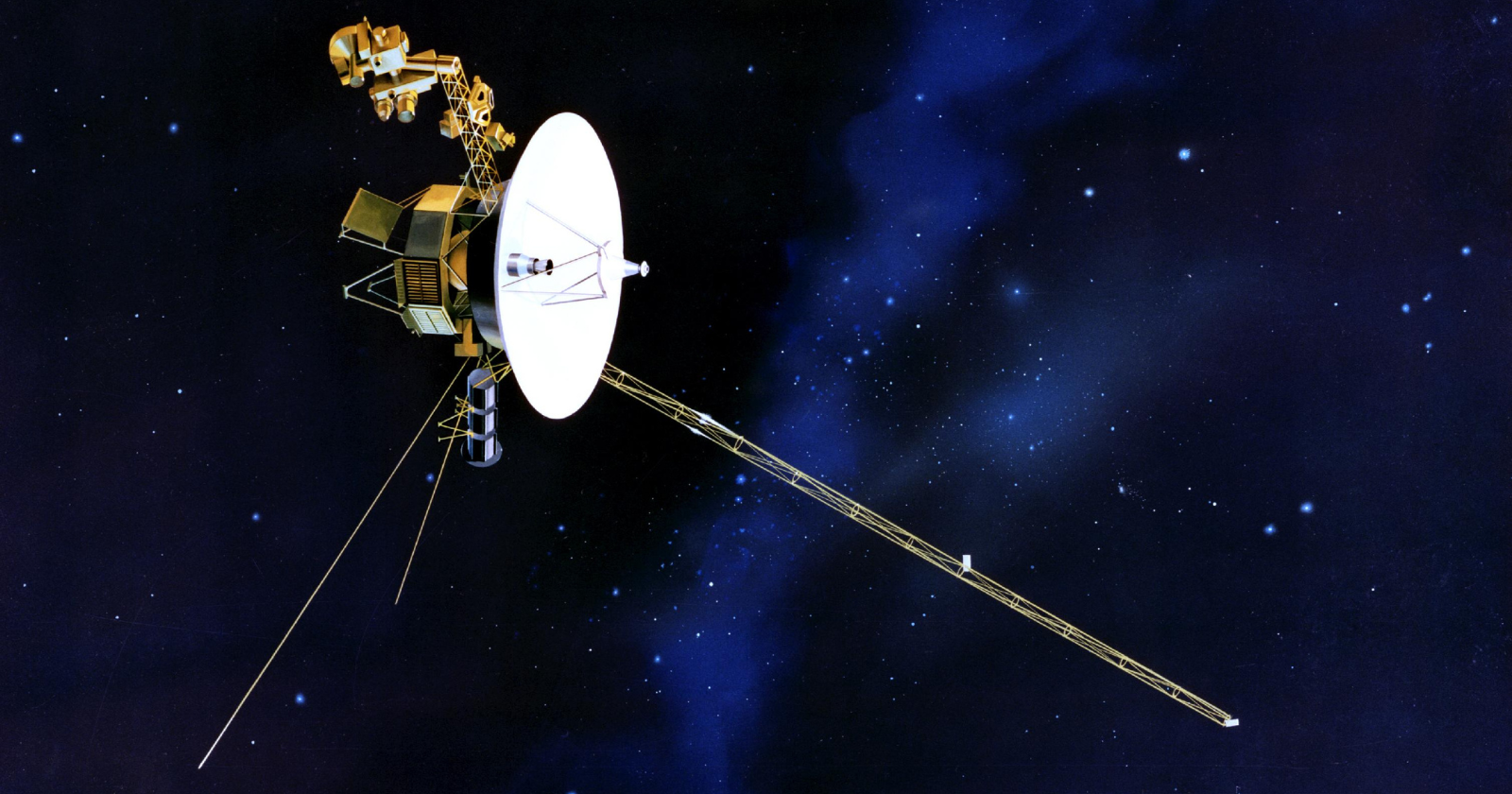
There’s a small puzzle in the most famous photograph Voyager 1 ever took. The spacecraft looked back at Earth, caught it as a speck of light, and just 34 minutes later stopped seeing anything at all.
Not a slow fade. A hard cut. The cameras were switched off and never used again, even though the craft is still flying and, as NASA reported in April 2026, still sending science data home.
The final images from 6 billion kilometers away
On February 14, 1990, Voyager 1 was 3.7 billion miles, or about 6 billion kilometers, from the Sun. It was already beyond Neptune and heading toward interstellar space when mission controllers commanded it to turn its cameras back toward the planets it had left behind.
NASA’s chronology is precise. The three exposures used to create the Pale Blue Dot image were taken at 04:48 GMT. At 05:22 GMT, 34 minutes later, Voyager 1’s cameras were powered off. They have remained off ever since.
Getting the pictures took some preparation. On February 13, Voyager 1 powered up its cameras and spent three hours warming them before beginning the sequence. Cold equipment billions of kilometers from the Sun did not simply snap to attention.
What the “Family portrait” actually was
The familiar Pale Blue Dot picture was not a single unfiltered snapshot. It is a color composite assembled from three exposures taken through green, blue and violet filters by Voyager 1’s narrow-angle camera.
Those exposures formed part of a 60-image sequence now called the Family Portrait of the Solar System. The sequence captured the Sun and six planets: Neptune, Uranus, Saturn, Jupiter, Earth and Venus. Mercury was too close to the Sun to be imaged, scattered sunlight obscured Mars, and Pluto was too small, distant and dark to be detected.
Earth barely made it into the picture in another sense. It occupies about 0.12 pixel, and sits inside a band of sunlight scattered through the camera’s optics. It is genuinely difficult to find.
Candy Hansen, a member of the Voyager imaging team, was the first person to see the Pale Blue Dot image when it reached Earth. “It was actually kind of terrifying,” she later recalled. She could not see Earth at first and feared that the team had missed the planet or used the wrong exposure before finally spotting it inside the scattered light.
People often assume Earth was the final thing Voyager 1 ever photographed. It was not. According to NASA’s published chronology, Voyager photographed Neptune, Uranus, Saturn, Mars, the Sun, Jupiter, Earth and then Venus. So Earth was among the final targets, but Venus came after it.
The whole sequence nearly did not happen. Voyager imaging-team member Carl Sagan first proposed photographing Earth from that distance in 1981. The idea was ultimately approved under NASA Administrator Richard Truly’s leadership, allowing Voyager to take one last portrait of the solar system before its cameras were retired.
Why the cameras went dark and never came back
The shutdown was not sentiment or drama. It was arithmetic. Voyager is powered by radioisotope thermoelectric generators whose electrical output slowly declines. Every instrument and heater left operating draws from a shrinking supply.
The cameras had already completed their primary work during Voyager 1’s encounters with Jupiter and Saturn. No further close flybys were planned, so there were few opportunities ahead in which the cameras could return useful planetary images. Mission controllers instead chose to preserve power and computer memory for the fields-and-particles instruments designed to study the spacecraft’s journey toward interstellar space.
In a purely technical sense, NASA says it might be possible to switch the cameras back on. In practice, there is no plan to do so. The controlling software was removed from the spacecraft, the ground computers once used to process the images no longer exist, and the cameras and their heaters have spent decades exposed to extreme cold. Even if the software and ground systems were recreated, NASA says it is unclear whether the cameras would still work.
The photographs were not even home when the cameras were shut down. Voyager stored them on its onboard tape recorder and transmitted them gradually through NASA’s Deep Space Network. It took four separate communications passes, ending on May 1, 1990, for all the image data to reach Earth. By the time anyone here could examine the complete sequence, the cameras that had recorded it were already switched off.
Why the image still matters
What makes the Pale Blue Dot land is the gap between how little it shows and how much people read into it. Hansen, who spent years working closely with Voyager’s images, put it simply: “The Earth picture reaches to our hearts”, while the rest of the Family Portrait speaks more directly to the head.
Sagan turned that feeling into the reflection most closely associated with the photograph. Writing about the image, he observed that “there is perhaps no better demonstration of the folly of human conceits than this distant image of our tiny world.” He kept the “perhaps” in there, which I’ve always liked. It is a reflection, not a proof.
Thirty years later, the image was increasingly read as a reminder of Earth’s fragility. Lisa Kaltenegger, director of the Carl Sagan Institute at Cornell, said it “shows our world as both breathtakingly beautiful and fragile, urging us to take care of our home.” That is one scientist’s reading of a tiny point of light, and a fair measure of how much a fraction of a pixel can carry.
What I keep coming back to is not the philosophy but the physical fact underneath it. Voyager 1 crossed into interstellar space in August 2012 and remains the most distant human-made object ever. It continues to move farther away with its cameras shut since February 14, 1990 — powered down just 34 minutes after photographing Earth.
Its cameras are still out there in the dark. Their final assignment was to look back across the solar system toward home. They did, and then they closed their eyes.