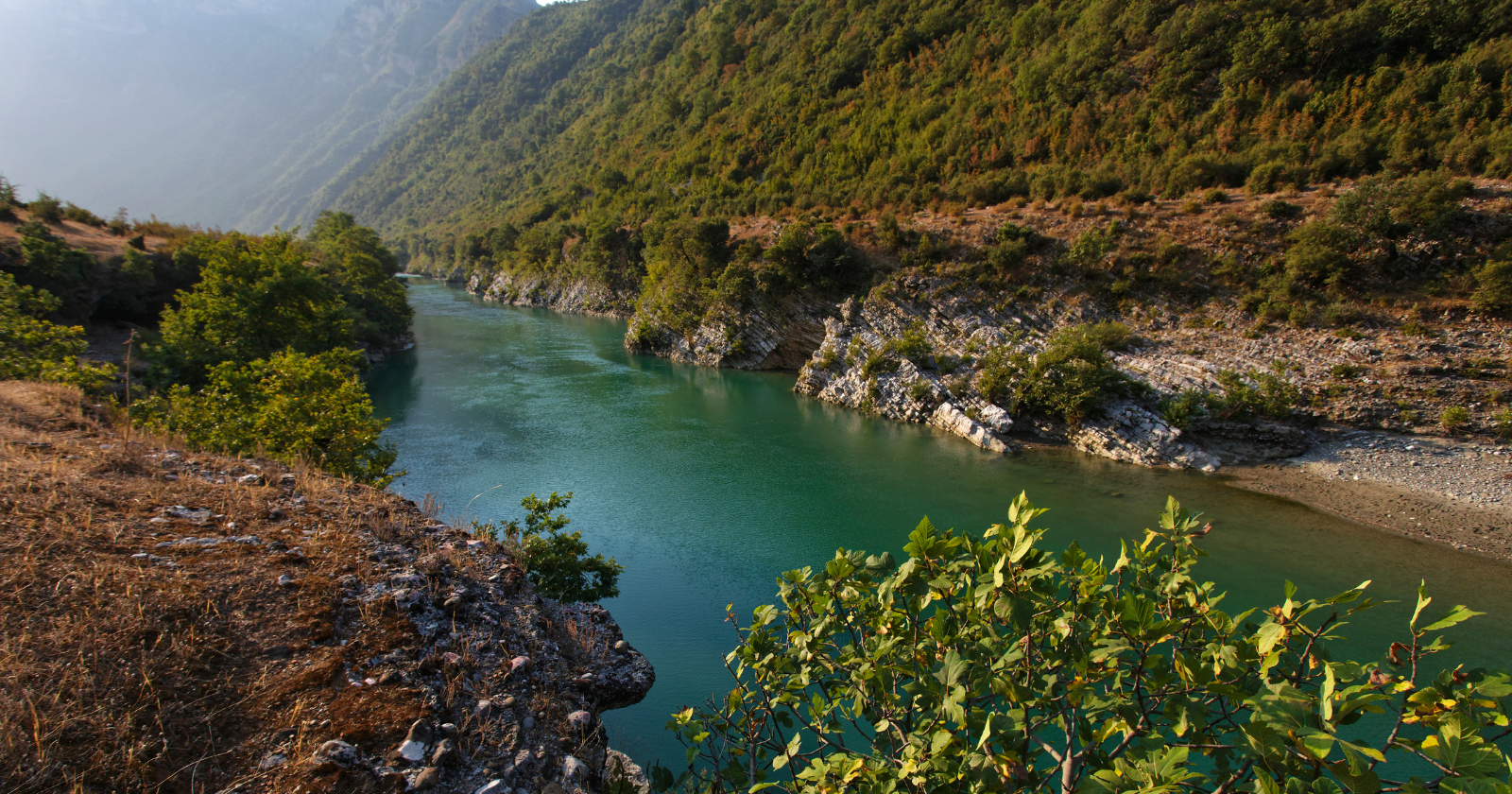
Almost every large river in Europe has been altered by human engineering. Dams, weirs, canalisation, diversion, straightening, sluice gates. In some cases the alteration is centuries old and forms part of the landscape people expect. In others it happened within living memory. Either way, the continent that gave the world hydropower has left itself with only a handful of rivers that still flow the way rivers flowed before industrial civilisation, and one of them, running for 270 kilometres from the Pindus mountains in northern Greece to the Adriatic coast in Albania, is the last of any real size that remains completely undammed on its main stem.
The river is called the Aoös in Greece and the Vjosa in Albania. And in March 2023, the Albanian government did something no European government had done before. They declared it, along with its major tributaries, the first Wild River National Park on the continent.
What makes it different
Most conservation stories are about protecting what’s left after decades of damage. The Vjosa is unusual because most of what makes it ecologically remarkable is still there. The river runs through narrow gorges in the upper stretches, spreads into wide braided channels in the middle sections, and enters the Adriatic through a near-natural delta. Between those three phases, the river creates and destroys islands, moves sediment across the entire watershed, and floods in patterns that scientists in most European countries have to reconstruct from historical records. In the Vjosa Valley, the process is still happening.
The biological consequences of that are substantial. According to the International Union for Conservation of Nature, the Vjosa and its tributaries support more than 1,100 animal species, including 13 that the IUCN has assessed as globally threatened, along with two threatened plant species. The area provides habitat for the critically endangered Balkan lynx, of which fewer than 50 are believed to survive in the wild. It provides habitat for the Egyptian vulture, otters, and endemic fish species that scientists were still identifying at the time the park was declared. Some of the plants and animals recorded in the valley had not been documented in central Europe for decades.
Only about a third of the world’s large rivers still flow freely from source to sea. In Europe, outside Russia, essentially none of them do at this scale. That’s what makes the Vjosa designation different from a typical national park announcement. It’s not protecting a rare species or a rare landscape. It’s protecting a rare kind of thing: an intact river ecosystem in a place where they no longer exist.
It’s worth seeing this river in all its glory – we came across a video that delves into its unique story, so give it a watch to fully appreciate the power of this river.
How close it came to being dammed
The story could easily have gone the other way. In the 2000s and early 2010s, the Albanian government approved plans for approximately 45 hydropower plants along the Vjosa and its tributaries. Two of them, at Poçem and Kalivaç, were among the largest planned dams in the Balkans and would have permanently altered the river’s flow through the widest and most ecologically productive stretches of the valley. Albania was already generating nearly all of its electricity from hydropower and treated new dam construction as the obvious answer to rising electricity demand. Public opinion, at that time, largely agreed.
What changed the trajectory was a decade of concentrated advocacy by two Albanian environmental scientists, Besjana Guri and Olsi Nika, working through their organisation EcoAlbania. Guri and Nika ran their first public conference calling for a Wild River National Park in 2014. They spent the following years commissioning scientific studies of the Vjosa’s biodiversity, building international coalitions of researchers and conservation groups, and taking the dam projects to court.
In 2017, the Administrative Court of Tirana annulled the Poçem hydropower concession after Guri and Nika, representing residents of the Vjosa valley through EcoAlbania, argued that the project’s environmental impact assessment had failed to properly study the river’s ecology. The assessment had mentioned only a handful of common fish species and made no reference to the endemic species scientists were still finding. It was the first time an Albanian court had cancelled a hydropower project on environmental grounds. The Kalivaç project collapsed shortly after when its private investor withdrew.
Guri and Nika received the 2025 Goldman Environmental Prize for their work, an award that has been given annually since 1990 to grassroots environmental activists working in extremely difficult conditions.
The park and how it happened
The formal designation came on 15 March 2023, when Albanian Prime Minister Edi Rama announced the park from the grounds of Tepelene Castle, an Ottoman-era fortress on a rocky outcrop overlooking the river. The Phase I designation protected 12,727 hectares along the 190-kilometre main stem of the Vjosa. Phase II, which is still being developed, will extend protection to the four major tributaries — the Shushica, Drino, Bënça, and Kardhiq — bringing the total protected river network to over 400 kilometres.
The park was structured as an IUCN Category II National Park, which is the highest level of legal protection for large natural areas and legally prohibits dam construction, mining, industrial development, and most forms of extractive land use. It’s the same category applied to Yellowstone in the United States and Serengeti in Tanzania, and it commits Albania to managing the Vjosa according to international conservation standards rather than domestic development priorities.
The designation was the product of an unusual coalition. Patagonia, the American outdoor clothing company, funded much of the international campaign and lobbied the Albanian government directly through the Save the Blue Heart of Europe initiative. The IUCN provided the scientific framework and the international legitimacy. Albanian NGOs, particularly EcoAlbania, provided the local knowledge and the domestic legal strategy. And the Albanian government, having initially been the target of the campaign, eventually became its partner. A joint process with the Greek government is now underway to create a transboundary Aoös-Vjosa park that would extend protection to the river’s source in the Pindus range.
Why this actually matters
There’s an ecological argument for wild rivers that runs beyond the specifics of any single species. Rivers that flow freely deposit sediment along their entire length rather than trapping it behind dam walls. They flood in patterns that fertilise adjacent floodplains and maintain the specific habitats that many aquatic species depend on. They allow fish species to migrate the full length of the watershed rather than being blocked by hydropower turbines. They maintain groundwater recharge across the entire river basin. They cool the air along the corridors they run through, in ways that dammed rivers do not.
None of these functions can be fully replaced by engineered systems. Every attempt to do so, whether at Owens Lake in California or the Aral Sea in Central Asia, has ended up costing more money and delivering less ecological value than simply leaving the river alone would have. The Vjosa designation is a bet that the long-term value of a functioning river ecosystem, including its contribution to eco-tourism, agriculture, fishing, and climate resilience, will exceed the short-term value of the electricity the dams would have generated.
On the accumulated evidence from three decades of European river restoration projects, that bet is likely to pay off. Restoring a dammed river is expensive, slow, and often only partially successful. Protecting one that has never been dammed in the first place is substantially cheaper and substantially more effective.
What’s still coming
Two years after the designation, the park is under pressure from a different direction. According to a May 2025 report in Geographical, the official magazine of the Royal Geographical Society, the Albanian government has approved a project called the Himara Aqueduct, which would divert water from the Shushica River, a major Vjosa tributary, to supply large-scale tourism development on the Adriatic coast. Residents of 36 villages in the Shushica Valley protested against the project in April 2025. A lawsuit filed by EcoAlbania is pending in the Administrative Court of Lushnje.
If the diversion goes ahead, approximately ten kilometres of the Shushica would be legally excluded from the park’s boundaries. Guri and Nika have described the situation, in the same Geographical piece, as the beginning of the real challenge rather than the end of it. Their formulation is worth quoting directly. The vision, they say, has always been not to have a national park on paper but to have a real national park, and that will require a lot more work.
The Vjosa is not out of danger. Gravel extraction, oil drilling proposals, and the tourism-driven water diversions continue to erode its edges. But what the park’s designation established is a legal baseline that did not previously exist. A river that flows freely from the Greek mountains to the Adriatic Sea is now legally recognised as more valuable than the hydropower it could have generated.
Two people, working in a country most Europeans could not point to on a map, spent ten years making that case.
They won.