

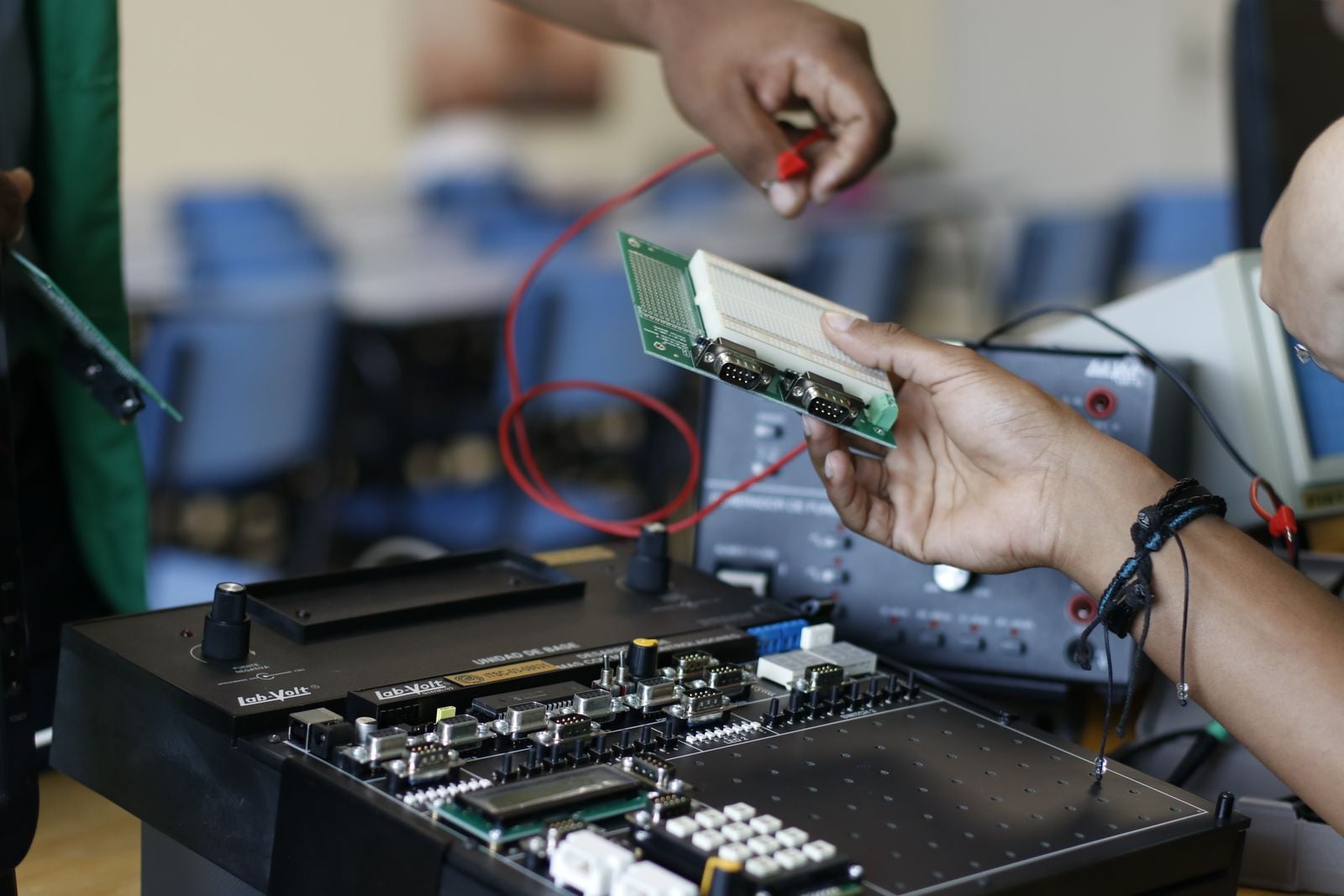
In 2026, engineers at ESA’s test centre in the Netherlands sealed Plato inside the Maxwell chamber and ran every one of its 26 cameras and subsystems at once to find out whether the spacecraft could survive its own electronics screaming at each other.
The European Space Agency’s Plato spacecraft has cleared its final major qualification hurdle before launch, completing electromagnetic compatibility testing inside the Maxwell Test Chamber at ESA’s technical centre in the Netherlands. The result keeps the exoplanet-hunting mission on schedule for a 2027 liftoff aboard an Ariane 6 rocket.
The Maxwell chamber is a Faraday cage nine meters tall, its walls lined with foam spikes that absorb stray radio signals and reproduce the electromagnetically silent conditions of deep space. Inside that anechoic box, engineers ran Plato’s electronics simultaneously to verify none of its subsystems interfere with any other — no crosstalk, no unexpected pickup from onboard transmitters, no chatter that could corrupt the faint signals the mission was built to detect.
Electromagnetic compatibility is the kind of engineering discipline that gets little public attention until it fails. For Plato, failure is not an option the science can absorb.
Why the silence matters
Plato’s job is to find rocky, Earth-sized planets around sun-like stars by watching for the tiny brightness dips that occur when a planet transits its host. According to ESA Plato Project Scientist Ana Heras, the mission must resolve variations in stellar luminosity smaller than 80 parts per million. That is a photometric precision at which noise from a spacecraft’s own electronics can drown out the signal.
Twenty-six cameras stare at the same patch of sky. Each has to hold its focus by controlling the temperature of its optical tube to a fraction of a degree. Every switching power supply, every reaction wheel motor, every data bus on the spacecraft is a potential source of interference. The Maxwell chamber test is where engineers confirm that when everything runs at once — cameras, computers, transmitters, heaters — the electronic environment stays clean enough for the science to survive.
The final exam in a long series
Electromagnetic testing was the last of Plato’s major environmental qualifications. The campaign began earlier in the year with vibration and acoustic tests that simulated the punishing shake and roar of an Ariane 6 ascent. From there the spacecraft moved to the Large Space Simulator at ESTEC for a month-long stay under thermal vacuum.
Inside the LSS, pumps evacuated the chamber to roughly a billionth of atmospheric pressure while liquid nitrogen chilled the walls to space temperatures. Heating elements simulated the sun striking Plato’s solar panels and sunshield. Engineers pushed the spacecraft into a hot phase — solar-panel side warmed to 150 °C, with the cameras held between –70 and –90 °C on the shaded side — and a cold phase in which onboard heaters had to prevent the cameras from freezing below their operating range.
Plato Project Manager Thomas Walloschek said engineers deliberately pushed conditions beyond what the spacecraft will encounter in orbit. The goal was to verify performance in both nominal and off-nominal thermal states.
What Plato is trying to do
The mission’s name — PLAnetary Transits and Oscillations of stars — signals its dual purpose. Plato will hunt for planets and study the stars they orbit through asteroseismology, the analysis of stellar pulsations. Together those measurements give scientists something exoplanet catalogs have often lacked: reliable ages and radii for host stars, and therefore for the planets around them.
NASA’s Kepler mission established that small, rocky planets are common. TESS has been finding them around nearby bright stars. Plato is designed to close a specific gap — Earth-sized worlds in the habitable zones of sun-like stars, characterized well enough to be handed off to follow-up spectroscopy from ground-based extremely large telescopes and space missions like the James Webb Space Telescope.
That is a narrower target than it sounds. Most confirmed exoplanets orbit close to their stars, where transits are frequent and easy to detect. Finding a true Earth analog — roughly Earth-sized, roughly one-year orbit, around a G-type star — requires years of continuous staring at the same field. Plato is built to do exactly that from the second Sun-Earth Lagrange point.
An Ariane 6 payload with something to prove
Plato’s launch also matters for the vehicle carrying it. Ariane 6 is Europe’s answer to a commercial launch market it has been losing ground in for a decade. Every high-profile institutional payload the rocket delivers on schedule strengthens the case that Europe still has sovereign heavy-lift capability.
The 2027 date represents a small slip from earlier planning. A two-month adjustment on a mission this complex is unremarkable, but it reflects the reality that qualification campaigns rarely finish exactly when planned.
The unglamorous work of getting to the pad
Space missions are usually described in terms of what they will discover. The work that actually gets them to orbit is more prosaic: months of testing in chambers that mimic conditions the spacecraft will never quite see again. Vibration tables that reproduce launch loads. Acoustic horns that blast the vehicle with the sound pressure of a rocket at ignition. Thermal vacuum runs that catch problems no analysis can predict.
Electromagnetic compatibility testing sits at the end of that sequence for a reason. It is the check that everything the engineers built and integrated over years actually works together as a single machine. A spacecraft that passes vibration and thermal but fails EMC is a spacecraft that has to be opened up, rewired, and retested. Plato passing on schedule is a signal that the integration was clean.
The mission’s ground segment will now shift toward launch preparations, shipping logistics, and the analysis of data collected during the environmental campaigns. Some of that analysis feeds directly into the science. Thermal models built from LSS data will be used to predict camera behavior in flight, allowing operators to distinguish real astrophysical signals from thermally induced noise.
Europe’s exoplanet decade
Plato joins a European exoplanet program that has been building steadily. CHEOPS, launched in 2019, characterizes known planets by measuring their radii precisely. Ariel, scheduled for later in the decade, will study exoplanet atmospheres. Plato fills the discovery role — the mission that will, if it works as designed, produce the catalog of small planets around sun-like stars that the next generation of instruments will study in detail.
The stakes are less about any single detection than about statistics. How common are Earth analogs? What fraction of sun-like stars host them? Those numbers shape how astronomers design the next round of missions — including proposed direct-imaging observatories that would attempt to photograph potentially habitable worlds and search their atmospheres for biosignatures.
None of that happens without the catalog Plato is meant to produce. And the catalog does not happen without a spacecraft that survives launch, reaches L2, and holds its cameras steady enough to see 80 parts per million.
The Maxwell chamber test says the electronics are ready. The Ariane 6 slot says the ride is booked. What comes next is the part space agencies have less control over — the launch itself, and the years of quiet observation that follow.