
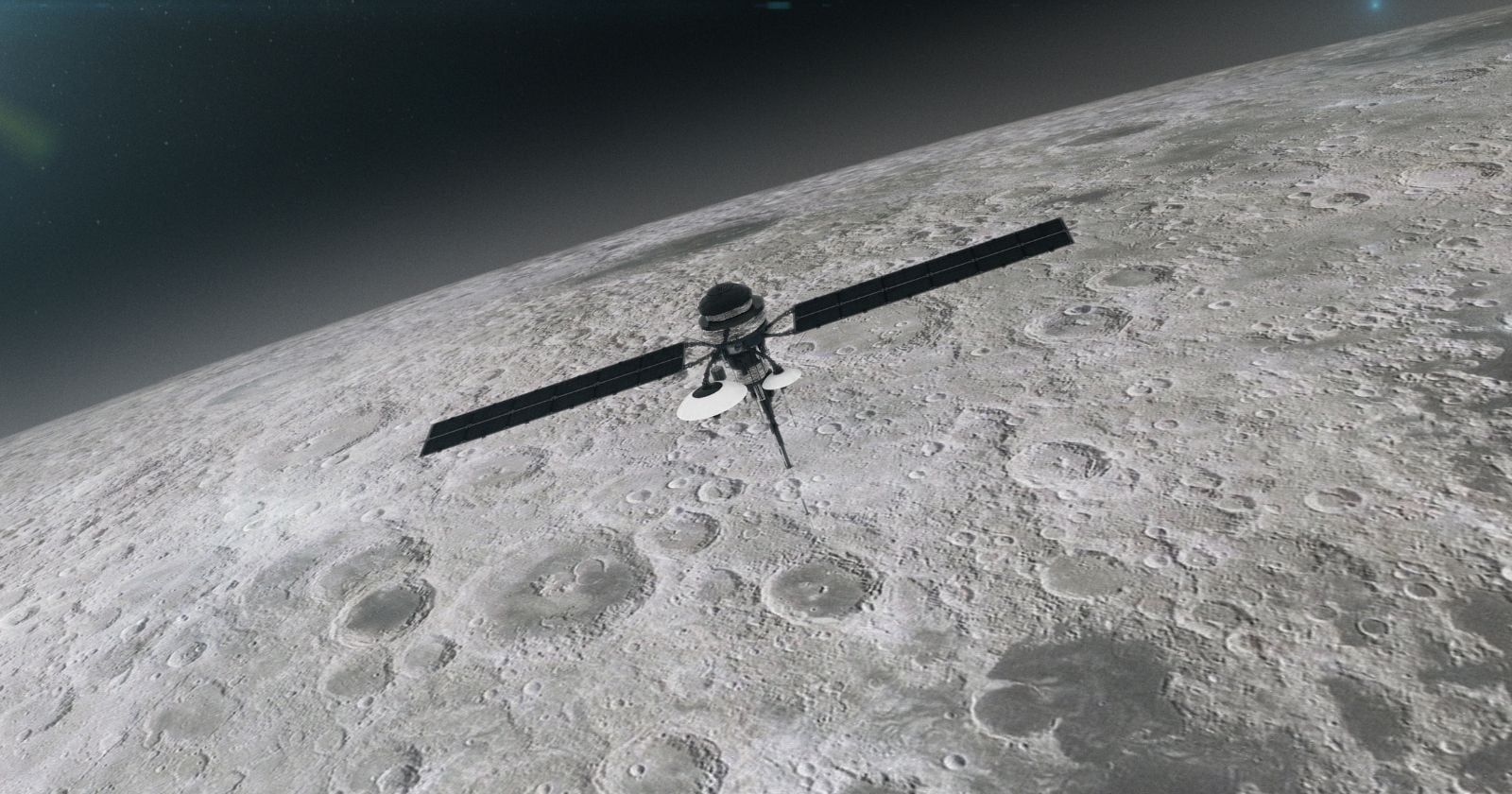
For 48 minutes out of every two-hour orbit around the Moon in July 1969, Michael Collins was the only human being alive who could not talk to any other human being alive. He was flying the command module Columbia above the lunar surface, and each time his orbit carried him behind the far side, the Moon itself blocked every radio signal from Earth and from the lunar module Eagle sitting in the Sea of Tranquility below. No voice, no telemetry, no beacon. Just the spacecraft ticking, his own breathing, and a view of stars nobody had ever seen from that angle before.
By the reckoning of physical distance from every other member of his species, he was the most isolated human being who had ever lived. And by his own written account, he was fine.
The geometry of being unreachable
The Moon is a solid rock about 2,159 miles across. Radio waves travel in straight lines. When a spacecraft orbits behind it relative to Earth, the rock sits between the antenna and home, and the signal simply stops. Mission controllers call this loss of signal, or LOS. On Apollo 11, Collins looped once every two hours, and each loop included roughly 48 minutes on the far side with no way to reach Earth or the two men on the surface.
The same geometry still governs lunar missions today. The BBC has noted that the Artemis crews expected to circle the Moon in the coming years will lose contact for about 40 minutes on each far-side pass, a shorter window because of a different orbit but the same physics. Fifty-seven years of engineering progress has not changed the shape of the Moon.
Collins made that pass multiple times. He spent more than ten hours in total radio silence during the mission, alone in a small aluminum cabin, watching a landscape that no camera on Earth could see in real time.
What alone actually meant
Astronauts are rarely alone in any meaningful sense. Even on a solo spacewalk, a voice from Houston is always in the earpiece. On the International Space Station, there are crewmates a few metres away and a live downlink humming in the background. Collins, on the far side of the Moon, had none of that. His two crewmates were on a body he could not see. Earth was blocked. The tracking network at Goldstone and Honeysuckle Creek could hear nothing from him and he could hear nothing from them.
In Carrying the Fire, the memoir that has been called the best and least maudlin of the Apollo-era astronaut memoirs, Collins wrote the line that has followed him ever since: “I am alone now, truly alone, and absolutely isolated from any known life.”
Then, in the same passage, the turn: “I feel this powerfully — not as fear or loneliness — but as awareness, anticipation, satisfaction, confidence, almost exultation.”
He was 38 years old. He had trained for years. He was flying a spacecraft that had to work perfectly if his two crewmates were going to come home. And he found the silence, by his description, closer to a form of quiet contentment than to dread.
The man in the third seat
Collins was born in Rome in 1930, the son of a U.S. Army officer whose postings moved the family around the world. He went to West Point, joined the Air Force, and became a test pilot. He applied to NASA and was selected as an astronaut, joining the same class as Buzz Aldrin.
His first spaceflight was Gemini 10 in 1966 with John Young. On that mission Collins performed two spacewalks. The crew came home, and three years later NASA assigned him to the third seat of Apollo 11.
The third seat is the one people forget. Armstrong and Aldrin went down to the surface in Eagle. Collins stayed in Columbia, flying the ferry that had to still be there when the lunar module came back up. If the ascent engine on Eagle failed, there was no rescue plan. Collins would fly home alone. He knew this. He had rehearsed it.
Why he wasn’t lonely
Collins spent over twenty hours alone in lunar orbit. During each 48-minute far-side pass he was farther from other people than anyone in history — the two nearest humans were on the surface below the horizon, and the next-nearest were a quarter of a million miles away and blocked by 2,000 miles of rock. He was, in the phrase used in a Hackaday tribute after his death in 2021, alone but not lonely.
Part of that was temperament. Collins had a dry, self-deprecating streak that ran through everything he wrote. Collins wrote with dry humor about the differences between his generation of astronauts and earlier aviators, describing the technical and procedural nature of Apollo-era spaceflight compared to the romantic barnstorming era. He never seemed to want the surface. He wanted the job he had.
Part of it was training. The command module was a cockpit he understood in every detail. He had checklists, star sightings to take, systems to monitor, and a rendezvous coming up that had to be flown right. Silence in that environment is not empty. It is full of work.
And part of it, he suggested, was the view. On the far side, out of contact, he could see stars against a black sky sharper than any night on Earth. He could see the pocked, cratered landscape sliding past his window. He was watching a world nobody had watched from that vantage point in the history of the species.
The quiet return
When Armstrong and Aldrin lifted off from the surface on 21 July 1969, Collins had to catch them. The rendezvous went cleanly. Eagle docked with Columbia. The three men flew home together and splashed down in the Pacific on 24 July.
Collins retired from NASA the following year. He almost certainly would have been given command of a later Apollo mission and probably walked on the Moon himself. He chose not to. In an Esquire profile published for the 50th anniversary in 2019, Collins described himself as perfectly fine with the label of forgotten astronaut.
He served briefly in the State Department, then in 1971 became director of the Smithsonian’s National Air and Space Museum, overseeing the opening of its new building on the National Mall in July 1976. The command module Columbia — the actual spacecraft he flew — is one of the artifacts on display, and the museum’s own account of his solitary orbit preserves the words Mission Control broadcast at the time: not since Adam had any human known such solitude.
What the far side revealed
Collins is one of the cleanest examples anyone has of what it looks like when a person is given the loneliest 48 minutes ever measured and finds in them not a hole to fall into but a room to sit in.
He would not have described it that way. He described it in the plain sentences of a test pilot. The passage in Carrying the Fire ends without drama. He notes that he is alone, notes that the feeling is not fear, and gets on with flying the spacecraft.
Collins is the one whose story fits in the gap between the transmissions.
The last of the crew
Michael Collins died on 28 April 2021, at age 90, after what his family described in a public statement as a battle with cancer. The obituary carried by the Marco Eagle in his adopted state of Florida noted that he had lived quietly for years on the Gulf Coast, fishing and painting watercolours.
Armstrong died in 2012. Aldrin is the last of the three still living. The command module Columbia, meanwhile, still sits under museum lights on the National Mall, its heat shield scorched, its interior still smelling faintly, according to conservators, of the mission it flew. Anyone who walks past it can be closer, in that moment, to the vehicle that carried Collins around the far side of the Moon than Collins himself was to any other person for those 48 minutes in July 1969.
The Moon is still up there. The far side is still a place where radio signals stop. And somewhere in the archives of NASA’s tracking stations there are gaps in the tape — quiet stretches, each about 48 minutes long — where a man was flying a small ship over a dead grey landscape and, by every account he ever gave, was not lonely at all.