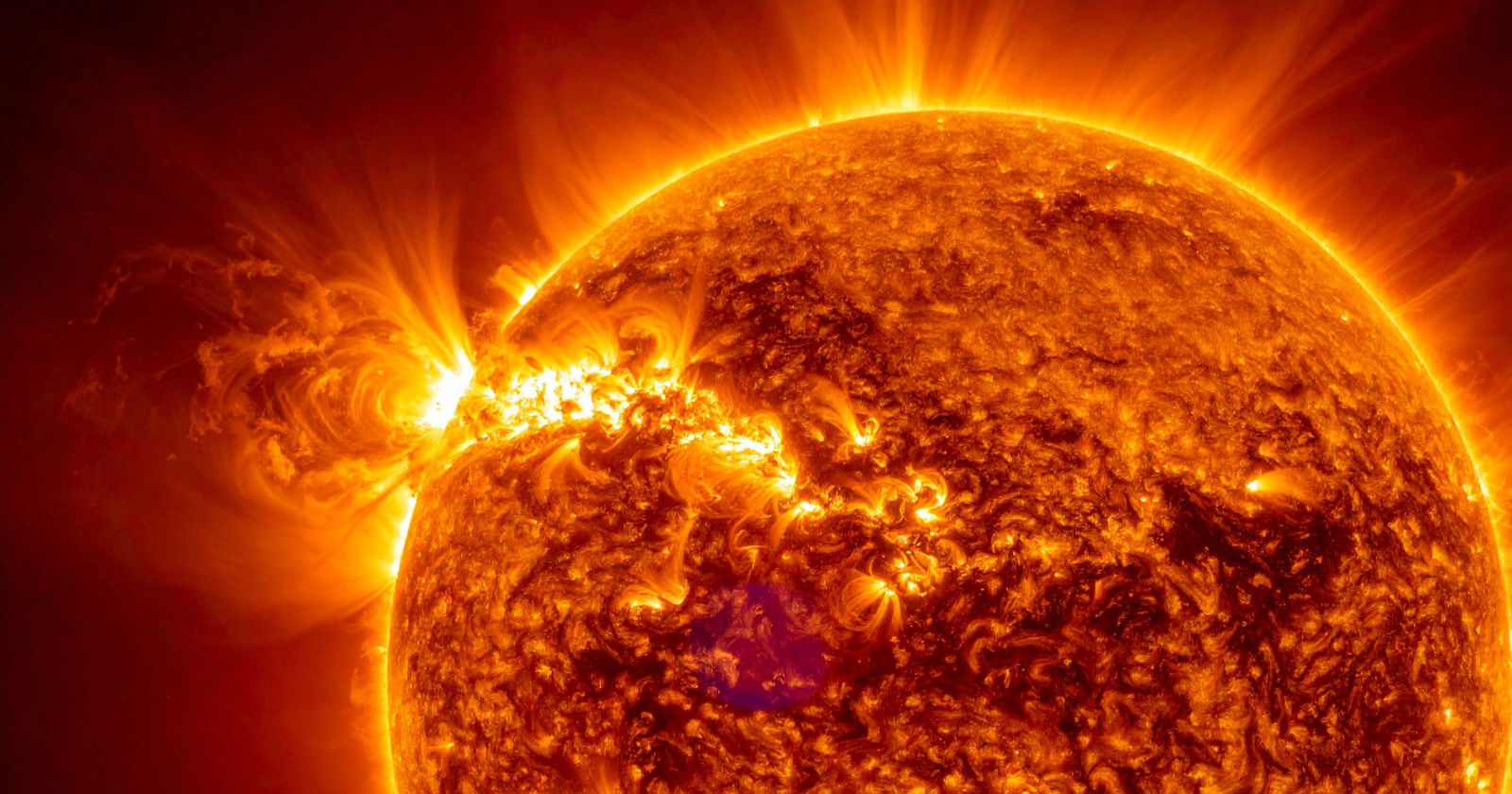
Start with the number, because it doesn’t quite fit in your head. According to a NASA educational resource, “Every second, a star like our Sun converts 4 million tons of its material into heat and light through the process of nuclear fusion.”
Not four million tonnes a day, or a year. A second. By the time you finish reading this sentence, the Sun has turned several mountains of it’s own weight into light.
The mass isn’t smashed or burned in the everyday sense. It’s converted. It stops being matter and becomes energy, which is a stranger idea than burning, and once you sit with it, a much better one.
How the Sun actually pulls this off
The engine sits in the Sun’s core, and it runs hot.
The ITER fusion organization describes it plainly: “In the Sun’s core where temperatures reach 15,000,000 °C, hydrogen atoms are in a constant state of agitation.” At those temperatures, atoms don’t sit still. They’re stripped down and flung around.
What makes fusion possible is a combination of crushing pressure and heat. As EUROfusion puts it, “The Sun’s gravitational force confines the positively-charged hydrogen nuclei and the high temperatures cause the nuclei to move around furiously.” Normally those positively charged particles push each other away, like two matching ends of a magnet. Push them hard enough, fast enough, and they slam together and stick.
The result is that four hydrogen nuclei end up fused into a single helium nucleus. The quietly astonishing part: the helium that comes out weighs slightly less than the four particles that went in. About 0.7 percent of the mass disappears. That missing sliver doesn’t vanish into nothing. It leaves as energy, following Einstein’s equation linking mass and energy, E=mc². Because the speed of light in that equation is such a large number, a tiny amount of lost mass releases an enormous amount of energy. Small mass, colossal light.
Scale it up and the “four million tonnes” figure falls out. The Sun fuses roughly 600 million tonnes of hydrogen every second, and only that 0.7 percent slice becomes pure energy. One source puts the precise conversion at 4.26 million metric tonnes of matter per second. The “mountain” in the framing is not an exaggeration. If anything it’s rounding down.
Four and a half billion years of this
Now stretch that rate across time. The Sun formed about 4.6 billion years ago, dated from the oldest material in the solar system. It has been running this reaction, more or less steadily, the entire time.
So here’s the question that number invites. If the Sun has been shedding millions of tonnes a second for billions of years, how is there anything left?
The answer is that the Sun is almost unimaginably large to begin with.
Even at that rate across its whole lifetime, the share of its total mass lost to fusion comes to only about a fraction of a percent. The mountain-per-second rate is terrifying on a human scale and trivial on a solar one, and both things are true at once. That’s most of what makes the Sun hard to think about.
What eventually runs out
The Sun isn’t infinite, though. It’s burning through a limited supply of hydrogen in its core, and one day that supply runs out. When it does, the core fusion stops and the whole structure changes.
How long is left? NASA’s science page says that “Scientists expect it will remain one (a star) for another 5 billion years before becoming a red giant.” Note the “expect.” This is a projection built on how stars the Sun’s size behave, not a date on a calendar. But it’s well grounded, and five billion years is the working figure.
When the hydrogen finally gives out, the Sun will swell into a red giant, large enough to trouble the inner planets, and eventually shed its outer layers. That’s the real “destruction” in the Sun’s story, and it’s a long way off.
What stays with me is the arithmetic of indifference. All of recorded human history, every empire and language and story we’ve ever told, fits inside a few thousand years. The Sun has another five billion years of fuel left. It has been quietly turning mountains into light this entire time, and it will keep doing so long after anyone reading this is here to notice. That’s not a tragedy. It’s just the scale we actually live on, stated plainly.