

The coldest temperature ever measured on Earth was not read from a thermometer. It was read from orbit, over the East Antarctic Plateau, where satellite sensors clocked the snow surface at minus 98 degrees Celsius — about minus 144 degrees Fahrenheit. The finding, published in 2018 by a team led by Ted Scambos at the National Snow and Ice Data Center, pushed the known floor of Earth’s surface temperature about five degrees below the previous satellite record. The lowest of those readings dates to 10 August 2010.
At that temperature the body’s defences run out of margin. Air that cold and that dry pulls heat and water out of the respiratory tract faster than tissue can replace either. A single unprotected breath would hurt, and it would do damage — not to the lungs, which are better shielded than the folklore suggests, but to the passages that condition the air on its way down.
Nobody has ever stood in air that cold. The satellite reading is of the ice surface itself, in the small hours of the polar night, on a plateau where no station operates. But the people who spend winters closest to it, at Concordia Station about 3,230 metres up on Dome C, have come within striking distance.
What the satellites actually saw
The minus 98 figure comes from thermal infrared sensors, not thermometers. MODIS instruments aboard NASA’s Terra and Aqua satellites, along with instruments on NOAA’s polar-orbiting weather satellites, measure the radiation emitted by the ice surface and convert that signal into a temperature. The 2018 paper in Geophysical Research Letters re-ran that conversion using recalibrated satellite data and fresh comparisons against automatic weather stations on the ground.
Scambos and his colleagues worked through the plateau’s winters between 2004 and 2016 — a windswept expanse roughly the size of Australia, carrying almost no instruments. Across a broad high region above 3,500 metres, the snow surface dropped below minus 90 almost every winter. Within that region, nearly 100 separate locations touched minus 98. An earlier sweep through 32 years of satellite imagery, presented in 2013, had put the floor at minus 93.
The record is a satellite record. The World Meteorological Organization still recognises the ground-station reading taken at Vostok on 21 July 1983 — minus 89.2 degrees Celsius — as the official coldest air temperature ever measured on the planet.
Why the plateau gets this cold
Three ingredients have to align.
The first is altitude. Dome C and Dome A on the East Antarctic Plateau sit more than three kilometres above sea level. The air is thin, and thin air holds very little heat.
The second is dryness. The plateau is one of the driest places on Earth, a polar desert. Water vapour is the atmosphere’s most effective greenhouse gas, and without it, heat radiating up from the ice escapes almost directly to space.
The third is stillness. When the sky is clear and the wind drops, a layer of extremely cold air pools against the ice while slightly warmer air sits above it — a temperature inversion. A 2022 study in the Journal of Geophysical Research: Atmospheres, described in reporting on Concordia’s weather record, examined how clouds and blowing snow act like a blanket over Dome C, holding warmth near the ground. Take the blanket away and the surface bleeds heat into the sky for days.
In the shallow hollows Scambos identified, the pooled cold air has nowhere to drain. It just sits. If the clear, still, dry conditions hold for several days running, the surface can slide down to minus 98.
What that temperature does to an airway
Human respiratory tissue sits at about 37 degrees Celsius. The nose and upper airway warm and humidify every breath before it reaches the lungs, and they are remarkably good at the job — good enough that the lungs themselves stay close to body temperature even in severe cold.
Which is why the popular image of frozen lungs is wrong. Clinicians are direct about it: the lungs are encased in the chest and the airway conditions the air on the way down, so freezing lung tissue is not the risk. Cold, dry air does its damage higher up. Drawing it in strips water from the cells lining the airway, and the irritation that follows triggers bronchospasm — narrowing, tightness, a burning cough. Controlled trials of healthy adults exercising at minus 15 degrees Celsius have measured airway symptoms and markers of epithelial stress after a single session.
The plateau sits far beyond that range. Concordia crews step outside into air near minus 70 to minus 80 in deep winter, and the standard kit is a balaclava or a heat-and-moisture-exchange mask that pre-warms and rehumidifies each breath. Polar workers have breathed air well below the temperatures used in any laboratory study without freezing anything. What they report is pain, coughing, and a strong incentive to cover the face.
At minus 98, nobody knows exactly, because nobody has been there. The honest version is that the airway, not the lung, is the organ at risk, and the risk scales with how cold and how dry the air is. The plateau is the driest place on the planet as well as the coldest: the atmosphere above the ultracold sites can hold less than 0.2 millimetres of precipitable water. An unprotected breath there would be injuring tissue on the way in.
The people closest to the record
Concordia Station, jointly run by Italy’s National Antarctic Research Program and the French Polar Institute Paul-Émile Victor, sits on Dome C at 3,230 metres. It is not in the coldest pocket — that lies deeper in the plateau, uninhabited — but it is close enough to give a sense of the neighbourhood.
On 18 July 2026, the station recorded minus 84.1 degrees Celsius (minus 119.4 Fahrenheit) at 6:25 a.m. and again at 6:34 a.m. local time. It was the lowest ground-station temperature recorded anywhere on Earth since 2012, and it came within 0.6 degrees Celsius of the station’s own all-time low of minus 84.7, set on 13 August 2010.
The reading came from the station’s automatic weather station, installed in January 2005 and logged by the Antarctic Meteo-Climatological Observatory. Nobody had to walk outside to take it.
Which is fortunate, because in July the sun does not rise. Concordia’s winter crew — up to 16 people — lives through four straight months of darkness, cut off from any possibility of aircraft rescue. The nearest other humans are about 600 kilometres away at Russia’s Vostok Station.
The European Space Agency sponsors a medical doctor to winter over with the crew each year, studying sleep, mood, teamwork and physical health under conditions that mirror a long-duration crewed mission. The station’s nickname is White Mars, and ESA uses it without irony: the people at Concordia are more isolated than astronauts on the International Space Station.
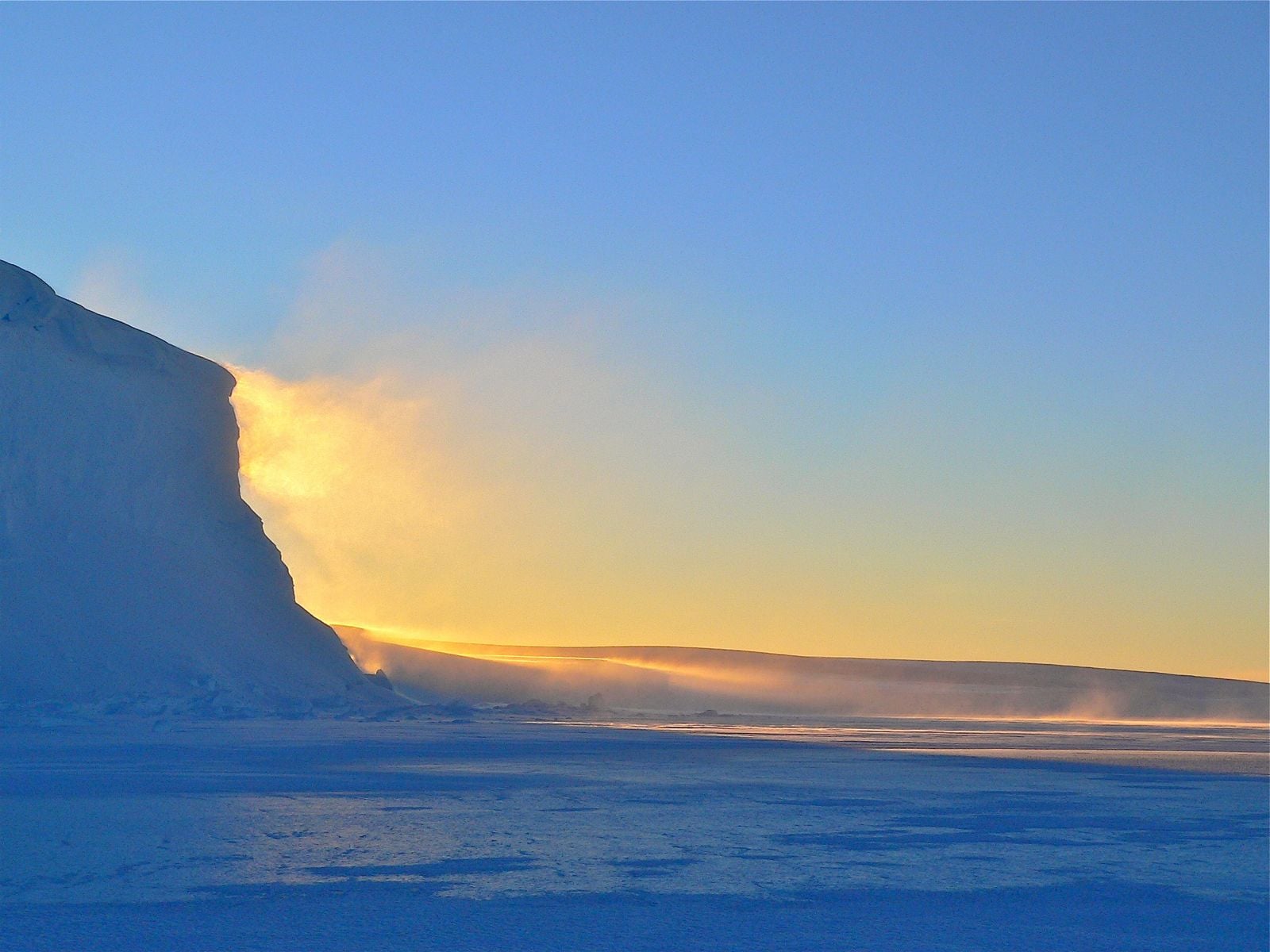
Concordia’s coldest recorded reading is nearly 14 degrees warmer than the satellite figure from the ultracold sites, and most of that difference is a matter of what is being measured. Station instruments read air temperature at about three metres above the ice. The satellite reads the skin temperature of the snow itself, which on a clear, still winter night can run several degrees colder than the air just above it.
The ultracold sites are also higher and further inland than Dome C, along the ridge running toward Dome A. So the two figures are not directly comparable. They describe the same phenomenon from different angles: a plateau where, when the weather cooperates, the ordinary rules of terrestrial temperature stop applying.
The verified station records bracket the planet neatly. The highest air temperature the World Meteorological Organization accepts is 56.7 degrees Celsius, logged in Death Valley in 1913. The lowest is minus 89.2, at Vostok in 1983. Roughly 146 degrees separates them. The plateau’s snow surface, in the right hollow on the right night, goes lower still.
What the record does not mean
Extreme cold in the Antarctic interior is not evidence against global warming. It is evidence that Antarctica is a very particular kind of place. The 2022 atmospheric study found the mechanism depends on persistent clear skies and light winds — conditions that can still occur even as the continent, on average, warms.
At the other end of Antarctica, the picture looks nothing like the plateau. Argentina’s Esperanza base on the Trinity Peninsula reached 15.4 degrees Celsius (59.7 Fahrenheit) on 6 June 2026, beating the station’s own winter record, set in 1998, by two degrees. It happened during a heatwave that held daily maximum temperatures above freezing for three consecutive weeks. The continent is losing ice mass overall. The Southern Ocean is warming. Krill, penguin colonies and fur seals are being reshaped by conditions that have nothing to do with what happens on Dome A in July.
Gabriele Carugati, the station leader at Concordia during the July 2026 reading, put the distinction plainly to Live Science: climate change describes long-term global trends, while individual weather events can still bring exceptional cold at specific places. The record and the trend are not the same measurement.
Cold that reaches further
Minus 98 Celsius sounds absolute until you leave the planet. The coldest naturally occurring temperature ever measured in the universe sits at the Boomerang Nebula, about 5,000 light-years away, at roughly minus 272 Celsius — one degree above absolute zero, colder than the cosmic microwave background itself. And in laboratories, physicists have gone further still: Space Daily has covered the coolest experiment in the universe, NASA’s Cold Atom Lab aboard the International Space Station, which chills atom clouds to within a fraction of a billionth of a degree of absolute zero.
Against those numbers, the East Antarctic Plateau is warm. Against every other place a human being can theoretically walk, it is the far edge.
The plateau’s ultracold sites have almost certainly gone colder than minus 98 in years no satellite happened to be watching. Scambos put the practical floor only a little below what his team measured: the clear, dry conditions would have to hold for weeks, which he called extremely unlikely. There is no station on the coldest hollows and no plan to build one. The record is, in a real sense, unattended.
Southern Hemisphere winter usually bottoms out in late August, just before the sun returns to the plateau. As of mid-August 2026, the polar night still has weeks to run. Somewhere on Dome A, in a shallow depression in the ice, the surface is quietly radiating heat into a clear sky, and the temperature is falling.