

A funnel-web spider described on 31 August has been found at three sites in northern Idaho and, so far, nowhere else, roughly 500 kilometres east of the Coastal Ranges and western Cascades that were the genus’s previously known distribution. Its describers named it Hexura vandal, after the University of Idaho’s mascot, and argue in the same paper that it is threatened and likely endangered.
The genus Hexura has been on the books since 1885, when Simon described Hexura picea from what was then Washington Territory. A second species, Hexura rothi, arrived in the genus’s only previous revision, in 1979. Both live west of the Columbia Basin, in mesic conifer forest: H. picea from southern Vancouver Island down to central Oregon, H. rothi in a smaller range the paper’s introduction puts at central to southern Oregon and its own distribution section at southwestern Oregon. Until this paper, the eastern edge of the genus was the western Cascades.
What the team found under the logs
The paper calls Hexura‘s way of living opportunistic. They build silken funnel-web retreats under or inside logs, or in the moss mats of damp conifer forest, and in the case of the new species the paper notes that the entrance of the funnel can usually be seen from outside the retreat.
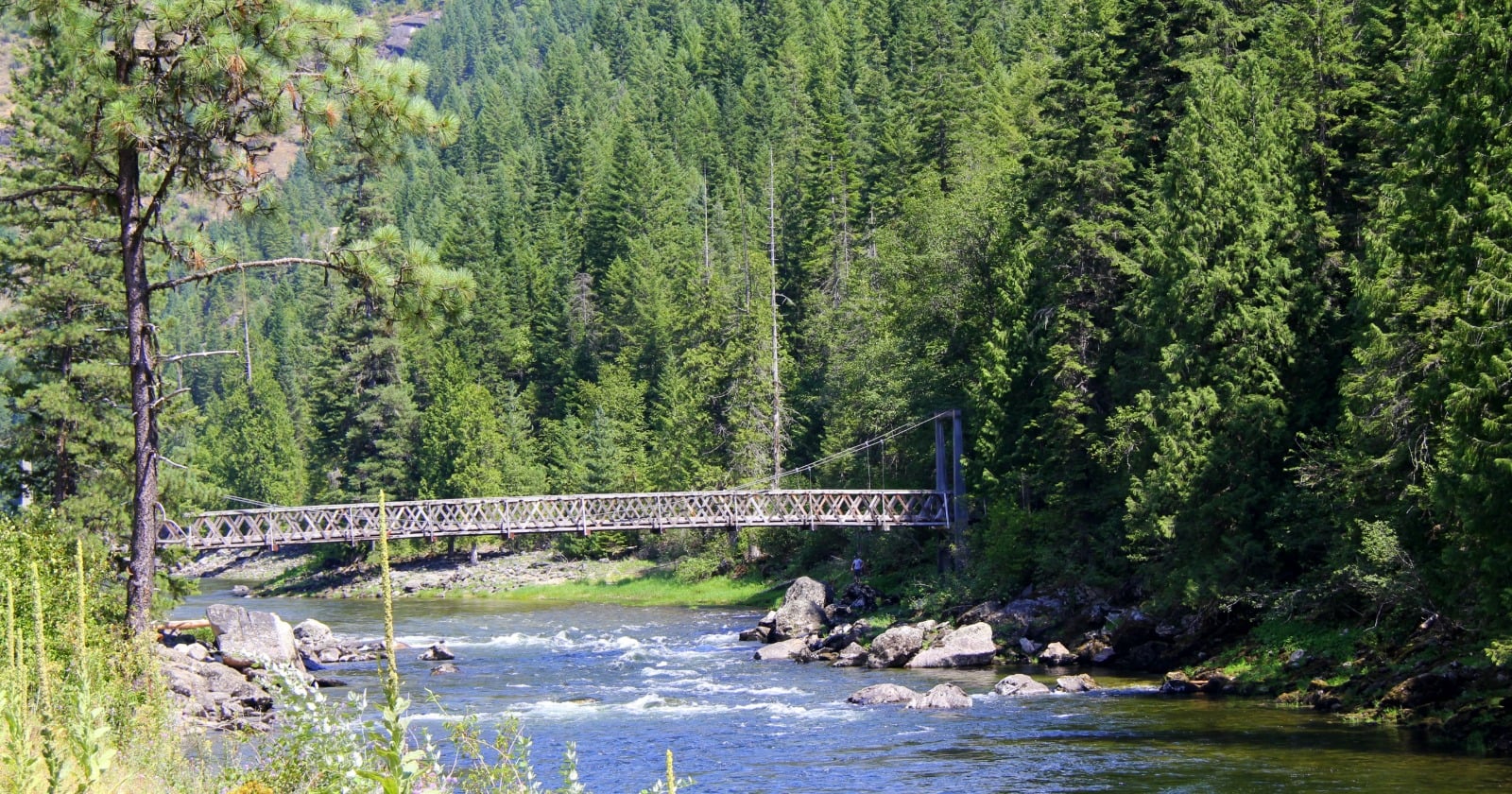
Arnau Calatayud-Mascarell, Ethan J. Briggs and Chris A. Hamilton collected it at three localities on four dates between September 2024 and September 2025: Apgar Creek, north of the campground near Kooskia in Idaho County, and two sites off Road 103 in Clearwater County, on Lolo Creek and near Weippe. All three sit between 1,050 and 1,300 metres in mixed conifer forest with a dense fern understory, in cool, moist spots the paper describes as north-facing slopes, riparian zones or shaded canyons.
The male holotype has a total length, including chelicerae and spinnerets, of 11.1 millimetres. The female paratype, measured the same way, is 13.1 millimetres. The paper describes the cephalothorax and chelicerae as light brown with dark streaks running from the side margins into the fovea, the appendages, spinnerets and sternum as yellow cream, and the abdomen as dark brown, adding a detail anyone comparing photographs will want: specimens look darker alive.
The 500-kilometre gap
Mygalomorph spiders are poor travellers. They are long-lived, faithful to a particular microhabitat, and disperse badly, which makes them unusually good recorders of where wet forests used to connect and where they were cut apart.
The barrier the paper points to is the Columbia Basin, which formed and progressively dried out from the late Miocene into the early Pliocene, and which the paper describes as a significant obstacle to species adapted to the moist forests of the Pacific Northwest. Ecologically similar mygalomorph genera such as Antrodiaetus and Microhexura were already known from both the Cascades and the Rockies.
Hexura was not.
Earlier work using ultraconserved elements estimated the origin and splitting of Hexura at somewhere between 60 and 180 million years ago, which the new paper reads as marking the genus a relictual lineage with a deep evolutionary history. A relict lineage sitting 500 kilometres east of its congeners is an argument about how those forests were joined in the deep past. The new paper does not settle it. It flags an active debate over whether divergences between Cascade and Rocky Mountain populations are recent or ancient, and adds a data point to it.
The genetics came out cleaner than the bodies
The new paper assembled an ultraconserved-element dataset of 26 specimens from 14 species spanning every family in the mygalomorph superfamily Atypoidea, combining newly sequenced material with reads pulled from the Sequence Read Archive, and recovered 728 loci and 292,837 base pairs at 60 per cent matrix occupancy.
On that data all three Hexura species come out monophyletic at maximum ultrafast bootstrap support, 100, with the Idaho species recovered as sister to H. picea and H. rothi as sister to the other two, both of those placements at 99. A separate species-tree analysis returned the same relationships at the highest possible support value.
The tree also speaks to an old field mark. H. picea has three pairs of spinnerets and H. rothi has only two, a difference the paper calls enough to distinguish the two easily. The Idaho species has three pairs and falls next to H. picea, which the authors say suggests three pairs may be the derived condition in the genus, with two pairs the ancestral state retained in H. rothi.
The morphometrics were less decisive. The team took 29 measurements, 27 somatic characters plus two male sexual ones, on 27 specimens. For males, principal component analysis and non-metric multidimensional scaling showed no distinct clustering, though the authors record subtle tendencies toward separation. For females, the paper reports that the analyses of all measured characters do not reveal distinct clustering among species, while noting that the morphospace plots suggest subtle tendencies of divergence. Only the canonical variate analysis separated the three species cleanly, which the running text reports without naming a sex, and the authors say plainly what canonical variate analysis does: it maximises discrimination among groups that have already been defined.
The counts of the animals need care as well. The paper’s phenology note rests on two mature males, recorded as “August, N = 2″, and its morphometric sample includes two H. vandal males. Its list of material examined itemises one, the holotype. The paper does not reconcile the two figures.
Named for a mascot, and a 1917 basketball write-up
The species epithet is “vandal”, a noun in apposition, and it points at the University of Idaho, which the paper says is the only Division I university using the Vandals as its mascot.
The nickname goes back to 1917, when a student journalist named Harry Lloyd McCarty described the aggressive defence of the men’s basketball team as vandalising their opponents, and the university adopted it. The paper’s etymology section says the name honours the university, which provided partial funding for the study. Hamilton put the lab’s reasoning more bluntly in the publisher’s announcement: the spider is found only in Idaho, it is not very far, relatively speaking, from campus, and it is a predator that attacks.
The paper’s acknowledgements thank Marshal Hedin and an anonymous reviewer for comments on the manuscript. Hedin first-authored the 2019 study that moved Hexura out of the family Mecicobothriidae and into the Antrodiaetidae, after the older family turned out not to be a natural group. This new paper describes itself as the first taxonomic information on the group in almost fifty years, and it arrives seven years after that reclassification.
A negative result from country that is hard to sample
The authors ran multiple sampling campaigns radiating outward from the known sites and found nothing. They also record that the area is fairly remote and, in their words, “is limited by forest roads that make it difficult to conduct comprehensive sampling throughout the region”. Both of those sentences sit in the same paragraph. A negative result from hard-to-sample country constrains the known range, not the actual one.
The species itself is well supported. It is the map that is thin.
“Threatened and likely endangered” is the authors’ own assessment, offered as a case for protection; it is not a formal listing. Their reasoning is specific: logging is common through the area, there is a lack of protected habitat, wildfires are common and increasing, and fire season overlaps the spiders’ mating season. That argument is coherent. The paper does not claim it has been made formally.
The paper’s introduction also says the discovery comes “one hundred and fifty years after the discovery of Hexura“, but the genus dates from 1885, which is 141 years on our count, against the paper’s 150. And the description of the species as black comes from a quote in the publisher’s announcement; the formal description in the paper gives light brown, yellow cream and dark brown, with the note that live animals look darker.
No viable egg sacs
The natural history section ends quietly. Three females were kept in captivity and produced egg sacs in late May, a few weeks after collection, which is the paper’s basis for suggesting that spiderlings likely hatch in spring. None of the egg sacs were viable.
Which leaves the funnel.
Back at Apgar Creek, north of the campground near Kooskia, the entrance to a Hexura vandal funnel web can usually be seen from outside the retreat, if you know to look for it. That is where the holotype was collected, on 19 August 2025. It is one of the three places anyone has yet found this animal.