

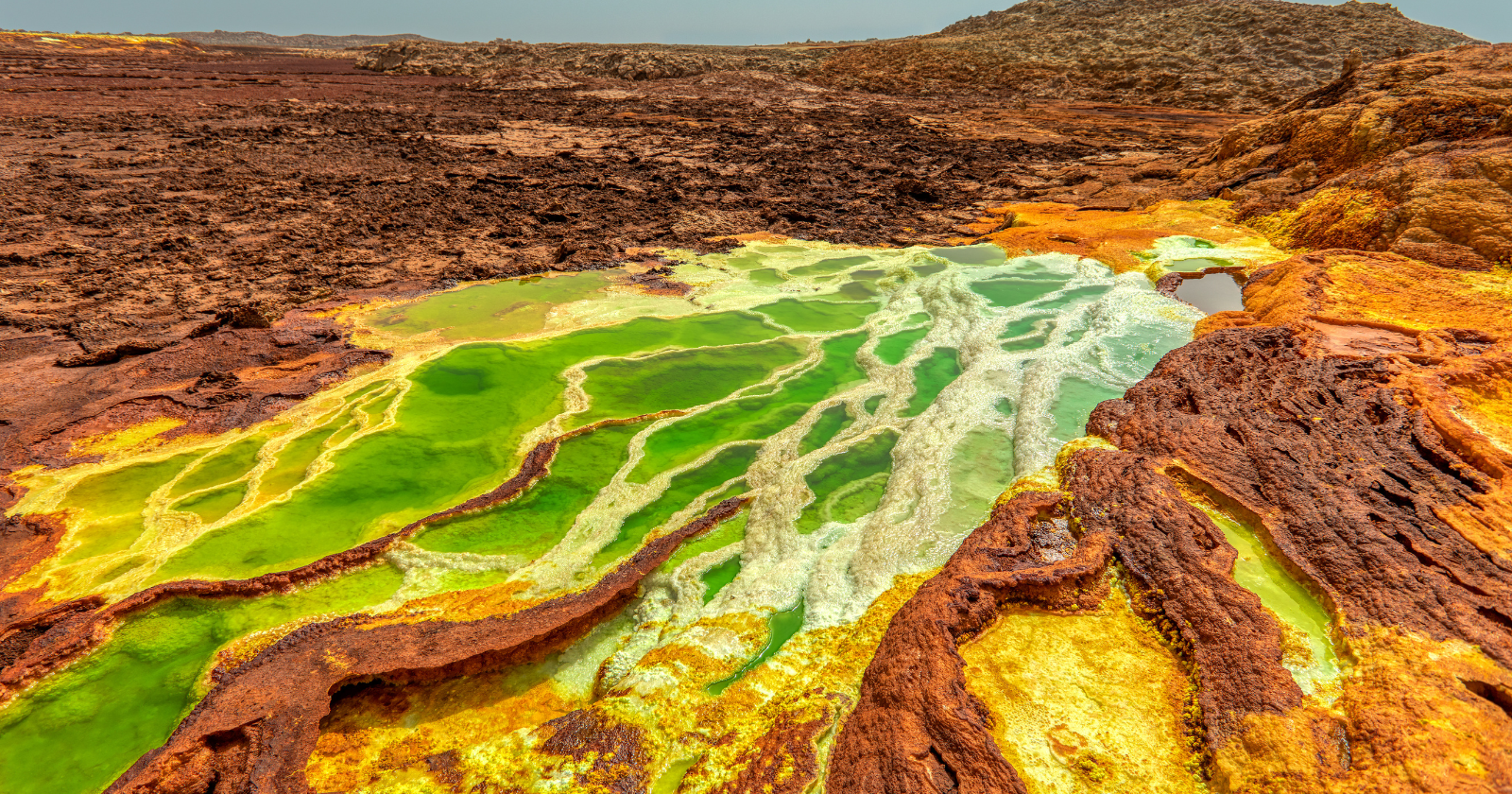
Near the base of the Dallol hydrothermal field in Ethiopia’s Afar region sits a pond barely 60 meters long, its water tinted pale yellow by dissolved iron. Chemists who sampled it found a total dissolved solids concentration of 433 grams per kilogram — 43.3 percent by weight — making it, by current measurement, the record for saltiest lake documented anywhere on Earth. The pond is known locally as Gaet’ale, and the figure comes from a 2017 study by Pérez and Chebude of Addis Ababa University’s Department of Chemistry, published in the journal Aquatic Geochemistry.
For context, the world’s oceans average about 35 grams of dissolved salt per liter, according to NOAA ocean salinity data and the USGS salinity reference — putting Gaet’ale at roughly twelve times ocean salinity. That figure is also higher than the Dead Sea, whose salinity is commonly cited around 340 grams per liter in recent measurements, though older or differently calculated figures put it lower — Guinness’s own comparison table, for instance, lists it at 23.1 percent by weight.
Ordinary seawater’s salt is mostly sodium chloride, or ordinary table salt. Gaet’ale’s brine is instead built around calcium chloride and magnesium chloride, at concentrations of roughly 2.72 moles per kilogram and 1.43 moles per kilogram respectively, according to Pérez and Chebude’s analysis, with trace sodium, potassium, nitrate and iron(III) complexes responsible for the water’s yellow cast. The researchers noted the pond’s chemistry closely resembles that of Don Juan Pond in Antarctica’s Dry Valleys, another calcium-chloride-dominated hypersaline pool long studied as one of Earth’s most extreme aquatic environments, though Gaet’ale’s higher temperature allows it to hold even more dissolved salt before reaching saturation.
The pond itself is shallow and crescent-shaped, sitting at around 50 to 55 degrees Celsius, with no inflowing or outflowing stream. According to the Gaet’ale Pond entry, local accounts attribute the pond’s formation to a January 2005 earthquake that reactivated a dormant thermal spring. The broader depression sits more than 100 meters below sea level in places, part of a tectonically stretched landscape laced with active volcanoes, sulfur vents and salt flats left behind by an ancient sea that repeatedly flooded and evaporated over geological time. The nearby Dallol hydrothermal field, roughly four kilometers northwest of the pond, is famous for acid ponds in shades of green, orange and yellow, produced when magma-heated groundwater dissolves the buried salt and mineral layers and pushes the resulting brine back to the surface.
A natural laboratory for other worlds
The combination of heat, acidity and salinity has made the region a working laboratory for scientists who study the outer edges of habitability. A multinational research effort coordinated through the Europlanet research infrastructure has sent microbiologists, geologists and planetary scientists to the depression in recent years. Karen Olsson-Francis and Vincent Rennie of the Open University sampled acidic, saline channels there for signs of microbial survival; Hugo Moors and Mieke De Craen of Belgium’s SCK CEN nuclear research center used the site to test methods relevant to how microbes might behave around deep nuclear waste repositories; and planetary geologists Daniel Mège of the Polish Academy of Sciences and Ernst Hauber of the German Aerospace Center studied Danakil’s salt-and-magma hydrothermal structures as an analog for Martian rift systems, work feeding into ongoing observations from the ExoMars Trace Gas Orbiter.
Jani Radebaugh of Brigham Young University and Ralph Lorenz of Johns Hopkins University’s Applied Physics Laboratory have separately used terrain models from the depression to interpret surface roughness data relevant to Saturn’s moon Titan.
Where even extremophiles give up
The scientific interest in the region’s brine pools goes beyond geology. A 2019 study led by Purificación López-García of the French National Centre for Scientific Research (CNRS), working with researchers from Spain’s Geological and Mining Institute and the Autonomous University of Madrid, searched the most extreme pools in the Dallol field — hyperacidic, near-boiling and saturated with salt simultaneously — for any trace of microbial life. Using genetic sequencing, culturing attempts, flow cytometry and electron microscopy, the team reported finding none, a result summarized by Phys.org as evidence that liquid water alone does not guarantee habitability. The researchers concluded that the pools’ combination of high magnesium and calcium concentrations, extreme acidity and heat produces a “chaotropic” chemical environment that actively breaks down biological molecules instead of simply placing them under stress.
That finding matters for astrobiology because it complicates a common assumption: that any environment with liquid water, however extreme, should host at least some microbial life. A separate 2021 study of nearby, slightly less extreme hypersaline lakes in the Danakil Depression, published in Environmental Microbiology by researchers including members of the same French-Spanish collaboration, found the opposite — diverse communities of salt-loving archaea thriving right up to the edge of what those less punishing pools could support. Gaet’ale itself is hot and dominated by chaotropic calcium and magnesium salts, not the sodium chloride of ordinary seawater. Pérez and Chebude’s 2017 paper focused on the pond’s chemistry rather than a dedicated search for microbial life, but a separate 2021 metagenomic study of Gaet’ale specifically found it dominated by bacteria — unlike the sterile conditions found in Dallol’s most extreme pools.
Together, the pond’s chemistry and its surrounding hydrothermal field illustrate why the Danakil Depression continues to draw researchers from chemistry, microbiology and planetary science alike. A 60-meter pool of scalding, mineral-saturated brine is, on its own, a curiosity of extreme terrestrial chemistry. Set inside a landscape already used to model early Earth, present-day Mars and the hydrocarbon lakes of Titan, it becomes a reference point for a broader question: how much stress a chemical system can absorb before it stops being able to host life at all.