

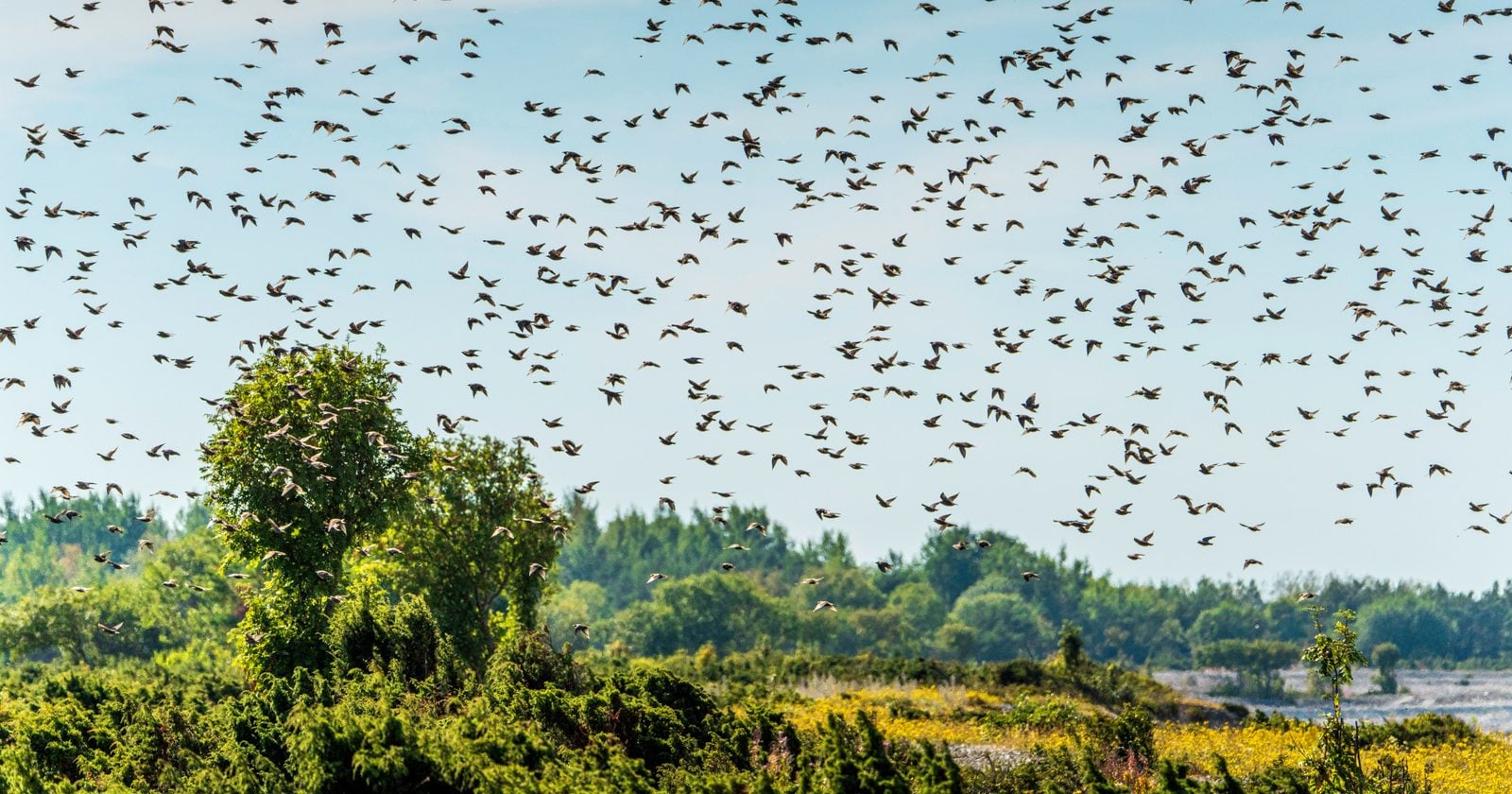
Here is the version you have probably heard. A wealthy New Yorker named Eugene Schieffelin loved Shakespeare so much that he set out to release into America every bird the playwright ever mentioned. The starling gets a single passing line in Henry IV, Part 1, and so, the story goes, Schieffelin freed about a hundred of them into Central Park on a literary whim, and thereby unleashed one of the continent’s most successful introduced species. A tidy, satisfying tale. Most of it is either wrong or unprovable.
The parts that are true are worth stating plainly, because they anchor everything else. Schieffelin, a pharmacist and member of the American Acclimatization Society, did release starlings into Central Park in the early 1890s. Those Central Park introductions became part of the founding history of the tens of millions of European starlings now spread across North America. The birds are real. The scale is real.
What is shaky is the motive, and the moral we hang on it.
The Shakespeare motive is shakier than it sounds
The claim that Schieffelin was on a mission to import Shakespeare’s birds is repeated so often it reads as settled fact. It is not. A 2021 article by literary scholars Lauren Fugate and John MacNeill Miller went looking for the origin of the story and could not find any source from Schieffelin’s own time for it. Miller told reporters the widely repeated tale was mostly fictional.
Their trail leads to a 1947 essay by naturalist Edwin Way Teale, written decades after Schieffelin’s death. That essay appears to be where the Shakespeare-obsession idea enters the record. A colorful detail treated as biography, added long after the man could confirm or deny it.
We would call this careful literary detective work rather than the final word. But it does something useful. It separates the documented event, the release, from the story we have wrapped around it, the motive, and shows that only the first is well supported.
What is solid: the release, the spread, and the cost
Strip away Shakespeare and the ecological facts still stand. The birds spread coast to coast with a speed that startled even the researchers who later studied their genes. A 2021 study led by Natalie Hofmeister at the Cornell Lab of Ornithology traced genetic changes associated with different environments across the continent. “The amazing thing about the evolutionary changes among starling populations since they were introduced in North America is that the changes happened in a span of just 130 years in parallel with a huge expansion in the bird’s range and population size,” Hofmeister said. The study describes the population growing from roughly 80 birds to a peak of about 200 million breeding adults. We would read the rapid-adaptation claim as one team’s interpretation of genetic signals, not a closed case, but the raw expansion is not in doubt.
An often-cited cost estimate exists too. A USDA National Wildlife Research Center review led by George Linz cited an estimate of starling damage to U.S. agriculture at about $800 million a year. But that figure came from an earlier estimate rather than a comprehensive measurement of nationwide losses. The review also noted that starlings may compete with native cavity-nesting birds for nest sites, although broader research has found few population-level effects on most native species studied.
The part the current headlines miss
The population is no longer climbing. It is falling, and fairly sharply. The same Cornell work that describes the 200-million peak also reports the decline to about 85.1 million, roughly half the 1970 level of 166.2 million. Those figures draw on a broader 2019 Science analysis of North American bird losses.
The trend is steady, not a one-off dip. The North American Breeding Bird Survey has clocked starlings declining at over 1.2% a year, adding up to a cumulative loss of about 50% between 1966 and 2023. The bird we picture as an unstoppable invader is, on the numbers, in retreat across the continent it once conquered.
How to hold both truths at once
None of this makes the starling harmless. It does not erase agricultural damage or competition for nest holes. Releasing a species outside its natural range remains a genuinely risky thing to do, and the starling is still an example of how fast such a move can run away from anyone’s control. That cautionary tale holds.
But the morality play, one Shakespeare-obsessed eccentric versus a continent, does not survive contact with the record. The Shakespeare motive appears to have entered the story in 1947.
Schieffelin was not the only person releasing starlings. And the North American population has been shrinking for decades. The starling saga is turning from a pure invasion story into something two-sided: an introduced species that boomed, created real conflicts, and is now in decline itself. The moral we usually draw from it was always a little too clean. The actual history, motive and all, is more interesting for being less certain.