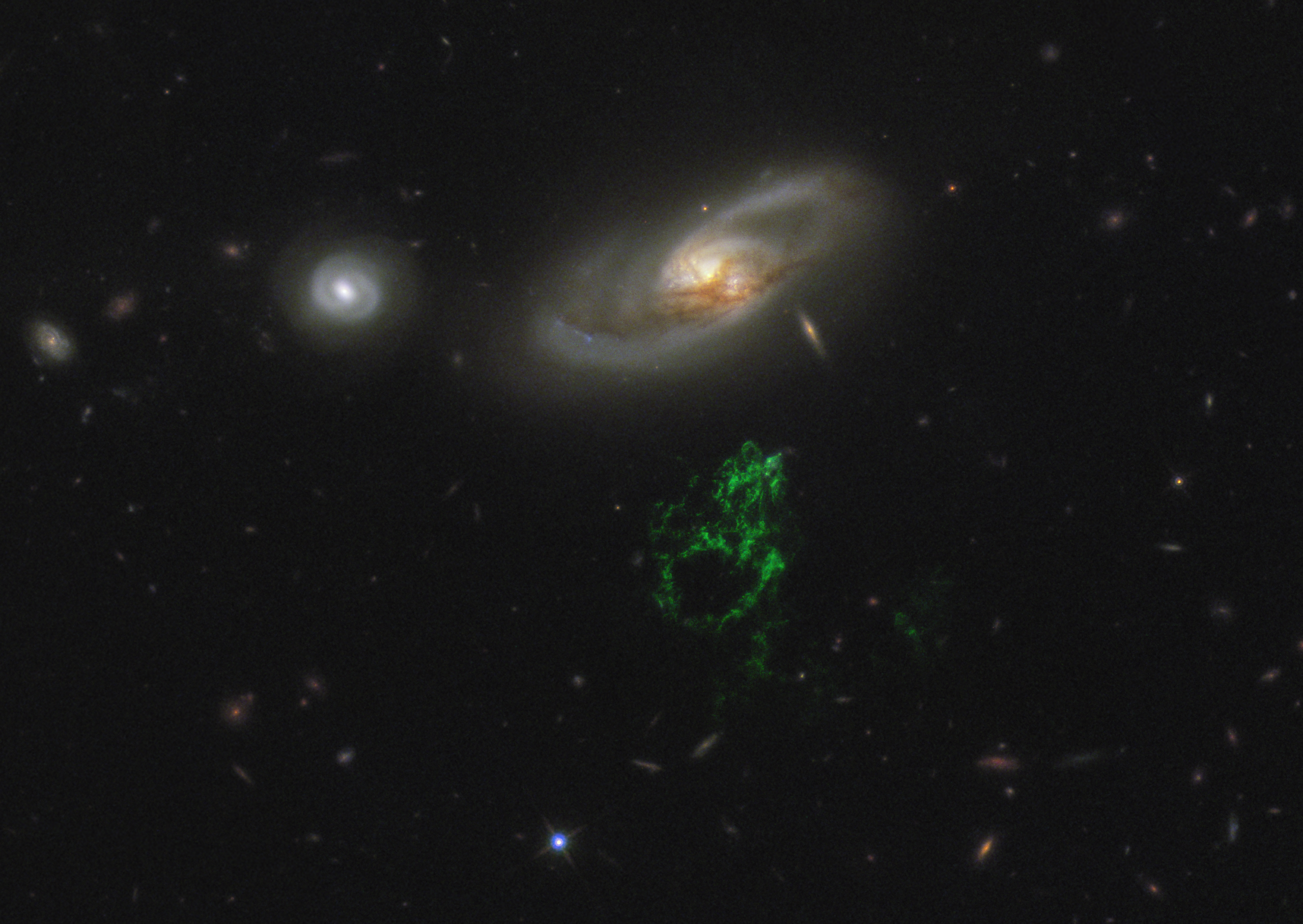
In August 2007, a 25-year-old primary school teacher in the Netherlands called Hanny van Arkel was working her way through the online classification queue of a citizen science project called Galaxy Zoo, which had been asking members of the public to look at individual galaxy images from the Sloan Digital Sky Survey and sort them into categories like spiral or elliptical. She had signed up because Brian May, the guitarist from Queen, had mentioned Galaxy Zoo on his personal website, and she was a fan. On one of the images she was classifying, sitting a little way off from the target galaxy, there was a small bright blue-green smudge that didn’t match anything on the sorting list she had been given. It wasn’t a spiral, it wasn’t an elliptical, and it didn’t look like the kind of image artefact she had been told to ignore. She emailed one of the astronomers running Galaxy Zoo, Chris Lintott at Oxford, to ask what she was looking at. Neither Lintott nor any of his colleagues immediately knew.
What Galaxy Zoo was for
Galaxy Zoo had gone live in July 2007, and the reason it existed was that automated computer algorithms of the time still couldn’t reliably classify galaxy shape from a photograph. Human eyes could, and the Sloan Digital Sky Survey had produced far more galaxy images than professional astronomers could work through themselves. The project put roughly 900,000 galaxy images online, invited anyone in the world to help sort them, and by the time it had reached full operation it had drawn something like 100,000 volunteers doing exactly that. Van Arkel was one of them. What the project’s designers had expected was mainly the sorting output itself, a very large, very reliable catalogue of galaxy morphology. What they had not fully anticipated was that some of the volunteers, looking at those images with fresh eyes, would spot things that hadn’t been catalogued at all. Van Arkel’s blue-green smudge was one of the first, and turned out to be one of the strangest.
What was actually there
The nearby galaxy in the image was called IC 2497. It sits in the constellation Leo Minor, about 650 million light-years from us, and up to 2007 it had been catalogued as an unremarkable spiral. The smudge to one side of it, once astronomers started looking properly, turned out to be a cloud of highly ionised gas the size of a small galaxy, glowing green because of an extraordinarily strong emission line from doubly ionised oxygen. The peculiar thing was the ionisation itself, which was much too energetic to be produced by any ordinary source in the object’s own vicinity. Whatever was lighting the gas up had to be delivering a hard ultraviolet radiation field of essentially quasar intensity. But when the team pointed X-ray telescopes at IC 2497 to look for that quasar, there was nothing there. According to the paper Chris Lintott, Kevin Schawinski, William Keel and colleagues eventually published in Monthly Notices of the Royal Astronomical Society in 2009, the best explanation for that combination of a highly ionised gas cloud and an apparently quiet host galaxy was that IC 2497 had contained a bright quasar in the recent geological past which had since switched off, and that what the cloud was showing was the light echo. The gas is far enough from the black hole that the radiation from the quasar’s active phase is still travelling across it, illuminating it, even though the quasar itself has already gone quiet at the source. The Lintott paper framed the object as, potentially, the first direct evidence that a quasar could shut down on timescales of order a hundred thousand years, which is very short compared to what most models of quasar life cycles had assumed.
What followed the discovery
Follow-up observations turned Hanny’s smudge into a considerably bigger object than it had first appeared. Time was granted on the Hubble Space Telescope, which is heavily oversubscribed and hard to get on, and the Hubble imaging revealed that the visible green Voorwerp was only the illuminated tip of a much larger streamer of hydrogen gas stretching across roughly 300,000 light-years around IC 2497, most of it not currently lit by anything. According to NASA Goddard’s account of the follow-up work, Hubble also picked up clusters of newly forming stars in a small region at the tip of the Voorwerp facing the host galaxy, evidence that gas being blown out of IC 2497 had compressed part of the cloud enough to trigger a modest starburst. Bill Keel, the astronomer at the University of Alabama who led much of the follow-up work, then went back through Hubble archival imagery of 15,000 galaxies that had once hosted quasars, using a further 200 Galaxy Zoo volunteers to look for anything comparable to Hanny’s original object. They found eight more similar structures across the archive. The population of quasars that had switched off within the last hundred thousand years was, on the strength of that survey, no longer an implausible or isolated phenomenon. It was a category.
What the naming actually meant
The object was catalogued in the astronomical literature as Hanny’s Voorwerp, using the Dutch word for object, and it kept that name because that was how the discovering team referred to it and because there wasn’t a more formal designation available. Astronomical objects picked up by professional surveys ordinarily get catalogue numbers rather than personal names, and objects picked up by amateurs traditionally get named after the amateur only in a narrow set of cases, most famously comets. What made this case different was that van Arkel hadn’t spotted anything by pointing a telescope of her own at the sky. She had spotted it in an image on a screen that a professional survey had already collected, that professional astronomers had already looked at, and that the target galaxy of the image had already been catalogued as ordinary. The relevant instrument was her attention. Galaxy Zoo has since gone on to spawn a whole family of related citizen science projects across biology, climate science and history, some of them running under the Zooniverse umbrella that Lintott and his collaborators established. Hanny’s Voorwerp remains the discovery that most clearly shows what those projects are actually for, which is putting a very large number of unpredictable human observations against a very large volume of automatically collected data, and letting the anomalies fall out.