

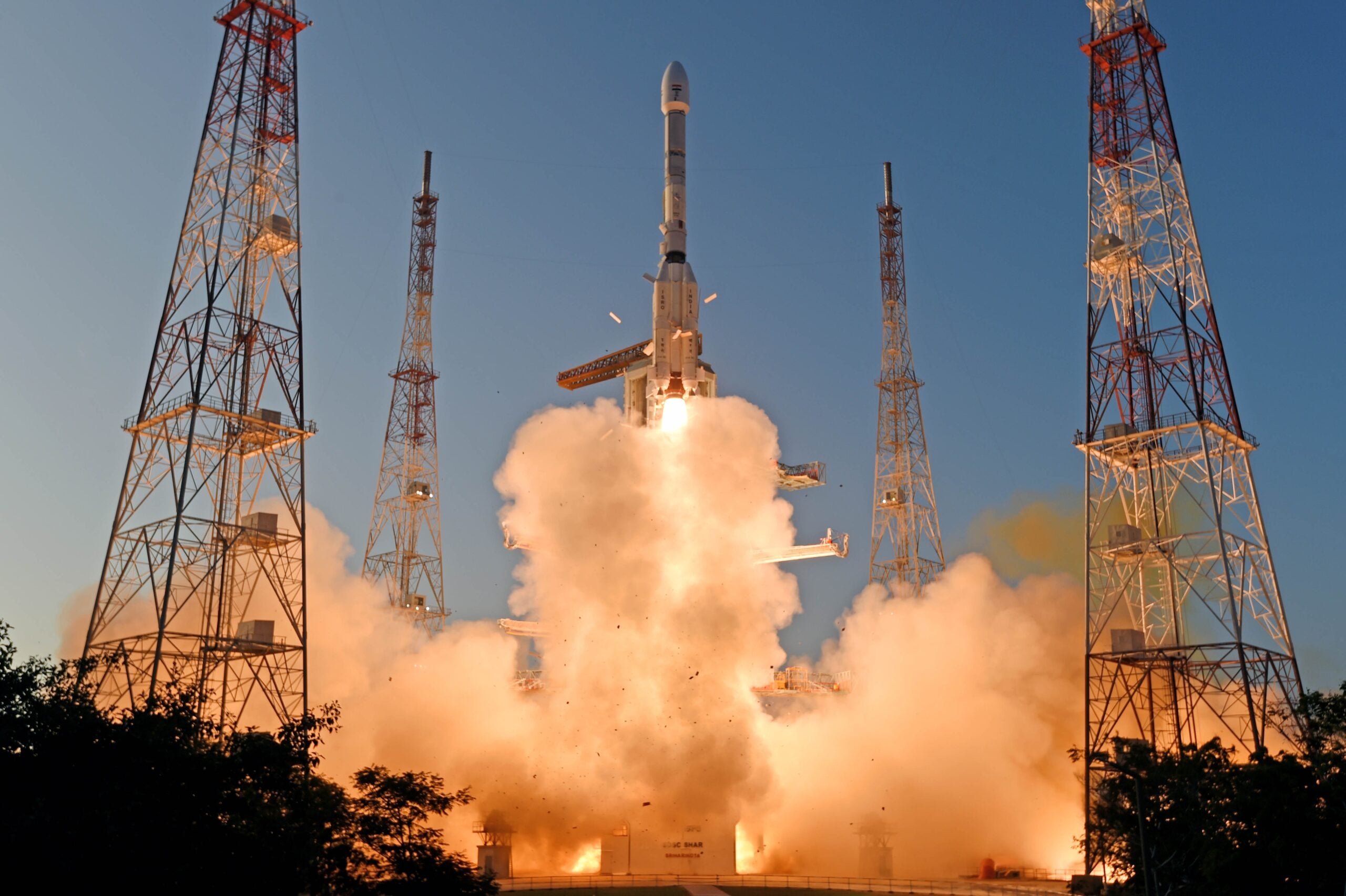
The next second-generation NavIC satellite, NVS-03, is being prepared for flight on a GSLV-Mk2 from Sriharikota, with the first stage of the launch vehicle already stacked and the spacecraft on site, following a government clearance granted in September. Sources told The Times of India that the campaign is targeting a launch window between 15 and 20 October 2026, with a preference for the earlier end of that window — reporting that reflects internal campaign targeting rather than a published Indian Space Research Organisation countdown or an announced launch date.
A campaign that began in mid-September
According to The Times of India, the launch campaign began on 14 September 2026 and the stacking of the GSLV-Mk2 first stage has been completed, with those involved expressing confidence that the remaining vehicle integration and checkout can be finished within a month. That timeline is what produces the 15–20 October framing carried by the newspaper’s sources; ISRO has not issued a formal launch date, and the window should be read as a working target that vehicle integration, spacecraft testing and range availability can still move.
Two elements of the schedule are already settled. The first is the satellite itself: NVS-03 was shipped to the spaceport ahead of clearance, so there is no transport lag between approval and campaign start. The second is the approval. The same report notes that NVS-03 and Gisat-1A had both been waiting on government sanction, which came through in September, unlocking the campaign that is now under way at Satish Dhawan Space Centre.
The GSLV-Mk2 is the standard vehicle for the NVS series, which sits at the heavier end of what India’s navigation satellites have required. The mission profile matters here because of what happened the last time an NVS spacecraft flew, and because the operational gap NVS-03 is meant to close has now been formally acknowledged by the Indian government.
The four-satellite floor
The Navigation with Indian Constellation system needs at least four satellites providing positioning, navigation and timing services in order to deliver standalone positioning — the basic geometric requirement for resolving a receiver’s three-dimensional position plus clock offset without external assistance. NavIC currently sits below that floor.
In a written reply placed on the record and circulated by the Press Information Bureau, Union Minister of State Dr Jitendra Singh set out the constellation’s operational status: after IRNSS-1F reached the end of its mission life, three satellites — IRNSS-1B, IRNSS-1I and NVS-01 — are providing PNT services. The timing service remains functional, but the constellation as presently configured cannot provide standalone positioning service. The same reply states that NVS-03 is ready, and that NVS-04 and NVS-05 are in advanced stages of realisation.
That is an unusually direct statement of a service shortfall, and it explains the sequencing pressure behind the October campaign. NavIC’s timing signals continue to serve users who need a national reference, including sectors that rely on time distribution rather than position fixes. But the positioning service that gives NavIC its strategic rationale — an indigenous regional alternative to foreign constellations over India and a surrounding service area — depends on getting the operational count back to four and then building margin above it.
NVS-03 is the satellite that restores that count, assuming a clean insertion and a successful transfer to its operational slot. NVS-04 and NVS-05 would then provide the redundancy that has been thin across the NavIC programme for several years, as first-generation IRNSS spacecraft have progressively reached the end of their design lives faster than replacements have been launched.
What went wrong with NVS-02
The reason the constellation is short is documented. NVS-02 was launched on 29 January 2025 aboard GSLV-F15 and was injected into an orbit of 170 by 37,039 kilometres at an inclination of 20.8 degrees. The spacecraft’s solar panels deployed and the satellite was healthy in that transfer orbit, but the orbit-raising manoeuvres required to circularise it into its geosynchronous operational slot could not be executed.
The Times of India has reported that the cause was traced to a pyro system anomaly, with an apex committee review pointing to a pyro valve and drive signal issue in the propulsion chain. Without the ability to fire its liquid apogee motor, the satellite could not leave the elliptical transfer orbit it had been delivered into, and the mission could not contribute to the PNT constellation as planned. ISRO’s own mission page for NVS-02 describes the spacecraft’s intended role in advancing NavIC’s second-generation capability.
The distinction between a launch failure and a spacecraft failure is relevant to the current campaign. GSLV-F15 performed its job: the injection parameters were as reported and the satellite separated in good health. The loss occurred downstream, in the satellite’s own propulsion system, during the phase that follows separation. That means the corrective attention for NVS-03 sits primarily with the spacecraft and its pyro-actuated propulsion elements rather than with the launch vehicle, even as the GSLV-Mk2 goes through its standard integration and checkout at Sriharikota.
For NVS-03, the sequence to watch after liftoff will therefore extend well beyond the roughly twenty minutes of powered flight. Injection into transfer orbit, solar panel deployment and initial acquisition are the immediate milestones; the sequence of apogee motor burns over the following days is where the previous mission was lost. Only after the spacecraft reaches and stabilises in its operational slot, and its navigation payload is commissioned, will NavIC return to the four-satellite threshold that Dr Singh’s reply identifies as the condition for standalone positioning. Until then, the mid-October window remains a campaign target, reported by sources, rather than a date on an ISRO countdown clock.