

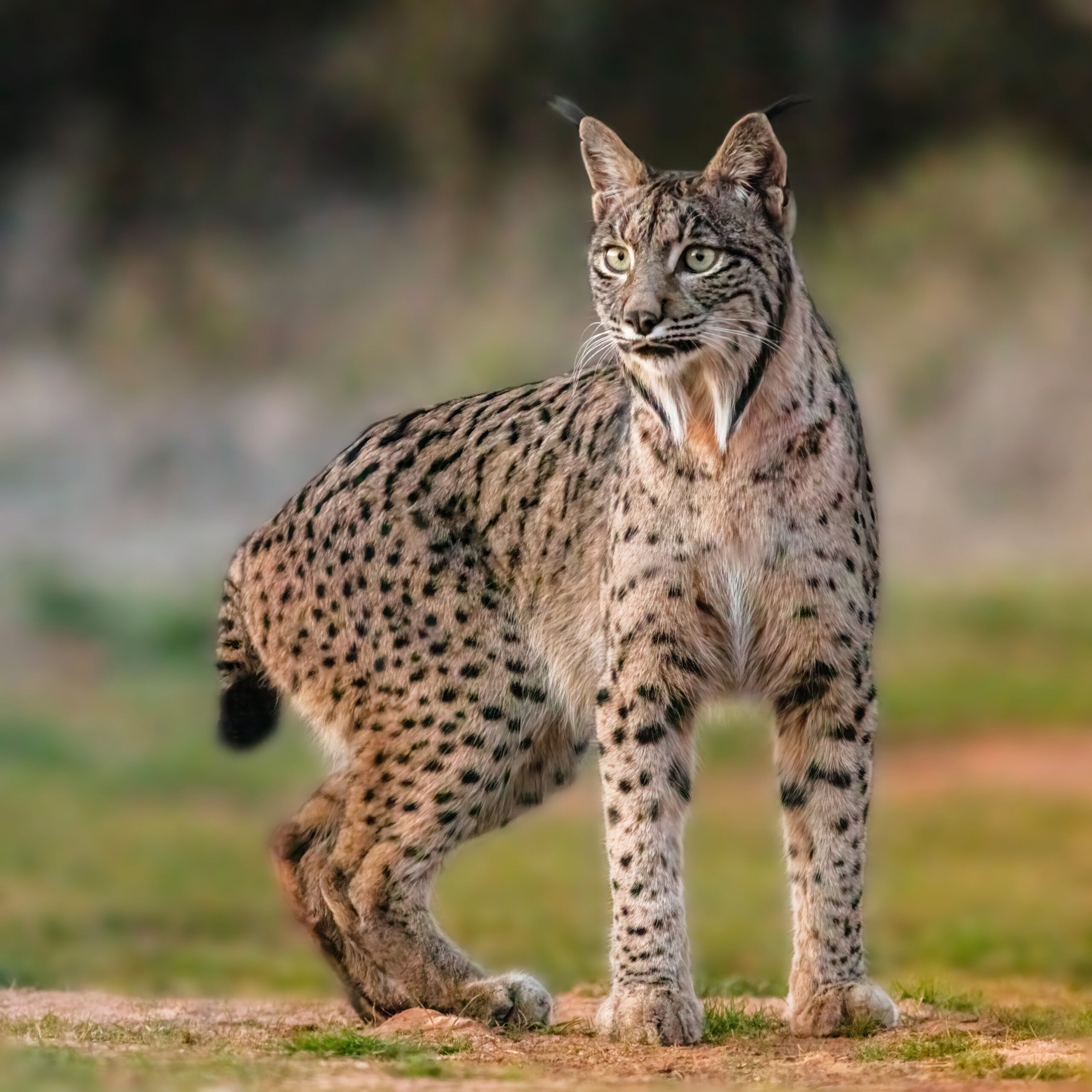
In 2002, field teams could account for 94 Iberian lynxes on the entire planet, and every one of them lived in Andalusia: 54 in the scrub and holm oak of Andújar, in the Sierra Morena of Jaén, and 40 in the sands and cork oaks around Doñana, in Huelva. Those two numbers, reported by El País in its account of the species’ rebound, described a cat that had already vanished from most of the peninsula. Twenty-three years later, the coordinated Spanish and Portuguese census for 2025 counted 2,663 Iberian lynxes across 26 geographical nuclei, including 542 territorial females, according to the census published by MITECO and ICNF.
Put plainly: the world population of Lynx pardinus has gone from two dots on a map of southern Spain to a scatter of breeding nuclei across two countries, and the number of females holding territory today is roughly six times the total number of lynxes alive in 2002.
Two pockets, 94 cats, 27 breeding females
The 2002 figure is small enough to be uncomfortable, but the structure behind it was worse than the total. WWF recorded 27 reproductive females among those 94 animals. A population’s future runs through its mothers, and 27 of them, split between two isolated patches of Andalusia, meant that the species’ entire reproductive capacity could be wiped out by a narrow set of events: an outbreak of feline leukemia, a collapse in wild rabbit numbers after viral disease, a bad fire season, a run of poor rainfall.
Isolation compounded it. Andújar’s cats and Doñana’s cats were not exchanging genes in any meaningful way. The Doñana group in particular carried the signature of a long squeeze, a small number of animals breeding among themselves in a coastal enclave hemmed in by farmland, roads, and development. Two pockets is not a population network. It is two lit candles in separate rooms, and the wind only has to find one of them at a time.
MITECO’s own documents tend to describe that era with the softer phrasing of “fewer than 100” animals. It is the same bottleneck, differently worded. The specific split, 54 and 40, is the version reported by El País and by conservation groups working the ground at the time, and it remains the clearest picture of what the species had left.
The arithmetic of 2,663
The 2025 census breaks down as 2,269 lynxes in Spain and 394 in Portugal, according to the note from Fundación Biodiversidad and MITECO published on 5 June 2026. Of the total, 1,711 were adults or subadults and 952 were cubs. That cub figure is the engine of the whole thing: more than a third of the animals counted in 2025 were born that year, which is what a population looks like when the food base and the territory hold.
The 542 territorial females matter more than the headline number. Territorial or breeding females are the countable unit of a lynx population’s productive capacity, and the leap from 27 to 542 is the single clearest measure of what changed between 2002 and 2025. Of the 26 geographical nuclei where lynxes were recorded, 18 produced young in 2025. That distribution is deliberate. It was built.
Since the first captive-bred releases in 2011, 424 lynxes have been reintroduced through 2025, per the Fundación Biodiversidad and MITECO note. Those releases seeded nuclei well beyond the original Andalusian pockets, into Castilla-La Mancha, Extremadura, and across the border into Portugal’s Guadiana valley. Castilla-La Mancha alone now holds 1,051 of the animals counted in 2025. A cat that existed in two Andalusian valleys at the turn of the century is now, in numerical terms, more a Castilian and Portuguese animal than a Doñana one.
What 2,663 does not settle
The number is a floor, not a ceiling, and not in a flattering way. Fundación Biodiversidad is explicit that as the population grows and spreads, registering every individual becomes harder; 2,663 is a minimum. That cuts both ways. It means the real figure is probably higher. It also means the census is getting coarser as the thing it measures gets bigger.
Then there is the mortality column. In 2025, 273 lynx deaths were recorded, and 212 of them, about 78 percent, were animals run over on road infrastructure. Roads are now the dominant identified cause of death for the Iberian lynx. A dispersing subadult looking for its own territory crosses highways, and the recovery’s own geography, nuclei spread across two countries, means more of those crossings every year. The same expansion that produced 2,663 also produces 212 roadkills.
The IUCN moved the species from Endangered to Vulnerable in 2024, as El País reported, following an earlier step down from Critically Endangered to Endangered in 2015. Vulnerable is progress. It is not secure. It is a formal statement that the species still faces a meaningful risk of extinction in the wild, arrived at while the population was rising.
So the honest shape of this story is a count, not a conclusion. In 2002 there were 94 Iberian lynxes and 27 females capable of raising a litter, in two pockets of Andalusia. In 2025 there were at least 2,663 in 26 nuclei, with 542 territorial females and 952 cubs, and 424 captive-bred animals released into the landscape since 2011 to make that spread possible. None of it runs by itself. The rabbits still have to be there, the corridors still have to connect, the roads still have to be crossed, and someone still has to count.